


The World Meteorological Organization says the strengthening climate phenomenon could disrupt agriculture and fisheries, while the October–December outlook points to below-normal rainfall across parts of South Asia.
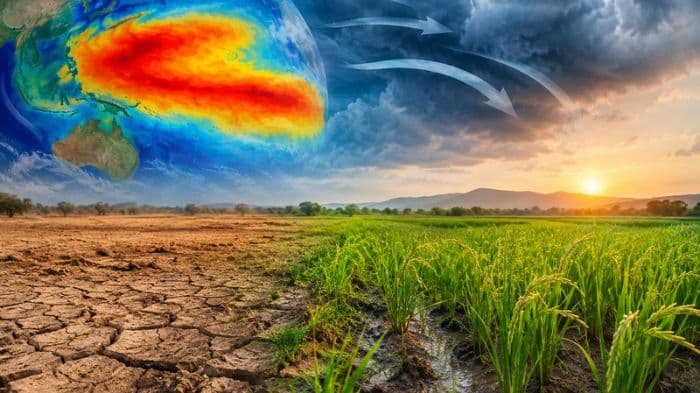
Representative Image generated by AI.
The World Meteorological Organization (WMO) has highlighted the potential risks of a strengthening El Niño for agriculture, fisheries and food production, warning that shifting rainfall patterns and rising temperatures could create challenges for climate-sensitive sectors.
In a statement issued on Oct 16 to mark World Food Day, the WMO said the evolving climate phenomenon was driving significant changes in rainfall patterns, ranging from drought to excessive rainfall. These changes can affect crop production, fishing communities and livelihoods dependent on natural resources.

The warning comes as the WMO and regional climate experts assess the possible effects of El Niño during the October–December 2026 season.
The phenomenon, associated with warmer-than-average sea-surface temperatures in the central and eastern tropical Pacific, influences atmospheric circulation and can alter rainfall and temperature patterns across different parts of the world.
South Asia faces an uneven rainfall outlook
According to the South Asian Climate Outlook Forum, normal to above-normal rainfall is likely over northwestern and parts of eastern and southern South Asia during October–December. Below-normal rainfall is likely across much of central and southern peninsular South Asia and parts of eastern South Asia. Above-normal maximum and minimum temperatures are also likely across most of the region.
The outlook is particularly relevant to southern India, where October–December rainfall supports agricultural operations. However, the regional forecast does not mean that every state or district will experience below-normal rainfall. Local conditions will depend on regional weather systems and the distribution and timing of rainfall.
The outlook was developed by experts from the national meteorological services of nine South Asian countries, alongside regional and international climate organisations, including the WMO Regional Climate Centre in Pune and the Indian Institute of Tropical Meteorology.
Why changing weather patterns matter for food production
The effects of El Niño extend beyond rainfall totals. Higher temperatures can increase water demand, place stress on livestock and reduce the number of safe working hours for agricultural labourers.
The WMO has also highlighted risks to fisheries from warmer ocean waters, including marine heatwaves and coral bleaching. Such conditions can affect marine ecosystems and the income of communities dependent on fishing.
In agriculture, the timing of heat and rainfall can be as important as seasonal averages. For example, unusually warm winter and spring conditions can accelerate wheat development and increase water demand, potentially reducing grain yields if heat occurs during sensitive growth stages, according to WMO expert Sebastian Grey.
These risks do not establish that crop losses will occur in India during the current season. Actual impacts will depend on local weather conditions, crop stages, water availability and farmers' ability to respond.
Forecasts can support agricultural planning
The WMO said its network of national meteorological services and regional climate centres provides seasonal outlooks and tailored climate information to help farmers, governments and humanitarian organisations prepare for changing conditions.
Such information can inform decisions on planting, irrigation, water management and preparedness for weather-related disruptions. The organisation also emphasised the role of national meteorological agencies in translating broad climate outlooks into country-level forecasts.
For India, the regional outlook provides context for agricultural planning, but state- and district-level forecasts are needed to assess local risks.
Monitoring updates from the India Meteorological Department and agricultural research institutions will be important for understanding how the evolving El Niño conditions may affect specific crops and growing regions.
The WMO's World Food Day warning underlines the importance of connecting climate forecasts with agricultural decision-making.
While seasonal outlooks cannot determine the exact effects on individual farms, timely information can help farmers and authorities prepare for potential disruptions to food production and rural livelihoods.
The revival of student-union elections at Indian universities: Explained
El Niño raises food-production risks as WMO flags uneven rainfall outlook for South Asia

EU research groups seek greater say in €175 billion Horizon Europe programme

NSF opens bioengineering funding call with awards of up to $50 million a year

A whale’s death inspired him at four, now 11-year-old is set for Earth Medal
A whale’s death inspired him at four, now 11-year-old is set for Earth Medal

Prof. Ajay Kumar Sood named International Science Council Fellow for 2026
2.6 million Afghan girls have lost five years of education, says UNICEF

Riyadh, Diriyah extend remote learning as security concerns persist
.jpg&w=256&q=75)
From Class 8 to hospital owner: Rajasthan Police expose alleged fake doctor registration

The revival of student-union elections at Indian universities: Explained
El Niño raises food-production risks as WMO flags uneven rainfall outlook for South Asia
EU research groups seek greater say in €175 billion Horizon Europe programme
NSF opens bioengineering funding call with awards of up to $50 million a year
A whale’s death inspired him at four, now 11-year-old is set for Earth Medal
A whale’s death inspired him at four, now 11-year-old is set for Earth Medal
Prof. Ajay Kumar Sood named International Science Council Fellow for 2026
2.6 million Afghan girls have lost five years of education, says UNICEF
Riyadh, Diriyah extend remote learning as security concerns persist
From Class 8 to hospital owner: Rajasthan Police expose alleged fake doctor registration
Copyright© educationpost.in 2026 All Rights Reserved.