Google takes free AI training for educators to five new regions
Brazil, Mexico, Spain, Australia and sub-Saharan Africa join Google's global AI training programme for educators.
By Amin MasoodiUpdated
Google is expanding its free artificial intelligence training programme for educators to five new regions, seeking to help teachers and university faculty integrate AI into classroom teaching, student assessment and academic administration.
Brazil, Mexico, Spain, Australia and sub-Saharan Africa will join the Google AI Educator Series in the coming months, extending access to practical training on the use of Google's Gemini tools in education. Developed in partnership with ISTE+ASCD, the Google AI Educator Series (GES) offers on-demand training for schoolteachers and higher education faculty. Participants can complete short learning sessions at their own pace and earn digital badges upon completion.
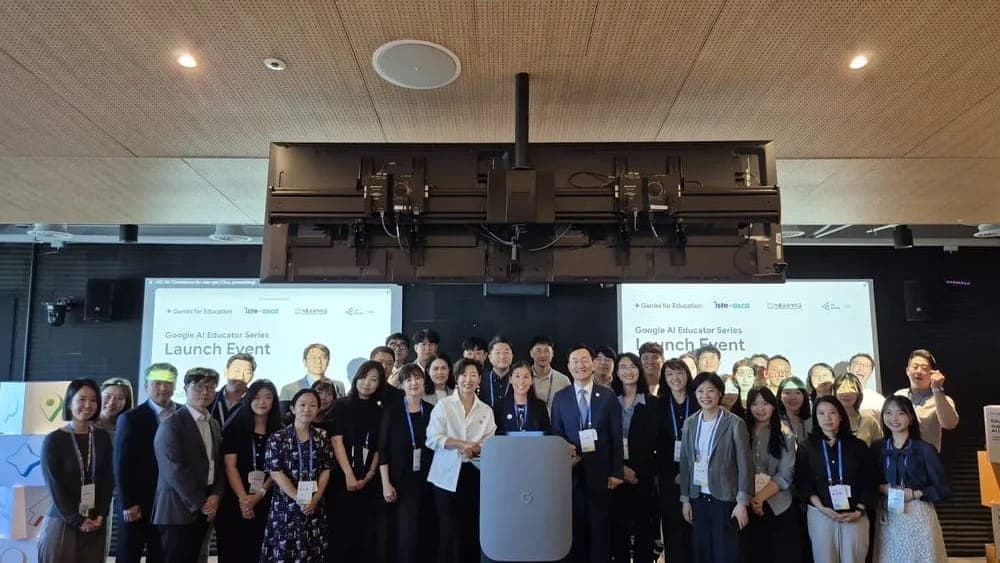
Launched in the United States earlier in 2026, the programme has since expanded to India, South Korea, Malaysia, the Philippines, the United Kingdom and Ireland. The latest expansion combines wider international access with new learning modules and partnerships with local education institutions.
New AI modules target classroom assessments and assignment design
Google's November update to its US programme introduces three new learning modules focused on practical applications of AI in teaching.
One module demonstrates how educators can use Gemini to develop practice tests and interactive web-based assessments. These include exit tickets that provide students with immediate feedback and hints when they answer questions incorrectly. Another explores game-based learning, using classroom activities to explain concepts such as data accuracy, model performance and the importance of human oversight in AI-generated outcomes.
The third module focuses on academic assignment design. It guides educators in using Gemini to identify questions that may encourage students to take shortcuts and redesign assignments to promote independent thinking, deeper engagement and critical analysis. The broader programme offers learning pathways covering AI fundamentals, teaching applications and administrative tasks. Its higher education modules address cognitive engagement, inclusive learning, student support, agentic workflows and the institutional implications of AI adoption.
Google says the content is updated monthly to reflect feedback from educators and changing classroom needs. Partnerships bring AI training to millions of educators
Country-level partnerships are emerging as a key part of Google's expansion strategy, helping take AI training beyond individual teachers and into national education systems. In the Philippines, Google is working with the Department of Education, the Commission on Higher Education and the country's technical skills authority to extend training to more than one million educators.
The Department of Education has also issued a memorandum endorsing the programme for teaching and non-teaching personnel nationwide. Among the classroom applications highlighted is the use of Gemini to simulate complex market scenarios for economics lessons. In the United Kingdom, Google says its training offer is available to 650,000 teachers. Virtual and in-person events are being organised across the UK and Ireland, with train-the-trainer workshops scheduled at Google's London office in November.
British educators have reported using Gemini Notebook to support creative writing exercises, prepare lesson plans and develop visual learning materials. India has also emerged as a major market for the initiative. Google reports that training sessions held in September reached 80,000 educators. Self-paced modules are available in English and six Indian languages — Hindi, Marathi, Telugu, Assamese, Odia and Punjabi — with additional languages planned for 2027.
Aligned with India's National Education Policy 2020, the training encourages teachers to use Gemini and Gemini Notebook to turn complex subjects into accessible learning formats, including comic strips, podcasts and infographics. Vishal Varia, an educator from Rajkot, said the training helped him explore new classroom applications.
"The best thing I learned was making use of Google Gemini Canvas and creating a quiz," he said. In Malaysia, the next phase will involve train-the-trainer boot camps with local partners, extending participation to private school educators, prospective teachers and university faculty.

Google says Malaysian teachers have reported saving three to five hours of preparation per topic by using AI tools to develop curricula, assessments and visual teaching aids. The figure is based on teacher feedback cited by the company. Siti Nuramirah Binti Rozi, an educator in Malaysia, said the sessions had strengthened her confidence in applying AI to everyday teaching.
"Most importantly, the sessions give me greater confidence in integrating effective strategies into my daily teaching," she said. In South Korea, Google has partnered with Seoul National University of Education to align the training with the country's 2022 Revised Curriculum and the Ministry of Education's Teacher AI/Digital Education Competency Framework.
Educators there are using AI to develop inquiry-based lessons and assessments, prepare communications for parents and analyse educational data.
Badges offer pathways to further education credits
The programme is designed to accommodate educators with different schedules and levels of familiarity with AI. Individual sessions last up to 45 minutes, and participants can complete modules in any order.
Higher education learning pathways are aligned with ISTE+ASCD Standards for Educators and Faculty and its AI-Ready Graduate profile. Beyond classroom applications, the training also explores how AI can streamline administrative responsibilities and reduce time spent on routine academic tasks.
Participants can earn digital badges, while additional pathways to college and continuing education credits are available through partner institutions, including ISTE, Dominican University, College Unbound and IDEA.
ETIH Innovation Awards 2027 open for global entries
The ETIH Innovation Awards 2027 have opened for entries, inviting companies, educational institutions, projects and individuals to showcase measurable contributions to education technology.
The global awards feature 26 categories spanning AI in education, digital learning, higher education, skills and workforce development, inclusion, education operations, evidence and impact. Entries are being accepted worldwide through ETIH's online awards platform.
The early-bird entry deadline is December 18, 2026, while the final deadline is February 26, 2027, at 11.59 pm UK time.