


NPCI has postponed a 0.4% fee on select UPI merchant payments above ₹2,000. Here is who pays, which transactions remain free and why retailers opposed it.
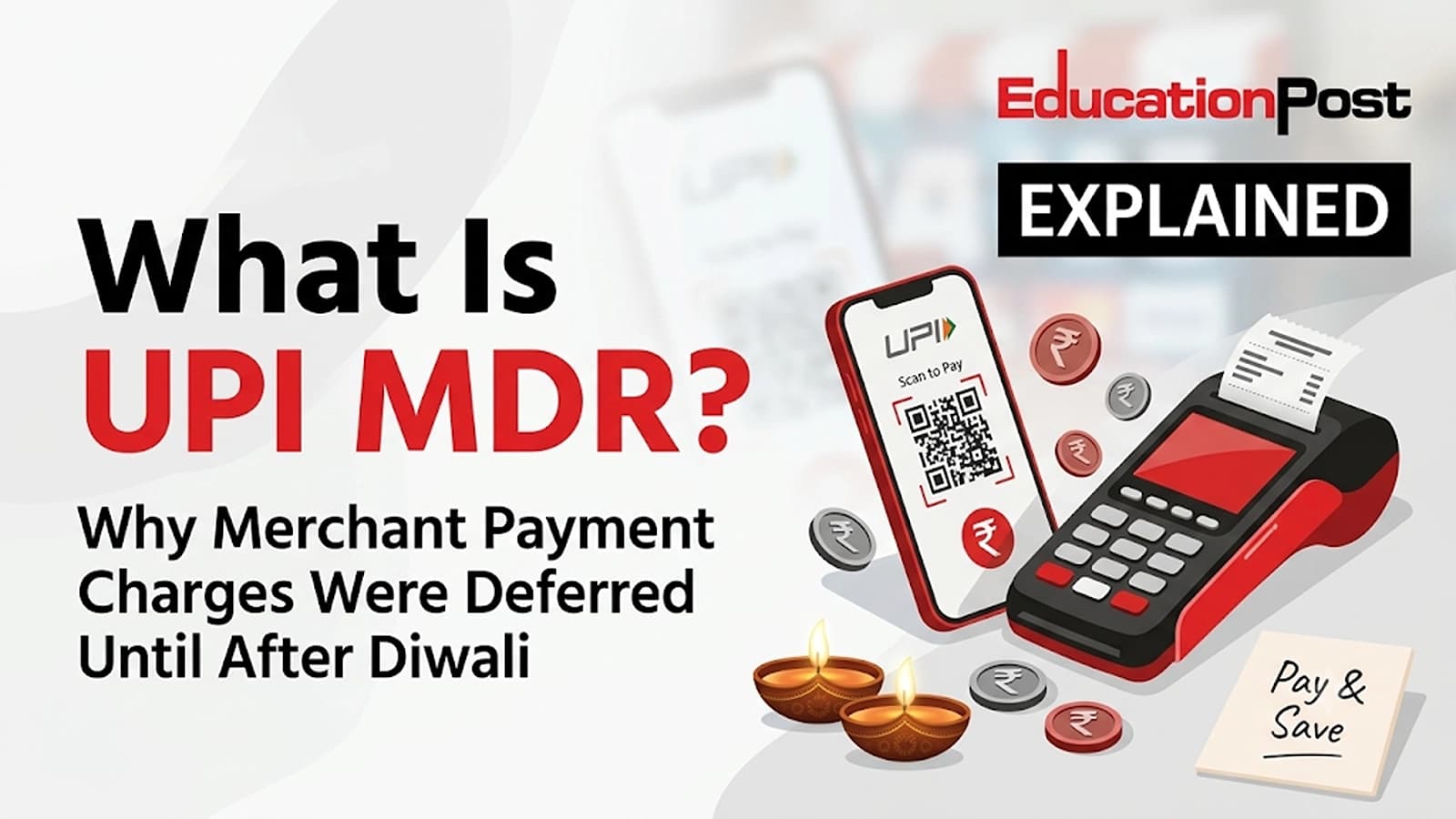
NPCI has deferred the implementation of MDR on select UPI merchant transactions above ₹2,000 until after Diwali 2026.
The National Payments Corporation of India (NPCI) has postponed the implementation of the Merchant Discount Rate (MDR) on select Unified Payments Interface (UPI) transactions until after Diwali 2026, providing temporary relief to merchants during the festive shopping season.
The decision was announced on October 13, two days before the new charging framework was scheduled to come into effect on October 15. NPCI's UPI and Services Steering Committee cited the festive season as the reason for deferring implementation. A revised date will be announced separately.

Under the framework introduced in September, a 0.4% MDR will apply to eligible person-to-merchant (P2M) UPI transactions exceeding ₹2,000, subject to a maximum charge of ₹300 per transaction. However, the charge is intended for merchants rather than customers, and ordinary person-to-person transfers will remain free.
The government's decision marks a change from the zero-MDR system followed for most bank-account-based UPI payments since January 2020. While the Finance Ministry argues that charging certain commercial transactions will help finance the growing digital payments infrastructure, merchant associations have raised concerns about additional operating costs and their possible impact on digital payment adoption.
MDR stands for Merchant Discount Rate. It is a transaction-processing charge paid by a merchant to the financial institutions and payment service providers involved in accepting a digital payment.
When a customer purchases goods or services through UPI, the payment moves through an interconnected system involving banks, payment applications and other payment infrastructure providers. These organisations incur expenditure on transaction processing, servers, cybersecurity, fraud prevention and customer support. MDR allows payment ecosystem participants to recover part of these expenses through a charge on eligible merchant transactions.
For example, once the new framework takes effect, a retailer receiving a qualifying UPI payment of ₹5,000 will incur an MDR of ₹20 at the prescribed rate of 0.4%. The charge will be distributed among the participating payment entities according to the applicable arrangements.
The Finance Ministry has clarified that MDR is neither a tax nor revenue collected by the government or NPCI. Instead, it operates as a payment-processing charge within the merchant payment ecosystem.
The new MDR framework was announced on September 15, 2026, following a Finance Ministry notification issued a day earlier. Its implementation was originally scheduled for October 15. However, the proposed timeline coincided with India's festive shopping period, when retailers typically experience increased sales and payment volumes.
Introducing a transaction-processing charge during this period could have increased costs for businesses already preparing for seasonal demand. Several trade associations also expressed concern about the proposed 0.4% rate, particularly its implications for retailers operating on narrow profit margins.
Representatives of the Confederation of All India Traders (CAIT), the All India Mobile Retailers Association (AIMRA) and other trade organisations raised the matter with Union Finance Minister Nirmala Sitharaman. Some trade bodies had also proposed observing October 2 as a "No UPI Day" to protest the charges. AIMRA and the All India Consumer Products Federation subsequently withdrew their protest call following discussions with the government.
Against this backdrop, NPCI's steering committee decided on October 13 to postpone implementation until immediately after Diwali. The announcement provides additional preparation time for merchants, banks and payment companies. However, the postponement does not amount to withdrawal of the MDR framework, and NPCI has not officially specified the new implementation date.
According to the Finance Ministry's September 15 notification and NPCI's explanatory guidelines, the standard MDR will be 0.4% on eligible UPI merchant transactions above ₹2,000. The calculation is based on the transaction amount, subject to the prescribed ceiling.
A qualifying payment of ₹3,000 will attract ₹12 in MDR, while a ₹10,000 transaction will carry a charge of ₹40. For a ₹50,000 payment, the MDR will be ₹200. For transactions worth ₹75,000 or more, the charge will be capped at ₹300, meaning a qualifying payment of ₹1 lakh will not attract the otherwise applicable ₹400 fee.
However, not every payment exceeding ₹2,000 will be charged at the standard rate. The framework provides concessional treatment to selected essential services and sectors where payment-processing costs could affect businesses operating with narrow margins. Transactions above ₹2,000 in designated categories, including railways, telecommunications, insurance, fuel, agricultural inputs and public utilities, will attract a flat MDR of ₹5 instead of the standard percentage-based charge.
Capital market transactions involving mutual funds, securities, stockbrokers and dealers will have a lower MDR of 0.02%, subject to a maximum of ₹300 per transaction. Automated recurring payments made through UPI Mandates or AutoPay, such as recurring investments and subscription payments, will remain outside the prescribed MDR charges. The new framework specifically concerns bank-account-funded merchant payments. Credit-linked UPI transactions, including payments made through RuPay credit cards linked to UPI, are governed by separate payment rules.
The government has maintained that ordinary UPI users will not be required to pay MDR. Person-to-person transfers, including payments to friends, family members and personal contacts, will continue to remain free irrespective of the amount transferred, subject to existing banking and transaction limits.
Similarly, payments of up to ₹2,000 to merchants will not attract MDR. The Finance Ministry has advised banks to ensure that merchants do not transfer the new processing costs to customers. NPCI's guidelines also restrict UPI application providers from imposing additional platform fees or hidden charges on ordinary UPI transactions.
However, the distinction between a direct transaction fee and a merchant's overall business costs is important. Although customers are not supposed to pay MDR separately, trade associations have warned that some businesses could respond to higher payment-processing expenses by revising prices or encouraging cash payments.
Such outcomes remain concerns raised by industry representatives rather than established effects of the policy. The government maintains that the relatively low MDR, combined with exemptions for smaller transactions, should minimise the impact on consumers.
The framework provides specific protection for micro-merchants, including street vendors and small businesses receiving payments through the designated Person-to-Person-Merchant (P2PM) category. Under this arrangement, eligible small merchants receiving up to ₹1 lakh per month through UPI QR codes into their accounts will continue to benefit from zero MDR.
Importantly, receiving an individual payment exceeding ₹2,000 does not automatically make an exempt P2PM merchant liable for the charge. Applicability also depends on the merchant's account classification. According to NPCI's guidelines, merchants in the P2PM category whose monthly UPI receipts exceed ₹1 lakh for three consecutive months will be moved into the regular P2M merchant category.
The guidelines also clarify that eligible small merchants do not need to replace their existing QR codes or register for GST solely to access the zero-MDR protection. The Finance Ministry estimates that approximately 96% of person-to-merchant UPI transactions by volume will remain unaffected because they fall below the prescribed threshold or qualify for exemptions. This figure refers to the number of merchant transactions, not the proportion of all UPI transaction value.
The new rules also have implications for educational institutions accepting digital payments for tuition fees, university term fees and entrance examinations. According to NPCI's official FAQ, educational fee collections are included in a designated industry programme category that benefits from concessional processing arrangements.
Educational transactions up to ₹2,000 will remain free of MDR. Payments above the threshold will qualify for flat-fee arrangements or capped processing rates rather than automatically attracting the standard 0.4% commercial charge. This distinction matters because school and university fee payments can involve relatively large amounts.
For example, applying the standard 0.4% rate to a college fee payment of ₹50,000 would produce a processing charge of ₹200. However, the designated concessions for educational institutions are intended to prevent such percentage-based charges from routinely applying to eligible educational fee collections. The final amount will depend on the applicable merchant category and processing arrangement. Institutions should therefore verify their classification and the relevant rate with their acquiring bank or payment provider.
The government has also stated that MDR should not be imposed on students as an additional payment charge. For educational institutions, the framework makes it important to distinguish between a payment-processing cost borne by the institution and any separate convenience fee displayed by an online payment platform. The proposed MDR rules do not, by themselves, authorise institutions or payment providers to add the MDR amount to students' bills.
The principal argument behind introducing MDR is the long-term cost of maintaining India's rapidly expanding UPI infrastructure. UPI has become central to everyday payments, serving businesses ranging from street vendors to large commercial establishments.
According to NPCI's transaction statistics, UPI processed approximately 24.07 billion transactions worth ₹29.37 lakh crore in September 2026 alone. Maintaining this network requires continuous investment in banking infrastructure, transaction-processing systems, fraud prevention, cybersecurity and technical support. In its September 15 FAQ, NPCI cited industry estimates suggesting that maintaining the UPI payments ecosystem costs approximately ₹20,000 crore annually.
For several years, government incentives and subsidies have helped support the zero-MDR system. The government now argues that depending exclusively on annual budgetary support creates uncertainty for banks and payment companies. It maintains that a limited commercial charging framework can provide a more predictable source of revenue for infrastructure development while keeping ordinary transactions free.
The proposed policy also provides for a dedicated fund supported by an amount equivalent to 5% of MDR collections. The fund is intended to encourage UPI adoption among smaller merchants, particularly in rural areas and Tier 3 to Tier 6 centres, by supporting merchant onboarding and digital payment infrastructure. NPCI's September guidelines stated that the detailed operational arrangements for the fund would be finalised in consultation with the Reserve Bank of India.
Despite the government's assurances, the framework has attracted criticism over its possible impact on retailers, particularly businesses that receive frequent payments above ₹2,000. Merchant associations argue that even a relatively small processing charge can affect businesses operating with limited margins. The concerns are particularly relevant to sectors such as electronics, jewellery and consumer goods, where individual purchases frequently exceed the ₹2,000 threshold.
Trade groups have argued that merchants could face a choice between absorbing the cost, adjusting prices or encouraging customers to use alternative payment methods. Critics also question whether reintroducing charges could weaken the incentives that helped UPI gain widespread acceptance.
The proposed framework has faced a legal challenge as well. A public interest litigation filed by advocate Anjan Datta in the Supreme Court questioned the legal basis of the September notifications and the proposed MDR charges.
On September 28, the Supreme Court declined to grant an interim stay on the framework but sought responses from the Union government, the Reserve Bank of India and NPCI. The court's refusal to issue an interim stay did not constitute a final ruling on the legality of the policy. The subsequent postponement announced by NPCI was a separate decision concerning implementation during the festive season.
As of October 14, 2026, the government and NPCI have not announced a confirmed revised implementation date. The October 13 announcement states that MDR on select P2M transactions will be introduced immediately after Diwali, on a date to be notified separately. Until that date is formally announced and the framework takes effect, the proposed charges will not apply under the new system.
For customers, ordinary bank-account-based UPI payments will continue as before. For merchants, the pending implementation will require attention to transaction thresholds, account classifications and any applicable sector-specific concessions. The key issue now is whether further consultations with payment companies and trade associations will result in changes to the proposed rates and exemptions before the revised rollout.

What Is UPI MDR? Why Merchant Payment Charges Were Deferred Until After Diwali: Explained

The British School New Delhi and UCL Hold Leadership Development Conference for School Leaders
.jpg&w=256&q=75)
FT Executive MBA Rankings 2026: ISB climbs to 38th, IIM Bangalore rises to 64th
Bihar PMS Scholarship Status 2026–27: How to Check Your Latest Status on Mobile

Delhi CM Rekha Gupta Opens New Dwarka School, ITI Training Centres; Announces New Education Projects
FT Executive MBA Rankings 2026: ISB climbs to 38th, IIM Bangalore rises to 64th

IIIT Ranchi student death: Education Ministry panel to probe emergency care, hostel facilities and support systems

Germany proposes higher student aid but plans to cut housing allowance for students living with parents

NMC clarifies digital authentication of medical records: Key rules on liability, security and foreign experts

‘Dear Italy, how much do you cost us?’ Students pitch tents over soaring rents

What Is UPI MDR? Why Merchant Payment Charges Were Deferred Until After Diwali: Explained
The British School New Delhi and UCL Hold Leadership Development Conference for School Leaders
FT Executive MBA Rankings 2026: ISB climbs to 38th, IIM Bangalore rises to 64th
Bihar PMS Scholarship Status 2026–27: How to Check Your Latest Status on Mobile
Delhi CM Rekha Gupta Opens New Dwarka School, ITI Training Centres; Announces New Education Projects
FT Executive MBA Rankings 2026: ISB climbs to 38th, IIM Bangalore rises to 64th
IIIT Ranchi student death: Education Ministry panel to probe emergency care, hostel facilities and support systems
Germany proposes higher student aid but plans to cut housing allowance for students living with parents
NMC clarifies digital authentication of medical records: Key rules on liability, security and foreign experts
‘Dear Italy, how much do you cost us?’ Students pitch tents over soaring rents
Copyright© educationpost.in 2026 All Rights Reserved.