


Women's share of IIT seat allotments reached just 20.22% in 2026. Exam participation, qualification gaps and the design of female-only seats help explain why.
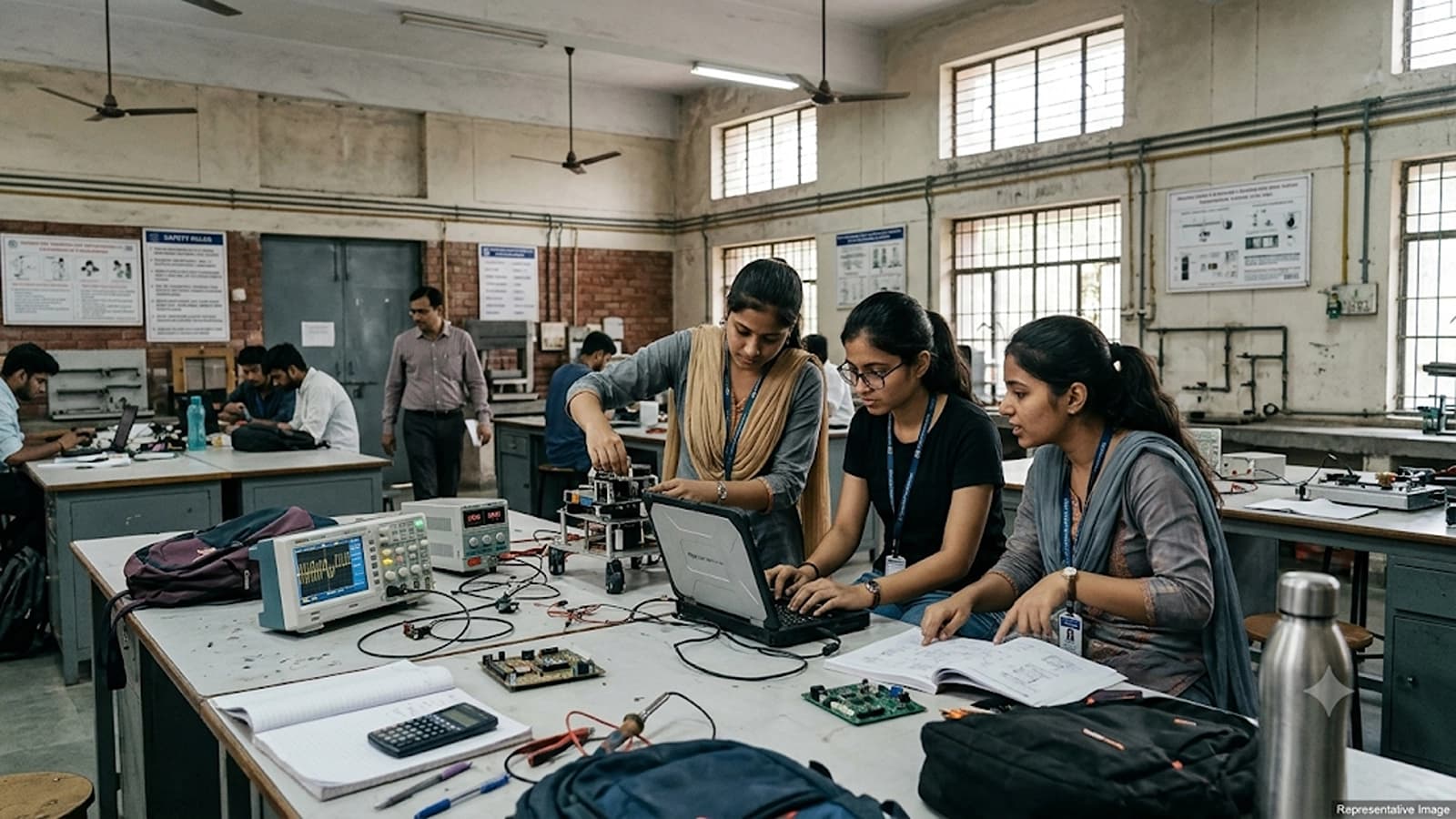
Women accounted for 20.22% of IIT seat allotments in 2026, up from 19.90% in 2022, according to JEE Advanced data. (Representational Image)
Nearly nine years after India introduced additional seats to bring more women into the Indian Institutes of Technology (IITs), the country's premier engineering institutions have reached their original target. But they have barely moved beyond it.
The latest JEE Advanced 2026 Joint Implementation Committee (JIC) report shows that 3,814 women were allotted seats across 23 IITs, accounting for 20.22% of the 18,861 total allotments. In 2022, women received 3,310 of the 16,635 seats allotted, representing 19.90%.The number of women receiving IIT seats has increased by more than 500 over four years, but their share has risen by just 0.32 percentage points.

At first glance, this appears difficult to reconcile with the expansion of female-only seats. A recent India Today analysis reported that such seats increased from 1,567 in 2022 to 3,776 in 2026, a rise of almost 141%. There is, however, an important distinction in those figures. The 2022 report specifically identifies 1,567 supernumerary seats, meaning additional seats created beyond the original intake.
The 2026 figure refers to the broader female-only seat pool, which includes supernumerary seats as well as other seats assigned to that pool. Comparing the two directly risks overstating the expansion. The more revealing question is why women's representation has remained close to one-fifth despite years of intervention. The answer lies partly in the design of the policy itself, but also in the much longer journey students make before they can compete for an IIT seat.
What Are Female-Only Supernumerary Seats, and How Do They Work?
The policy originated in 2017, when the IIT Council approved a proposal to increase women's enrolment through additional seats. At the time, women accounted for only about 8% of undergraduate intake at IITs, according to the Ministry of Education. A committee headed by then-IIT Mandi Director Timothy A. Gonsalves recommended increasing the proportion in stages: 14% in 2018–19, 17% in 2019–20 and 20% by 2020–21.
The scheme was introduced in 2018, with the central objective of improving gender representation without reducing the number of seats available to male candidates. Under the JoSAA 2026 Business Rules, seats are organised into two pools: gender-neutral and female-only. Male candidates compete for gender-neutral seats, while eligible female candidates can be considered for both pools. The allocation algorithm first considers a woman for a female-only seat in her preferred programme. If she does not obtain one, she can compete for a gender-neutral seat according to the applicable rank and category rules.
The arrangement is different from simply reserving 20% of existing seats for women. Supernumerary seats increase capacity beyond the original intake, while the female-only pool includes both ordinary and additional seats. JoSAA's rules explicitly distinguish the mechanism from conventional reservation. The system also preserves existing constitutional reservation categories. The female-only and gender-neutral pools are divided according to the applicable categories, including SC, ST, OBC-NCL, GEN-EWS and persons with disabilities.
Importantly, the 20% requirement for IITs applies to their undergraduate intake at the institute level, rather than guaranteeing exactly 20% female enrolment in every individual course. In other words, the policy was designed to ensure a minimum level of representation, not automatically produce gender parity. This helps explain the apparent stagnation. A mechanism built around reaching 20% can successfully maintain that level without necessarily pushing the overall share towards 30%, 40% or 50%.
What Does the JEE Advanced 2026 Data Actually Show?
The figures demonstrate both progress and a continuing imbalance.
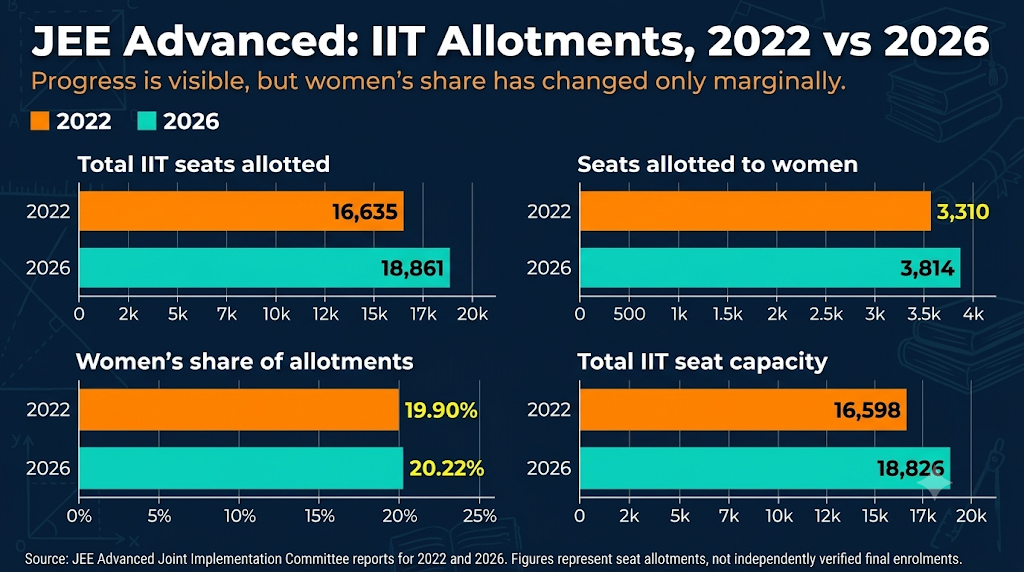
Women's absolute allotments increased by about 15.2%, broadly alongside the expansion of IIT intake. The 2026 report also records that 3,777 women received allotments through the female-only pool, while just 37 obtained seats through the gender-neutral pool. This distribution reflects how the allocation algorithm prioritises the designated female-only pool. It should not be interpreted as proof that only 37 women would qualify for admission without the scheme.
There has been a considerable improvement since the policy began. Government records show that women's representation increased from approximately 8% before the intervention to nearly 20% by 2020. A 2025 study published in the Southern Economic Journal, examining IIT admission data between 2014–15 and 2021–22, estimated that the policy was associated with an 8.7-percentage-point increase in the proportion of women admitted. The researchers also observed an increase in female participation in entrance examinations.
The scheme, therefore, cannot reasonably be described as ineffective. It expanded access and helped establish a more balanced student intake. But sustaining a minimum level of representation is different from achieving further growth.
Where Does the Gender Gap Begin? The JEE Examination Pipeline
To understand why fewer women reach IITs, it is necessary to examine what happens before seat allocation. Admission to IIT undergraduate engineering programmes generally requires students to clear JEE Main, become eligible for JEE Advanced, qualify in the advanced examination and participate in JoSAA counselling.
The National Testing Agency's April 2026 JEE Main data records 3,26,167 female candidates among 10,34,330 candidates who appeared for Paper 1, the BE/BTech examination. Women therefore represented approximately 31.5% of candidates in that session. By JEE Advanced, the proportion was lower.
According to the official JEE Advanced 2026 results, 40,562 women appeared in both examination papers out of 1,79,694 candidates, representing approximately 22.6%. Of the 56,880 candidates who qualified, only 10,107 were women, or about 17.8%. This indicates that women's representation is lower at successive stages of the engineering entrance examination process.
However, the JEE Main April-session figure and the JEE Advanced figures represent different examination populations. They cannot be used to calculate a direct dropout rate for the same group of students. The qualification rates offer another perspective. Among women who appeared in both JEE Advanced papers in 2026, approximately 24.9% qualified. The corresponding figure for male candidates was approximately 33.6%.The difference is substantial, but the aggregate results cannot independently establish its causes.
The figures reflect candidates across different reservation categories, educational backgrounds and preparation circumstances. What is clear is that the female-only seat mechanism operates after students have already entered and qualified through this highly competitive examination system. It cannot directly correct inequalities that arise before candidates reach that stage.
Coaching, Family Support and Access to Engineering Education
Why do fewer girls reach the final stages of the JEE pipeline? The reasons cannot be reduced to examination performance alone. In a Lok Sabha reply in July 2017, the Ministry of Human Resource Development, now the Ministry of Education, identified societal biases and inadequate educational facilities in rural areas and smaller cities among the reasons for women's low representation in IITs.
The concern remains relevant because preparing for JEE often requires sustained academic support during Classes 11 and 12, access to study materials and the time needed to prepare for a highly competitive examination. Private coaching can provide some of these resources, but families differ considerably in their ability to finance coaching, travel and accommodation.
Girls may also encounter restrictions related to mobility, household responsibilities or family expectations about education and careers. The extent of these constraints varies across households and regions. A 2025 study titled Choosing Engineering Education: Understanding the Motives of Indian Young Women, published in the European Journal of Engineering Education, examined how family support, exposure to engineering, personal interests and access to preparation influenced women's educational choices.
The study highlights an important aspect of engineering admissions: decisions are shaped well before the entrance examination. A student who receives encouragement to study mathematics and physics, information about engineering careers and financial support for preparation may have a different set of opportunities from one whose family cannot provide those resources.
The broader digital divide also provides context. The Annual Status of Education Report (ASER) 2024 found that among surveyed rural children aged 14–16, 70.2% of boys and 62.2% of girls could bring a smartphone to complete digital tasks during the assessment.
This is not a direct measurement of access to JEE coaching, but it illustrates differences in access to digital resources that may also affect learning opportunities. These findings suggest that expanding IIT seats addresses only one stage of a much larger educational process. Without comparable opportunities to study mathematics and science, access preparation resources and make independent educational choices, the number of women competing for IIT admission may remain constrained.
Are Women Equally Represented Across IITs and Engineering Branches?
The national figure of 20.22% can conceal differences between institutions and academic programmes. According to a published compilation of the 2026 JIC data, IIT Tirupati recorded a female allotment share of 21.26%, followed by IIT Madras at 21.12%. Other campuses, including IIT Dharwad, IIT Bhubaneswar and IIT Hyderabad, were also reported to have female shares slightly above 20%.
These figures suggest that several IITs remain relatively close to the minimum requirement rather than approaching equal representation. There is another question within the institutions themselves: which engineering disciplines are women entering? Students do not simply choose an IIT. They submit an ordered list of institute-programme combinations through JoSAA, and allotments depend on examination ranks, available seats and their preferences.
A student may prefer computer science at one IIT over mechanical engineering at another. Another may prioritise the institution's location, a particular branch or the financial and personal circumstances associated with studying away from home. These choices influence the composition of different programmes. Research on engineering education in India has also documented differences in women's participation across disciplines. A report by the Initiative for What Works to Advance Women and Girls in the Economy (IWWAGE), drawing on earlier AISHE figures, found particularly low female representation in mechanical engineering compared with several other engineering and technology disciplines.
However, national engineering enrolment figures cannot be treated as equivalent to current IIT branch-wise admissions. The 2026 JoSAA seat matrix provides programme-level seat allocations, but a full assessment of gender differences would require comparing those allocations with actual admissions and students' programme preferences across individual IITs. This matters because an institute may satisfy the overall 20% requirement while women remain unevenly represented in particular engineering courses.
Why the 20% Target May No Longer Be Enough
The policy's initial purpose was clear: increase women's presence in engineering institutions where they had historically accounted for a small minority of students. By that measure, it achieved considerable progress. But the JEE Advanced data now raises a different policy question. Should the 20% benchmark remain the principal measure of success nearly a decade after the scheme was approved?
An automatic increase in female-only seats is one possible response, but the evidence does not establish that this alone would address the underlying imbalance. A more complete approach would examine how many girls study mathematics and physics at the senior-secondary level, how many register for JEE Main, how many become eligible for JEE Advanced and how their qualification rates vary by region and socioeconomic background.
It would also examine the experience of women after admission, including academic support, access to laboratories and research opportunities, campus safety and placement outcomes. The government has introduced several measures beyond additional seats. These include scholarships, outreach programmes for female school students and counselling initiatives to encourage participation in science and engineering.
The AICTE Pragati scholarship scheme also provides financial assistance to eligible women pursuing technical education. Yet the available admission figures do not establish how effectively these initiatives are reaching potential IIT aspirants who face the greatest barriers. The next stage of policy evaluation should therefore measure more than the number of additional seats created. It should examine whether more women are entering the JEE pipeline, whether qualification gaps are narrowing and whether participation is improving across engineering disciplines.
The central finding is that IITs have largely achieved the gender representation target they set out to reach. What remains uncertain is whether the broader education system is creating the conditions for women's participation to grow beyond it. After years of expanding seats, the question is no longer simply how many places are available for women at IITs. It is how many girls are being given a fair opportunity to compete for them in the first place.

Schools urged to make relationship education central to fight domestic violence in Australia

The Future Belongs to Those Who Can Collaborate Intelligently with AI

Diljit Dosanjh Delhi Concert Today: Traffic Restrictions from 1 PM, Check Roads to Avoid, Metro Timings and Parking Details
Why Are Women Still Only 20% of IIT Admissions? JEE Advanced 2026 Data Explained

Australia weighs screen time curbs and AI restrictions in schools
The Future Belongs to Those Who Can Collaborate Intelligently with AI
Diljit Dosanjh Delhi Concert Today: Traffic Restrictions from 1 PM, Check Roads to Avoid, Metro Timings and Parking Details
Why Are Women Still Only 20% of IIT Admissions? JEE Advanced 2026 Data Explained

Google adds hundreds of free textbooks to Gemini Notebook for students in India and US

NBEMS opens NEET Super Specialty 2026 applications: Check eligibility, dates and registration steps

Schools urged to make relationship education central to fight domestic violence in Australia
The Future Belongs to Those Who Can Collaborate Intelligently with AI
Diljit Dosanjh Delhi Concert Today: Traffic Restrictions from 1 PM, Check Roads to Avoid, Metro Timings and Parking Details
Why Are Women Still Only 20% of IIT Admissions? JEE Advanced 2026 Data Explained
Australia weighs screen time curbs and AI restrictions in schools
The Future Belongs to Those Who Can Collaborate Intelligently with AI
Diljit Dosanjh Delhi Concert Today: Traffic Restrictions from 1 PM, Check Roads to Avoid, Metro Timings and Parking Details
Why Are Women Still Only 20% of IIT Admissions? JEE Advanced 2026 Data Explained
Google adds hundreds of free textbooks to Gemini Notebook for students in India and US
NBEMS opens NEET Super Specialty 2026 applications: Check eligibility, dates and registration steps
Copyright© educationpost.in 2026 All Rights Reserved.