


Despite over 11 lakh NEET qualifiers, nearly 2,000 MBBS seats reportedly remain vacant, raising questions about private medical college fees, admission rules and affordability.
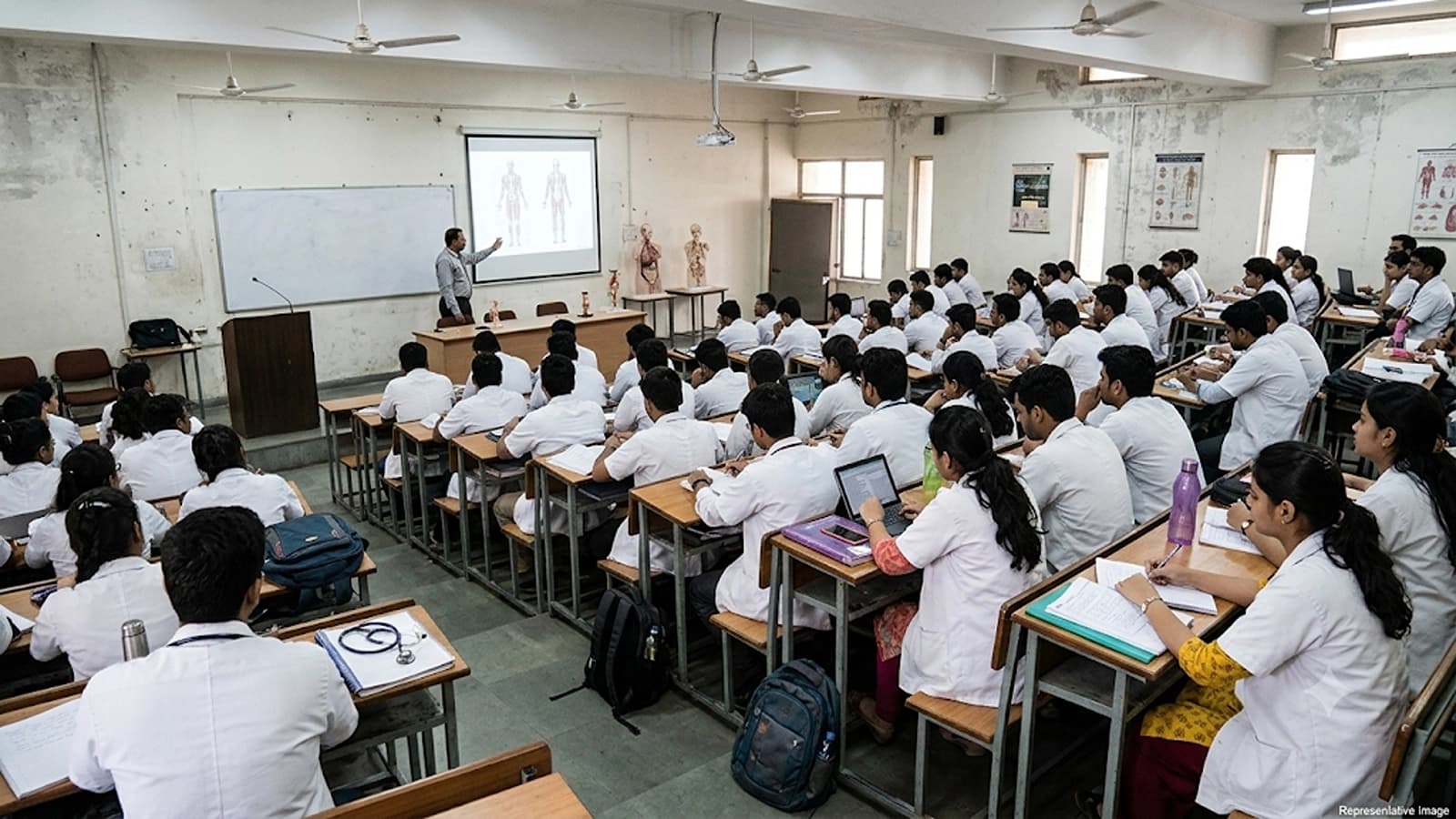
Private medical college fees and counselling restrictions are among the factors being examined as India attempts to fill remaining MBBS seats through another NEET-UG counselling round. (Representational Image)
More than 11 lakh students qualified for NEET-UG in 2026, yet nearly 2,000 MBBS seats reportedly remained vacant across India after multiple rounds of medical counselling. Some colleges have reduced their fees to attract candidates, while others are seeking permission to admit students through additional counselling rounds.
The situation raises an obvious question. How can a country with intense competition for medical education struggle to fill thousands of seats? The answer is not necessarily a shortage of students willing to become doctors. It lies partly in the difference between qualifying for medical admission and being able to afford the seats that remain available.

According to the National Testing Agency (NTA), nearly 20 lakh candidates appeared for NEET-UG 2026, and approximately 11.21 lakh qualified. These candidates were eligible to compete for seats in MBBS, BDS, AYUSH and other applicable undergraduate programmes, subject to their ranks and admission requirements.
Meanwhile, the National Medical Commission (NMC) has continued expanding the country's medical education capacity. As reported in September, a revised 2026–27 seat matrix had approved 13,186 additional MBBS seats, taking the total sanctioned intake to 1,40,214 across 836 medical colleges, excluding Institutes of National Importance.
Despite that expansion, hundreds of seats have remained unfilled in institutions where annual tuition fees can reach ₹23 lakh to ₹35 lakh. The latest figures emerged from reporting by The Times of India on October 29–30, 2026. The newspaper examined vacancy information released by the Medical Counselling Committee (MCC), figures from state counselling authorities and responses from medical education officials.
Its reporting estimated that nearly 2,000 MBBS seats remained vacant nationally. The figure is a consolidated media estimate rather than a final, independently reconciled count released by MCC. Following requests from states and medical colleges, the Directorate General of Health Services (DGHS) announced a special stray vacancy round, beginning November 2, to fill eligible remaining seats. But another counselling round may not resolve the issue if the seats being offered remain financially inaccessible to students.
Where Are the Vacant MBBS Seats?
The vacancies are concentrated largely in private medical institutions and deemed universities, although some seats in government colleges and under government quotas have also remained unfilled. According to the Times of India report, 824 MBBS seats across 14 deemed universities in Tamil Nadu and Puducherry went unallotted in the final round of central counselling. These institutions charge annual tuition fees ranging from ₹23 lakh to ₹35 lakh, according to the report.
At those rates, tuition alone could exceed ₹1 crore over the four-and-a-half-year academic portion of the MBBS programme, depending on the institution's fee schedule. Hostel accommodation, food and other expenses add to the financial commitment. The situation is particularly noticeable because deemed universities operate within the centralised MCC counselling system, allowing eligible candidates from across India to apply for their seats.
However, national eligibility does not guarantee that a student can afford the institution allotted to them. Karnataka provides another example. After seven rounds of counselling, 191 MBBS seats remained vacant in the state on October 26. According to a report by The Times of India, the Karnataka Examinations Authority (KEA) conducted two additional allotment rounds that day, filling 84 of the 273 medical seats that had remained vacant following the preceding stray vacancy round. KEA Executive Director H Prasanna said further counselling could be conducted if the relevant authorities permitted it.
The state's Directorate of Medical Education also approached the NMC seeking a reduction in the NEET qualifying percentile to widen the pool of eligible candidates. Private medical colleges in Karnataka reportedly responded by offering lower fees, with some quoting approximately ₹80 lakh for the four-and-a-half-year course, including hostel charges. The newspaper also reported that certain institutions had begun negotiating fees with prospective students to prevent seats from remaining empty.
In Tamil Nadu, State Selection Committee Secretary Dr V Lokanayaki told the newspaper that 16 seats in private institutions remained vacant because candidates who received allotments did not join. Her explanation points to another issue: even when a seat is allotted, it does not automatically become a completed admission.
The figures from central and state counselling authorities describe different seat pools and stages of admission. They should not be added indiscriminately because doing so may duplicate vacancies or mix allotment-stage data with subsequent non-joining figures. The national estimate of nearly 2,000 seats will need to be assessed again after the special counselling rounds and final college reporting are completed.
Why Are Students Not Taking the Available Seats?
The most frequently cited explanation is affordability, but several factors can affect whether a medical seat is ultimately occupied. First, the cost of private medical education varies considerably. Government medical colleges generally charge much lower tuition fees for regular government-quota seats, while management and NRI quota seats in private institutions can cost substantially more.
In Karnataka, for example, reporting has identified NRI quota seats in some government institutions costing approximately ₹25 lakh annually. Management and NRI seats at private colleges can cost even more. This makes the type of seat available as important as the number of seats available. A qualified candidate may find that a college still has an MBBS vacancy but cannot realistically finance the course.
Medical education counsellor Manickavel Arumugam, speaking to the Times of India, said that some candidates with relatively strong NEET ranks were declining private college seats because of the fees. That observation is consistent with the vacancy patterns in high-fee institutions, although the extent to which affordability explains all remaining vacancies has not been established through a comprehensive national study.
Second, allotments and admissions are different stages. During NEET counselling, candidates submit college preferences and receive allotments based on their examination ranks, reservation categories, available seats and the applicable counselling rules. An allotted candidate may subsequently decide not to join because of fees, location, institutional preferences or other circumstances.
Seats may also remain empty when candidates are ineligible for the particular category in which a vacancy exists. This is why a vacant seat does not necessarily mean every NEET-qualified student can apply for it.
Third, counselling takes place through multiple systems. MCC conducts counselling for the 15% All India Quota in participating government medical colleges, along with seats in deemed universities, central institutions, AIIMS and other institutions under its jurisdiction. State authorities handle the remaining state-quota seats and other seats assigned to their counselling systems.
Candidates may participate in both central and state processes, subject to the relevant rules. But later rounds impose restrictions intended to prevent students from holding seats in multiple institutions. These rules are necessary for the orderly allocation of seats. However, they also mean that an unoccupied seat cannot always be immediately reassigned to another interested candidate. The 2026 MCC information bulletin provides for fresh registration and choice filling during the stray vacancy round. It also excludes candidates holding or having joined a seat, as well as certain candidates who were allotted seats in previous rounds but failed to report.
The counselling system therefore has to balance two competing concerns: preventing repeated seat blocking and ensuring that vacancies are filled before the academic admission deadline. The result can be a situation in which willing candidates exist, but they are unable to claim particular seats because of eligibility, quota, financial or procedural restrictions.
Does Lowering the NEET Cutoff Solve the Problem?
Some medical institutions and state authorities have suggested lowering the NEET qualifying cutoff so that more candidates become eligible for admission. In Karnataka, the Directorate of Medical Education approached the NMC seeking a relaxation of the qualifying percentile. The argument is that expanding the pool of eligible students may help colleges fill seats that have remained vacant despite several counselling rounds.
However, there is a distinction between making more candidates eligible and making medical education affordable. According to the NTA's official July 16 results, approximately 11.21 lakh candidates had already qualified for NEET-UG 2026. That figure covers several undergraduate medical and allied courses, not exclusively MBBS. Nevertheless, it demonstrates that the examination has produced a large pool of qualified candidates compared with the number of MBBS seats available.
If a college charges ₹30 lakh annually, lowering the qualifying threshold does not automatically make the seat affordable to another student. Indeed, additional eligible candidates may face exactly the same financial restrictions as those who qualified earlier. The disagreement has also reached Parliament. DMK Rajya Sabha MP P Wilson, speaking to the Times of India, argued in favour of capping private medical college fees rather than reducing the entrance examination cutoff.
Medical education institutions, meanwhile, have argued that greater flexibility could help them avoid losing seats and revenue. Both positions raise legitimate policy questions. A lower cutoff could increase the number of candidates permitted to compete, but it would not independently address tuition costs. Fee regulation could improve affordability, but its effects would depend on how fees are fixed, enforced and reviewed alongside the cost of running medical institutions. Neither intervention should be presented as a proven solution without evidence on the reasons individual seats remain vacant.
Is This the First Time India Has Faced Vacant MBBS Seats?
No. Government records show that unfilled medical seats have been a recurring problem. In August 2025, Education Post reported on parliamentary data showing that 2,849 undergraduate medical seats remained vacant in 2024–25. The same data showed 4,146 vacancies in 2022–23, the highest figure among the four academic years covered.
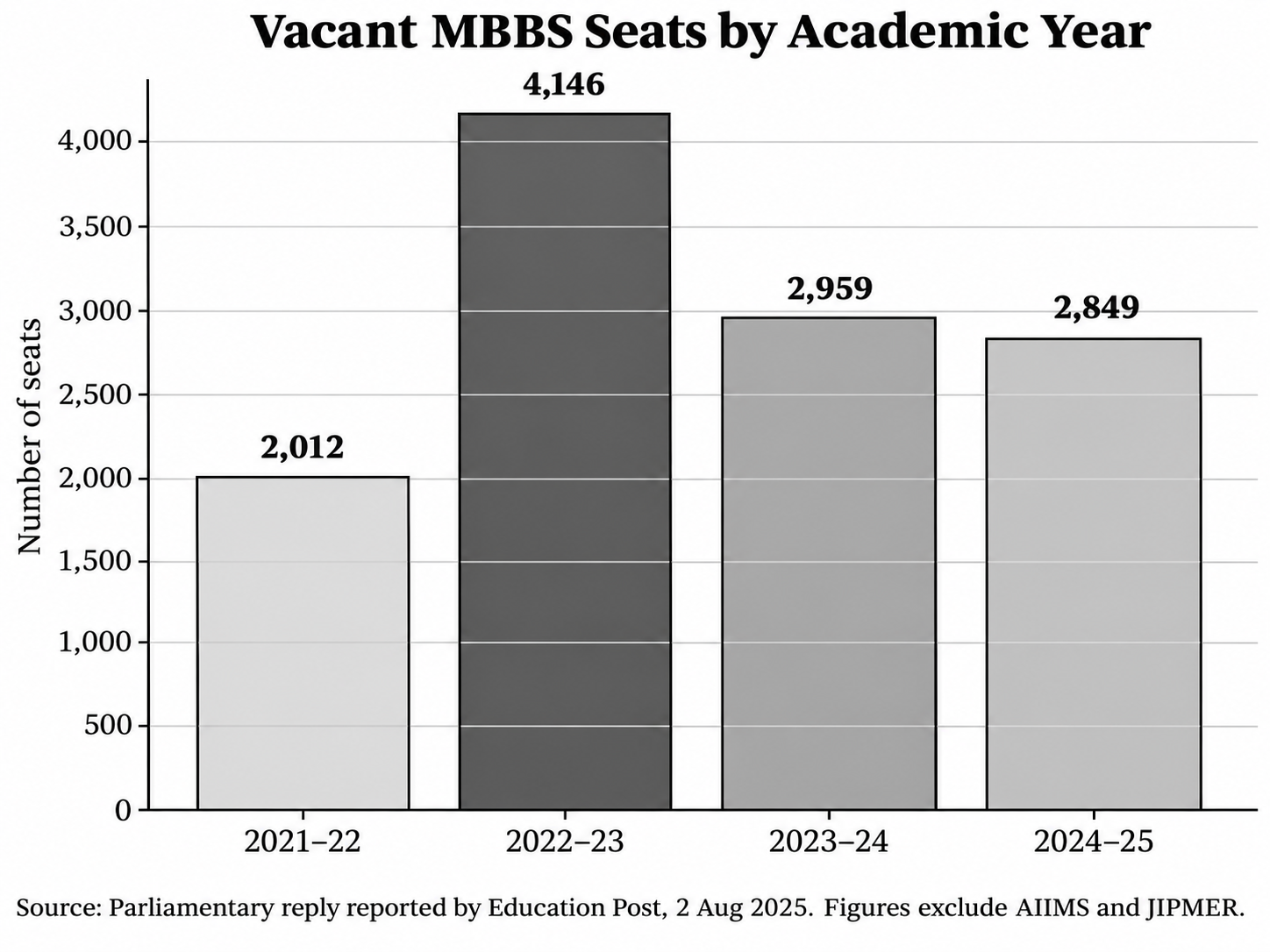
These figures demonstrate that the current situation is not an isolated failure in one admission cycle. Over the same period, India has substantially increased its medical education capacity. A Ministry of Health and Family Welfare statement issued in July 2026 reported that MBBS seats had increased from 1,09,115 in 2023–24 to 1,28,976 in 2025–26.
In September, Education Post's analysis of the revised NMC seat matrix found that private medical colleges accounted for 10,400 of the 13,186 additional seats approved for 2026–27, representing nearly 79% of that increase. The expansion of private medical capacity is important because it increases the number of available seats without necessarily ensuring that those seats are affordable to the students seeking admission.
However, the relationship between private expansion and vacancies needs careful interpretation. More seats may also produce temporary mismatches as colleges receive approvals, candidates assess new institutions and counselling authorities adjust their seat matrices. A complete evaluation would require final occupancy figures, fee details and vacancy trends across individual colleges, rather than simply comparing national seat capacity with vacancies reported at different points in the admission cycle.
What Happens Now? MCC Announces Another Counselling Round
The MCC's special stray vacancy round began on November 2, 2026, following the DGHS schedule issued on October 30. Registration closes at 3 pm on November 4, with the payment facility remaining available until 6 pm the same day. Choice filling continues until 11 am on November 5, while the result is scheduled for November 7.
Candidates allotted seats must report to the respective institutions by November 16. On November 2, MCC also issued a separate notice adding two specific MBBS seats to the special round: an NRI quota seat at the Hamdard Institute of Medical Sciences and Research in New Delhi and an OBC-PwD seat at Stanley Medical College in Chennai. The additions illustrate that the final available seat pool is not limited to high-fee, open-category private college seats. It can include vacancies in specific categories and institutions, each carrying its own eligibility conditions.
MCC has also issued a coordinated schedule for state counselling authorities, with the special round scheduled during November 3–7 and the final joining deadline set for November 16. Candidates should check the current MCC seat matrix and official notices before making choices, rather than relying on vacancy numbers reported several days earlier. The next round will establish whether additional counselling can substantially reduce the reported shortfall.
But it will not, by itself, answer the larger question raised by the vacancy figures. India has increased the number of medical seats available to students, yet access continues to depend heavily on the institution, the seat category and the amount a family can afford. The current dispute over vacancies also exposes competing priorities. Medical colleges want their sanctioned capacity filled, students want access to reasonably priced education, and regulators must preserve admission standards while enforcing the counselling framework.
The government has demonstrated that it can expand the number of MBBS seats. The more difficult question is whether those seats are being created in institutions that qualified students can realistically attend. That is the distinction the final NEET-UG 2026 admission figures will need to help answer.
Why Are Nearly 2,000 MBBS Seats Still Vacant After NEET Counselling 2026?
Ghaziabad School Introduces Global Lexile Framework to Assess Reading Skills of Students
SRMIST to Host National Conference on Regenerative Biology and Bioengineering from November 3
VJIM, CII Institute of Logistics sign MoU to boost supply chain career opportunities

Hong Kong plans weekly AI and coding lessons for children: Is India ready for the shift?
Why Are Nearly 2,000 MBBS Seats Still Vacant After NEET Counselling 2026?
Hong Kong plans weekly AI and coding lessons for children: Is India ready for the shift?

Who handles student discipline? Singapore schools look beyond teachers, lessons India can learn

Can Six Years of MBBS Abroad Still Leave Indian Students Unable to Practise in India?

What kind of future are schools preparing children for? Singapore educators explore question

Why Are Nearly 2,000 MBBS Seats Still Vacant After NEET Counselling 2026?
Ghaziabad School Introduces Global Lexile Framework to Assess Reading Skills of Students
SRMIST to Host National Conference on Regenerative Biology and Bioengineering from November 3
VJIM, CII Institute of Logistics sign MoU to boost supply chain career opportunities
Hong Kong plans weekly AI and coding lessons for children: Is India ready for the shift?
Why Are Nearly 2,000 MBBS Seats Still Vacant After NEET Counselling 2026?
Hong Kong plans weekly AI and coding lessons for children: Is India ready for the shift?
Who handles student discipline? Singapore schools look beyond teachers, lessons India can learn
Can Six Years of MBBS Abroad Still Leave Indian Students Unable to Practise in India?
What kind of future are schools preparing children for? Singapore educators explore question
Copyright© educationpost.in 2026 All Rights Reserved.