


NCERT’s new AI module brings deepfakes, data privacy and digital literacy into classrooms, but questions remain over compulsory teaching, trained teachers and infrastructure.
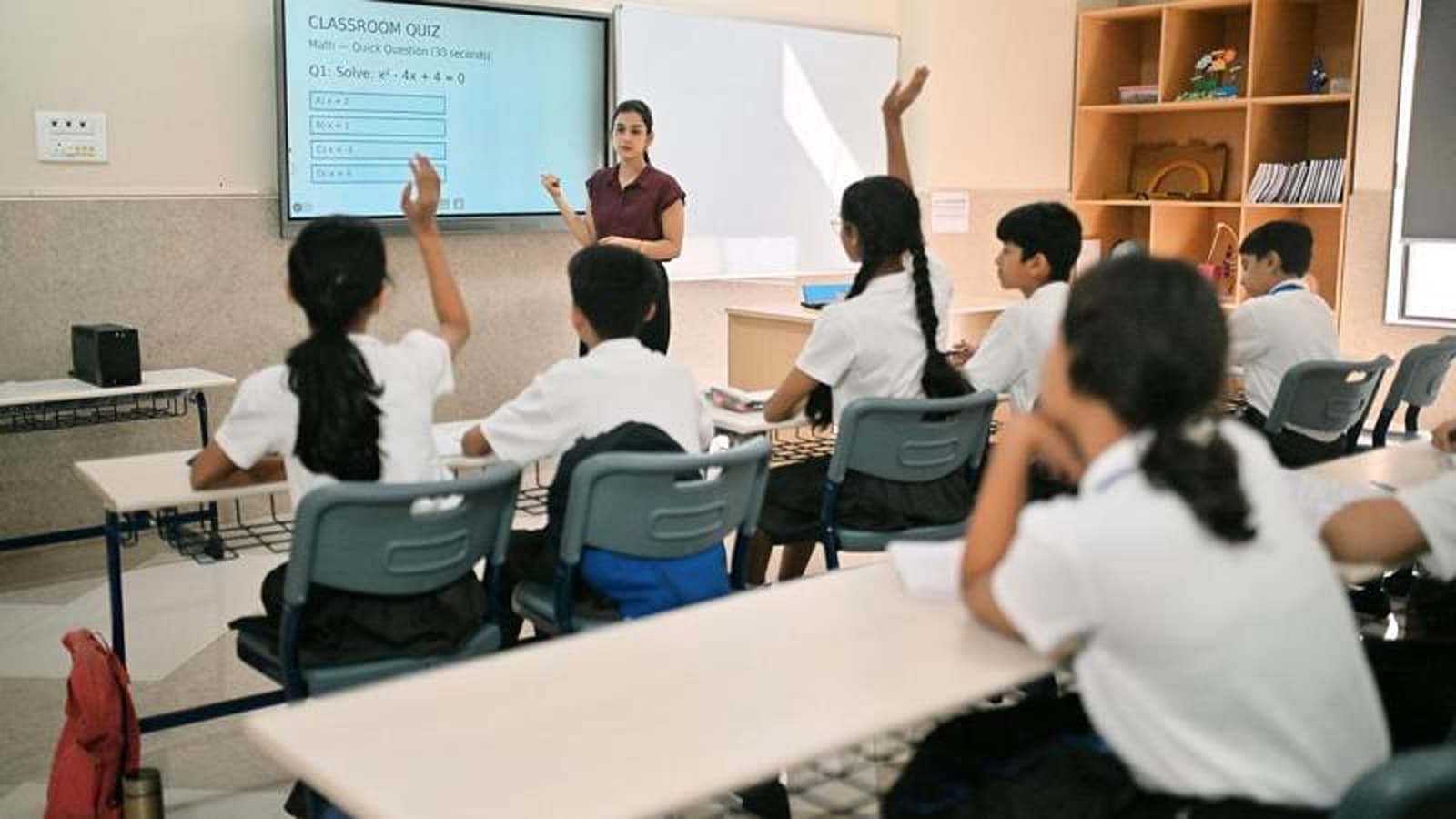
NCERT has introduced a 20-hour AI module for Classes 9–12 as CBSE expands computational thinking and AI learning in schools. (Representational image)
A lesson about artificial intelligence does not necessarily require a computer. Students can learn how algorithms recognise patterns using paper, puzzles and classroom discussions. But understanding why an AI chatbot produces incorrect information, how a deepfake is created or what happens to personal data shared online becomes more complicated without access to the technology itself.
This distinction is becoming increasingly important as India begins introducing artificial intelligence into mainstream school education.

On October 23, 2026, the National Council of Educational Research and Training (NCERT) announced a 20-hour introductory module on Computational Thinking (CT) and Artificial Intelligence (AI) for students in Classes 9 to 12. Developed with contributions from IIT Madras and IIT Jodhpur, the module covers how AI works, why it makes mistakes, how misinformation spreads and how students can use digital tools responsibly.
The development follows an earlier decision by the Central Board of Secondary Education (CBSE) to introduce computational thinking and AI learning for Classes 3 to 8 from the 2026–27 academic session.
Together, these developments signal a shift in India's approach to school education. AI is gradually moving beyond an optional technical skill towards something every student is expected to understand.
But does this mean AI is becoming compulsory in Indian schools? The answer depends on the class, the examination board and how the curriculum is being introduced.
What Will Students Learn Under NCERT's New AI Module?
The new NCERT module is designed for students with no previous knowledge of artificial intelligence. Rather than beginning with programming languages or complex mathematical concepts, it introduces AI through situations students may already encounter in their daily lives.
The 20-hour module has five units covering AI in everyday life, how machines learn from examples, the limitations of AI systems, data privacy and responsible use, and working with modern AI tools.
Students will examine how recommendation systems operate, why algorithms produce biased results and how generative AI can confidently present incorrect information as fact. The curriculum also addresses deepfakes, misinformation and the importance of verifying information before sharing it.
One particularly relevant component concerns AI hallucinations, instances in which a system generates information that may sound convincing but is inaccurate or fabricated. Students are encouraged to question such outputs rather than assume that a computer-generated answer is reliable.
The module also covers digital privacy. It introduces students to issues involving consent, personal information and India's Digital Personal Data Protection Act, 2023. Students are cautioned against sharing sensitive information, including identification numbers, passwords and personal documents, with AI platforms.
In its final section, the module introduces prompting, or the process of giving instructions to AI systems. However, the emphasis is on using these tools to assist learning rather than allowing them to complete intellectual tasks on students' behalf.
Instead of relying exclusively on examinations, the module encourages students to maintain a reflective portfolio, called the Curious Notebook, documenting observations, activities and what they have learned.
The intention is to develop students who can evaluate technology critically, not simply operate it.
Is Artificial Intelligence Now Compulsory in CBSE Schools?
There is an important distinction between introducing AI into the curriculum and making it a separate compulsory subject.
In April 2026, Union Education Minister Dharmendra Pradhan launched CBSE's Computational Thinking and Artificial Intelligence curriculum for Classes 3 to 8.
Under this framework, students in Classes 3 to 5 develop computational thinking through Mathematics and other subjects. Activities include identifying patterns, solving logical problems and breaking complicated tasks into smaller steps.
These activities do not necessarily involve using AI software. For Classes 6 to 8, the curriculum expands to include basic AI literacy, data analysis, applications of artificial intelligence and ethical questions surrounding technology. CBSE recommends integrating these concepts into classroom projects and existing subjects.
The official curriculum suggests 50 hours annually for Classes 3 to 5 and 100 hours annually for Classes 6 to 8. These are flexible teaching allocations, not additional annual hours that every school must necessarily add to its timetable.
The position is more explicit for secondary classes. According to CBSE's 2026–27 scheme of studies, Computational Thinking and Artificial Intelligence is listed as a compulsory, school-assessed module for the new Class 9 framework. The board's published scheme also states that CT and AI will become a compulsory subject in the 2027–28 academic session.
A separate CBSE circular dated April 9, 2026, states that NCERT will provide AI and computational thinking modules for Classes 9 to 12 for internal assessment during 2026–27. It also specifies transitional arrangements under which Class 10 students in that session continue with the previous academic scheme.
This does not mean that every school in India must immediately introduce a new compulsory AI subject.
The Centre announced a broader plan in October 2025 to introduce AI and computational thinking from Class 3 onwards across schools. However, school education involves both central and state governments, and implementation across different boards requires their respective curriculum decisions.
Therefore, CBSE's compulsory provisions should not automatically be interpreted as identical requirements for every state-board school.
The new NCERT module provides a common learning resource, while the precise timetable, assessment and adoption arrangements depend on the relevant board.
Can Schools Teach AI Without Computers or Internet Access?
This is where the policy faces its most practical challenge. According to the Ministry of Education's UDISE+ 2025–26 report, 69.9% of schools in India had access to computers, while 67.4% had internet connectivity.
Both figures show improvement over the previous academic year, when 64.7% of schools reported computer access and 63.5% had internet connectivity. However, the national figures also reveal that substantial gaps remain.
More importantly, having access to a computer does not establish how many devices are available, how frequently students can use them or whether internet connectivity is reliable enough for regular classroom instruction.
These figures cover schools nationally and should not be treated as a separate measure of CBSE-affiliated or secondary schools. NCERT has attempted to address the equipment problem by designing its 20-hour module for different teaching environments.
Activities can be conducted using individual or shared devices, through demonstrations by teachers, or without digital devices using printed materials, discussions and classroom exercises.
This approach could make AI education accessible to schools without sophisticated computer laboratories. For example, students can examine a printed example of misleading information and discuss how to verify it. They can also learn about algorithmic bias by examining how a system might produce different outcomes depending on the data used to train it.
Such activities are useful because computational thinking is not dependent on technology alone. But there is a limitation. Students who can directly interact with an AI system may be able to test prompts, compare responses and observe errors. Those learning only through printed exercises may understand the principles without gaining comparable experience using the tools.
The challenge is therefore not simply whether AI can be taught without computers. It is whether students in schools with different resources will receive comparable learning opportunities. Without careful implementation, a curriculum intended to improve digital literacy could reproduce existing educational inequalities.
Are Indian Teachers Prepared to Teach Artificial Intelligence?
Technology is only one part of the problem. Teacher preparation is equally important. Under CBSE's curriculum framework, teachers of Mathematics and other subjects are expected to introduce computational thinking in Classes 3 to 5. At the middle-school stage, subject teachers and computer teachers are expected to work together, with computer teachers handling AI literacy components.
This creates new expectations for teachers who may not have received specialist training in artificial intelligence. Explaining why an algorithm produces biased results or how a chatbot generates convincing misinformation requires more than familiarity with basic computer applications.
A teacher must also be able to connect these concepts to everyday examples and explain why technology should not automatically be trusted. The government has begun developing training programmes to support implementation.
In April 2026, CBSE identified computational thinking and AI as its teacher-training theme for the 2026–27 academic session. It also organised an orientation webinar for teachers and issued student and teacher resource books.
In August, CBSE and IIT Gandhinagar announced an eight-part online learning programme on computational thinking, AI and STEM, using simple classroom activities to explain technical concepts.
The Ministry of Education has also identified NISHTHA, its teacher-capacity-building programme, as a channel for digital and AI-related training. Separately, the government's SOAR initiative includes a 45-hour AI for Educators module.
These measures establish that teacher preparation is part of the policy response. They do not, by themselves, demonstrate how many teachers have completed appropriate training or whether schools have adequate specialist support.
That distinction matters. Providing educational resources and ensuring teachers can use them effectively are separate challenges.
Learning About AI Is Different From Learning Through AI
One of the more important questions surrounding the curriculum is what schools actually want students to become capable of doing.
There are two different approaches to AI in education.
The first is teaching students about artificial intelligence. This includes understanding how systems process information, the role of training data, algorithmic bias, privacy risks and the limitations of automated decision-making.
The second is teaching students to use artificial intelligence. This may involve working with chatbots, conducting research, analysing information, preparing projects or using AI-powered educational applications.
The first approach develops technological understanding. The second develops practical familiarity.
Neither necessarily guarantees that students can assess whether AI-generated information is correct.
A student who can produce an assignment using a chatbot may still be unable to recognise a fabricated quotation, identify an unreliable source or understand why a generated answer is misleading.
That is why the emphasis on critical verification in NCERT's module is particularly relevant.
There are also questions of student privacy and age-appropriate access. UNESCO's guidance on generative AI in education recommends stronger protection of learners' data, appropriate age limits and human oversight when introducing AI tools into educational settings.
For schools, this means AI literacy should not automatically require children to create accounts on commercial platforms or upload personal information.
A well-designed lesson could ask students to evaluate an AI-generated answer against a textbook, a verified source or a government document. Such an exercise would assess their reasoning rather than their ability to obtain a polished response from a chatbot.
What Will Determine Whether India's AI Curriculum Succeeds?
India's decision to introduce AI literacy during school education reflects a genuine change in the skills students will need to navigate digital information.
The National Education Policy 2020 had already called for greater emphasis on mathematical reasoning, computational thinking and contemporary subjects such as artificial intelligence.
The latest NCERT module takes that policy into more practical territory by addressing issues students may already encounter online, including deepfakes, inaccurate AI-generated information and personal-data risks.
Yet the effectiveness of the programme cannot be judged by the number of schools that download a handbook or add AI to their timetable.
Several questions remain important: How many teachers have received training? How will students without regular computer access receive practical exposure? Will schools assess independent reasoning or reward AI-generated assignments? How will state boards adopt the learning materials?
The government has established the curricular direction, but the quality and consistency of classroom implementation still require scrutiny.
For students, the most valuable outcome may not be the ability to operate another technology platform. It may be knowing when an AI-generated answer deserves to be questioned.
That is a skill Indian schools can begin teaching now, provided the curriculum does not become another exercise in memorising definitions.

Will AI Become Compulsory in Indian Schools? What NCERT’s New Curriculum Means

American Express to Support 7,500+ Micro-Entrepreneurs and Artisans Across India

McMaster University researcher wins $250,000 fellowship to advance bone implant research

Jharkhand Schools Closed Till October 29 in Four Districts Amid Cyclone Arnab

University of New Brunswick to launch data science degree in 2027
Will AI Become Compulsory in Indian Schools? What NCERT’s New Curriculum Means
McMaster University researcher wins $250,000 fellowship to advance bone implant research
Vande Bharat Sleeper Train: Varanasi–New Delhi Route Approved, Check Route, Timings and Stops

DA Hike 2026: Centre Approves 3% Increase, Allowance Rises to 63%

Haryana Listed 500 CHEERAG Seats at School After Recognition Withdrawal, Records Show

Will AI Become Compulsory in Indian Schools? What NCERT’s New Curriculum Means
American Express to Support 7,500+ Micro-Entrepreneurs and Artisans Across India
McMaster University researcher wins $250,000 fellowship to advance bone implant research
Jharkhand Schools Closed Till October 29 in Four Districts Amid Cyclone Arnab
University of New Brunswick to launch data science degree in 2027
Will AI Become Compulsory in Indian Schools? What NCERT’s New Curriculum Means
McMaster University researcher wins $250,000 fellowship to advance bone implant research
Vande Bharat Sleeper Train: Varanasi–New Delhi Route Approved, Check Route, Timings and Stops
DA Hike 2026: Centre Approves 3% Increase, Allowance Rises to 63%
Haryana Listed 500 CHEERAG Seats at School After Recognition Withdrawal, Records Show
Copyright© educationpost.in 2026 All Rights Reserved.