


New ULLAS guidelines require trainee teachers to support five to eight adult learners, but questions remain over credits, certification and implementation across teacher education institutions.
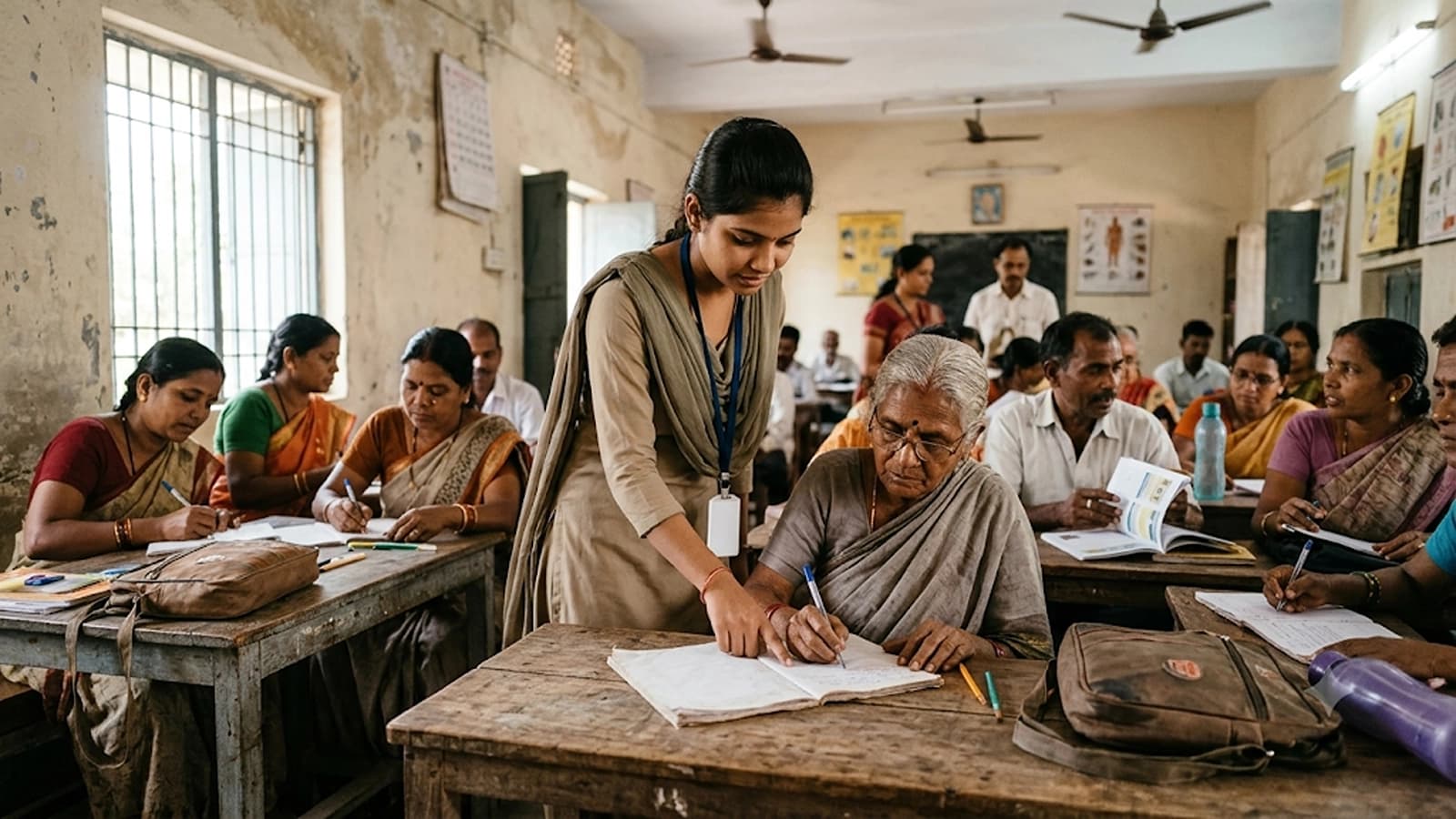
Under new ULLAS guidelines, student teachers will support five to eight adult learners, with academic credits linked to successful literacy certification. (Representational Image)
A student pursuing a Bachelor of Education (B.Ed.) degree may soon have to look beyond school classrooms for teaching experience. Under new guidelines issued by the Ministry of Education, trainee teachers will be expected to help adults who cannot read or write acquire basic literacy skills and obtain certification. Their academic credits will be linked to the success of those learners.
The arrangement raises a question that goes beyond the government's adult literacy campaign: What happens if a student teacher completes the required teaching work, but the adults being taught do not pass their literacy assessment?

The Ministry of Education has yet to publicly clarify the precise credit-award mechanism in the materials examined for this report. It has not specified whether credits will depend on the certification of every assigned learner, whether partial credits will be possible or how circumstances beyond a trainee teacher's control will be considered.
The Guidelines for Teacher Education Institutions under ULLAS – Nav Bharat Saaksharta Karyakram, launched by Union Minister of State for Education Jayant Chaudhary on October 28, envisage the participation of students enrolled in National Council for Teacher Education (NCTE)-recognised programmes, including B.Ed., M.Ed., B.P.Ed. and M.P.Ed.
Each student teacher will be required to facilitate the literacy and certification of five to eight non-literate learners. Academic credits will be linked to successful learner certification, according to the ministry. The guidelines were released during an event recognising the winners of the Viksit Bharat Buildathon 2025 in New Delhi.
Speaking at the event, Chaudhary acknowledged the role of ULLAS in helping adult learners gain literacy, dignity and confidence. According to the ministry's official account, he said the new guidelines would enable student teachers to contribute directly to the country's adult literacy effort.
The Department of School Education and Literacy said the framework was developed after consultations with stakeholders and defines responsibilities for NCTE, NCERT, the Centre for National Centre for Literacy, state education bodies, district authorities and teacher education institutions.
Yet the announcement leaves important operational questions unanswered, particularly about how colleges will assess student teachers and translate adult learning outcomes into academic credits.
The idea began in 2023, so what has changed?
The participation of university students in adult literacy programmes is not new. Under the National Education Policy (NEP) 2020, the government identified adult education as an important part of improving educational access. It subsequently approved the New India Literacy Programme, popularly known as ULLAS, for implementation from 2022–23 to 2026–27.
On January 27, 2023, the University Grants Commission issued directions encouraging higher education institutions to involve students as volunteer teachers. Students participating in the programme were to receive academic credits and certificates for teaching non-literate learners.
A few months later, on May 9, 2023, NCTE directed its regional offices to ensure the mandatory involvement of students at teacher education institutions in teaching eight to ten non-literate learners annually. These instructions were recorded in the Ministry of Education's 2023 year-end review.
The latest announcement, however, describes a target of five to eight learners per student teacher, compared with the earlier eight to ten. The numerical difference is clear, but the government has not explained in its October 28 release why the range has changed or whether the new guidelines formally supersede the 2023 directions. The earlier requirement was expressly annual, while the latest announcement does not specify the corresponding period.
There is also a difference in how academic credits are described. The 2023 directions provided for credits linked to students' participation in teaching. The new announcement makes successful literacy certification an explicit part of the credit arrangement.
This does not necessarily mean that the earlier system awarded credits solely for teaching hours, or that the new system automatically withholds them when an adult learner fails. The detailed rules are needed to determine how the arrangements differ in practice. The distinction matters because teacher training increasingly emphasises demonstrated learning outcomes rather than attendance or completion of prescribed activities.
As Education Post previously reported in its article on the new teacher training framework under NEP 2020, teacher education reforms have placed greater emphasis on practical experience, competency-based assessment and institutional accountability. The ULLAS guidelines bring another dimension to that discussion by connecting the work of trainee teachers with learning outcomes among adults outside formal schooling.
What exactly is ULLAS, and why are trainee teachers involved?
ULLAS, short for Understanding of Lifelong Learning for All in Society, is a centrally sponsored programme intended to provide literacy and continuing education opportunities to people aged 15 and above who missed formal schooling. Its five components include foundational literacy and numeracy, critical life skills, basic education, vocational skills and continuing education.
The programme is designed to help people acquire skills they can use in everyday life, whether reading instructions, handling financial transactions, understanding written information or accessing public services. The government approved an outlay of ₹1,037.90 crore for the five-year programme, with a target of reaching five crore learners.
According to the Ministry of Education's September 29, 2026, literacy backgrounder, ULLAS had registered approximately 4.03 crore learners and more than 52.20 lakh volunteers. Over 3.3 crore learners had participated in the Foundational Literacy and Numeracy Assessment Test (FLNAT).
These figures indicate the programme's scale, although registrations and assessment participation do not by themselves establish how many individuals have attained and retained functional literacy. The government has also reported a national literacy rate of 81.1% in the Periodic Labour Force Survey 2025, compared with 74.04% in Census 2011. The figures come from different statistical exercises and reference periods and should not be treated as a direct evaluation of ULLAS.
Education Post has previously examined the programme's progress in its report on India's improving literacy rate and ULLAS participation. ULLAS relies on volunteers to identify and teach adults who need literacy support. Learning materials are available through digital platforms, including the ULLAS application and DIKSHA, while training and orientation activities are conducted through face-to-face and online modes.
Under the new teacher education framework, student teachers will form part of this volunteer network. There is already a precedent for involving younger students. In August 2026, Education Post reported that Madhya Pradesh students in Classes 9 to 12 would become literacy ambassadors under ULLAS, with each student expected to support four adults in acquiring foundational skills. The latest guidelines extend the emphasis on organised participation to professional teacher education programmes, where teaching experience can form part of academic assessment.
What happens if an adult learner fails the literacy test?
This is the central unanswered question in the new framework. Consider a B.Ed. student assigned six adult learners. The student prepares lessons, spends several weeks teaching reading and numeracy, and helps all six register for FLNAT. Four subsequently qualify for certification, while two do not.
Would the trainee receive credits for teaching all six, credits based on the four successful learners, or credits only after all six obtain certification? The October 28 announcement does not explain.
FLNAT is the assessment mechanism used under ULLAS to evaluate foundational reading, writing and numeracy. Learners who meet the prescribed standards receive literacy certification through the programme's established assessment arrangements. For adult learners, however, educational progress may depend on circumstances that extend beyond the quality of instruction.
A person working irregular hours may struggle to attend classes consistently. Others may have family responsibilities, health-related interruptions or limited opportunities to practise reading outside lessons. These possibilities do not demonstrate weaknesses in the government's new policy. They explain why its assessment and credit provisions need to distinguish between the work performed by a volunteer teacher and the final examination outcome of a learner.
If academic credits depend entirely on certification, institutions will need a fair method of assessing situations in which learners attend irregularly, discontinue participation or require more time to acquire literacy. The ministry's announcement does not establish whether the framework already provides such safeguards.
There is also a question about how student teachers' contributions will be verified. Colleges would need to know whether teaching hours, lesson plans, learner attendance, assessment results and certification records form part of the evaluation. Without a clear and consistent framework, students at different institutions could be assessed differently for substantially similar work.
Can teacher education colleges implement the guidelines equally?
The new initiative could provide student teachers with experience of working with people whose learning needs differ from those of schoolchildren. Adult learners bring their own experiences, responsibilities and expectations into the learning process. Teaching them may require a different approach to lesson planning, communication and assessment.
For trainee teachers, this could provide experience in recognising learning difficulties, adapting instructional methods and working with communities. But the effectiveness of the arrangement will depend on institutional preparation. Teacher education colleges differ in staffing, infrastructure, location and access to adult literacy centres. Identifying five to eight learners may be straightforward in some communities but more complicated in others.
The geographical distribution of non-literate adults is also uneven. Institutions will need arrangements for identifying eligible learners, matching them with volunteers and monitoring progress. The ministry says the new guidelines allocate responsibilities across national, state and district authorities. That coordination will be essential because a college cannot independently manage every aspect of learner identification, training, assessment and certification.
There is another question about the programmes covered by the initiative. The government's announcement includes physical education degrees such as B.P.Ed. and M.P.Ed., alongside conventional teacher education qualifications. All participating students would therefore need suitable preparation for foundational literacy instruction, regardless of their principal field of training.
At present, the official announcement does not specify the duration of training, minimum teaching hours, supervision ratios or arrangements for students who cannot identify sufficient learners. These details will determine whether the programme becomes a structured part of teacher education or another activity that institutions must accommodate within already demanding academic schedules.
What does the government need to clarify?
The immediate challenge is translating the announced framework into consistent procedures. The Department of School Education and Literacy must clarify how many academic credits a student can earn, what evidence is required to claim them and how partial or unsuccessful learner outcomes will be handled.
NCTE must establish whether the new learner target replaces its 2023 instructions and how the requirements fit within existing teacher education curricula. Universities and teacher education institutions will need to determine how the credits are recorded, assessed and recognised. State literacy authorities will need dependable systems connecting volunteers with learners and recording examination outcomes.
The government has described the initiative as a way to strengthen adult literacy while offering practical opportunities to future teachers. Its scale could be considerable, given the number of students enrolled in recognised teacher education programmes. But those potential benefits are still policy objectives, not established outcomes of the new guidelines.
The larger question is how the education system should evaluate a future teacher's work. Helping an adult acquire literacy is a meaningful educational outcome, but unsuccessful certification does not necessarily mean that no learning occurred or that the teacher's effort was ineffective. A framework that rewards certified results could encourage institutions to pay closer attention to measurable progress. Its fairness will depend on how those results are assessed and whether the rules account for the circumstances of adult learners.
The October 28 guidelines place adult literacy more directly within teacher preparation. Whether they produce better teachers and more literate adults will depend on the credit rules, institutional support and assessment safeguards that accompany their implementation.
ULLAS 2026: Will B.Ed. Students' Academic Credits Depend on Adults Passing Literacy Tests?
Oxford researchers turn historic plant collection into a window on colonial science

Magnitude 5.1 Earthquake Strikes Near Andaman and Nicobar Islands; No Immediate Reports of Damage

Earth’s life story may not have begun with comets, new study finds

Can India's Biggest Examinations Become Leak-Proof?
ULLAS 2026: Will B.Ed. Students' Academic Credits Depend on Adults Passing Literacy Tests?
Earth’s life story may not have begun with comets, new study finds
Can India's Biggest Examinations Become Leak-Proof?

Less juggling for parents? Singapore to unite kindergarten learning and after-school care by 2030
Bihar’s NMCH suspends 146 students over ragging: Wake-up call for medical colleges

ULLAS 2026: Will B.Ed. Students' Academic Credits Depend on Adults Passing Literacy Tests?
Oxford researchers turn historic plant collection into a window on colonial science
Magnitude 5.1 Earthquake Strikes Near Andaman and Nicobar Islands; No Immediate Reports of Damage
Earth’s life story may not have begun with comets, new study finds
Can India's Biggest Examinations Become Leak-Proof?
ULLAS 2026: Will B.Ed. Students' Academic Credits Depend on Adults Passing Literacy Tests?
Earth’s life story may not have begun with comets, new study finds
Can India's Biggest Examinations Become Leak-Proof?
Less juggling for parents? Singapore to unite kindergarten learning and after-school care by 2030
Bihar’s NMCH suspends 146 students over ragging: Wake-up call for medical colleges
Copyright© educationpost.in 2026 All Rights Reserved.