


As Delhi witnesses protests, police detentions and restrictions on public gatherings, Section 163 of BNSS has come into focus. Here is what the law permits.
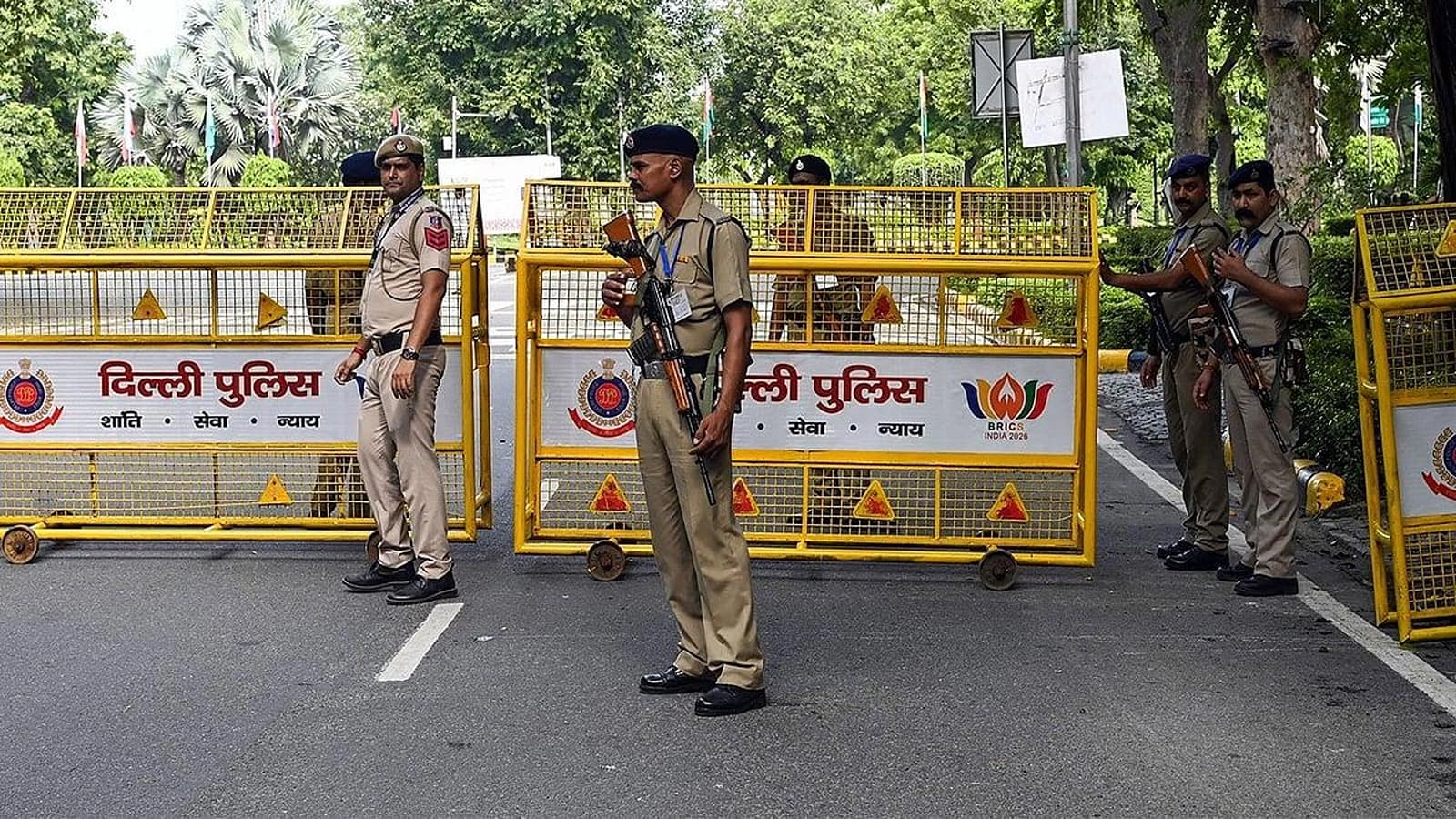
Delhi Police personnel deployed near Jantar Mantar amid restrictions on public gatherings during protests in October 2026.
The imposition of Section 163 of the Bharatiya Nagarik Suraksha Sanhita (BNSS), 2023, has drawn attention to the legal powers available to authorities to restrict public gatherings and prevent disturbances. The provision, which replaced Section 144 of the Code of Criminal Procedure (CrPC), allows designated magistrates to issue preventive orders in situations involving an immediate threat to public safety or tranquillity.
The law has come into focus following protests in the national capital against Chief Election Commissioner Gyanesh Kumar and the Election Commission's Special Intensive Revision (SIR) of electoral rolls. The demonstrations, organised by the Cockroach Janta Party (CJP) and supported by other political and student groups, have been accompanied by prohibitory orders, restrictions on movement, police detentions and changes to designated protest sites.

Delhi Police imposed restrictions in New Delhi district and denied permission for proposed gatherings at Jantar Mantar on October 10 and 11. According to reports, the police cited delays in seeking permission, concerns over public safety and alleged violations during earlier demonstrations.
The restrictions have also raised questions about the relationship between preventive policing and the constitutional right to peaceful assembly. While Indian law permits authorities to act before a disturbance occurs, courts have held that restrictions on fundamental rights must satisfy legal requirements and cannot be imposed arbitrarily.
What is Section 163 of BNSS?
Section 163 of the Bharatiya Nagarik Suraksha Sanhita empowers a District Magistrate, Sub-Divisional Magistrate or another Executive Magistrate specially authorised by the state government to issue written orders when immediate preventive action is considered necessary. The BNSS came into force on July 1, 2024, replacing the CrPC, 1973. Section 163 broadly retains the preventive powers previously exercised under Section 144 of the CrPC.
According to the statutory provision, an order may be issued to prevent obstruction or injury to persons lawfully employed, danger to human life, health or safety, disturbances of public tranquillity, riots or affrays. The magistrate must have sufficient grounds for taking action and must state the material facts supporting the order. In emergencies, the law permits an order to be issued without first hearing the affected person, a procedure known as an ex parte order.
Such directions may apply to a particular individual, people living in a specified locality or members of the public entering or visiting a particular area.
The provision does not automatically impose a nationwide or citywide ban on gatherings. Its effect depends on the geographical area, duration and specific restrictions mentioned in the written order.
Why has Section 163 been imposed in Delhi?
The immediate context is a series of demonstrations over the SIR of electoral rolls and demands for the resignation of Chief Election Commissioner Gyanesh Kumar. Protesters have alleged that the voter-list revision process has resulted in the exclusion of eligible voters and raised concerns about electoral transparency. The Election Commission has rejected accusations of political bias, while the Bharatiya Janata Party has denied allegations that the process was designed to benefit the ruling party.
Security measures were intensified in New Delhi ahead of demonstrations planned for October 10 and 11, particularly around Jantar Mantar and other sensitive locations. According to reports, Delhi Police invoked Section 163 to restrict unauthorised gatherings and maintain public order. Police also cited concerns about traffic movement, the expected number of demonstrators and compliance with conditions imposed during previous protests.
The restrictions were introduced against the backdrop of demonstrations in July 2026, which police subsequently referred to when assessing security arrangements for the October mobilisation.
What happened during the October protests?
On October 10, thousands of protesters were detained as authorities attempted to prevent large gatherings near Jantar Mantar and other parts of the capital. Reuters reported that more than 2,000 people were detained during the police operation. Reports from other news organisations carried varying figures, reflecting different reporting periods and categories of detention. A consolidated, independently verified total covering all operations has not been established.
Among those detained were organisers associated with the CJP, which had called for demonstrations demanding the removal of the Chief Election Commissioner. Police established barricades at several locations, while access to parts of central Delhi was restricted. Metro services and railway operations were also affected by security measures introduced during the protests.
Demonstrations subsequently spread beyond Jantar Mantar, with protesters gathering at locations including Connaught Place, Rajghat, Gole Market and areas near Safdarjung. Some groups organised smaller, short-duration demonstrations after restrictions prevented larger assemblies. Several political leaders, activists and journalists were also reported to have been detained or temporarily held during the police operations.
Police authorities maintained that preventive measures were necessary to prevent possible disturbances and manage crowds. Protest organisers disputed the restrictions and maintained that their demonstrations were intended to be peaceful. Reports also described confrontations between protesters and police personnel. Allegations of misconduct and violence require examination of individual incidents and should not be treated as established findings against all participants.
What restrictions can be imposed under Section 163?
Although Section 163 is commonly associated with restrictions on demonstrations, it does not contain a universal rule prohibiting every gathering of four or five people. The restrictions depend on what the competent authority specifies in the order.
In New Delhi district, the reported directions prohibited public meetings or assemblies of five or more people, processions, demonstrations, picketing and sit-ins without prior written permission. They also restricted slogans and public speeches without authorisation.
Orders under the provision may regulate particular activities, movement or access to specified locations when the statutory conditions are satisfied. The police cannot automatically treat every activity in the capital as prohibited merely because Section 163 has been invoked in one district. The law must also be distinguished from separate powers governing arrests, preventive detention, traffic diversions and telecommunications restrictions. Invoking Section 163 does not, by itself, automatically suspend mobile internet services or authorise every form of restriction on transport. Such measures require their own legal basis.
For residents, commuters and protest organisers, the practical implications therefore depend on the exact order in force, its territorial limits and any permissions or exemptions granted by authorities.
How long can Section 163 remain in force?
Under Section 163(4) of the BNSS, an order issued by a magistrate cannot ordinarily remain in force for more than two months from the date it is made. However, the law allows the state government to extend its operation for an additional period of up to six months if it considers the measure necessary to prevent danger to human life, health or safety, riots or affrays. This extension requires a government notification. The law does not permit an individual magistrate to extend an existing order indefinitely.
The provision also allows affected persons to seek modification or cancellation of an order. Under Section 163(5) and (7), an aggrieved person may apply to the competent magistrate for relief and is entitled to an early opportunity to present their case, either personally or through an advocate. If the application is rejected, the authority must record its reasons in writing.
What happens if someone violates Section 163?
Disobeying a legally issued prohibitory order can attract criminal liability under Section 223 of the Bharatiya Nyaya Sanhita (BNS), 2023.
The punishment depends on the consequences of the violation.
Where disobedience causes or is likely to cause obstruction, annoyance or injury to a person lawfully employed, the punishment may extend to six months of simple imprisonment, a fine of ₹2,500, or both.
Where the violation causes or is likely to cause danger to human life, health or safety, or causes or tends to cause a riot or affray, the punishment may extend to one year of imprisonment, a fine of ₹5,000, or both.
The existence of a Section 163 order does not mean every person present in the restricted area has committed an offence. Criminal liability depends on the applicable directions, knowledge of the order and the legal requirements for establishing disobedience.
What has the Supreme Court said about Section 163 and the right to protest?
The constitutional position on preventive restrictions has developed through several Supreme Court judgments concerning Section 144 of the CrPC, the predecessor of Section 163.
Articles 19(1)(a) and 19(1)(b) of the Constitution guarantee freedom of speech and expression and the right to assemble peacefully without arms. These rights are subject to reasonable restrictions under Articles 19(2) and 19(3), including in the interests of public order.
In Himat Lal K. Shah v. Commissioner of Police (1973), the Supreme Court recognised the government's authority to regulate public assemblies but held that regulation cannot amount to an arbitrary prohibition of the right to assemble.
In Mazdoor Kisan Shakti Sangathan v. Union of India (2018), the Court examined restrictions on demonstrations at Jantar Mantar. It rejected a blanket prohibition and called for a regulatory framework that balanced the rights of protesters with those of residents and commuters.
The Supreme Court subsequently addressed the limits of preventive orders in Anuradha Bhasin v. Union of India (2020). It held that preventive powers cannot be used to suppress legitimate democratic expression and that restrictions must satisfy the principle of proportionality.
Together, these judgments establish that authorities may regulate protests to protect public order, but the nature and extent of the restrictions remain subject to judicial scrutiny.
What has the Supreme Court said about the latest Delhi restrictions?
The Supreme Court has intervened in proceedings concerning the restrictions imposed during the October 2026 demonstrations.
On October 9, the Court questioned proposed widespread transport restrictions, particularly measures that would affect commuters not participating in protests.
In interim directions issued on October 11, the Court called for Metro and railway services to function normally, subject to legally permissible restrictions. It also directed that internet facilities should remain unhindered and that public movement should be facilitated within applicable law-and-order requirements.
The Court stated that there should be no illegal detention, particularly of people participating in peaceful, unarmed assemblies outside areas where Section 163 was in operation.
It also directed that lawyers, journalists and other professionals should not be obstructed while carrying out their professional duties.
The directions included removing a prohibitory-order notice board near the Supreme Court premises to avoid creating obstacles to access to courts.
The proceedings were listed for further consideration on October 13. These were interim directions rather than a final determination that every restriction or detention imposed by authorities was unlawful.
Why has Jantar Mantar been removed as a designated protest site?
In a separate development on October 12, Delhi Police removed Jantar Mantar from its list of designated venues for public demonstrations.
The police identified three alternative locations: Ramlila Maidan, Burari Ground and CBD Ground in east Delhi.
According to the standing order reported by the media, the decision followed recommendations from a committee constituted by the Union Ministry of Home Affairs. Revised standard operating procedures for organising demonstrations at these locations are to be issued separately.
The change is distinct from the invocation of Section 163. The former concerns the administrative designation of protest venues, while the latter provides statutory authority to issue urgent preventive orders.
Jantar Mantar had long served as a prominent location for political demonstrations because of its proximity to Parliament and other central government institutions. The removal of its designated status has consequently become part of the wider legal debate over where peaceful public assemblies may be held.
What is the situation in Delhi as of October 13?
The restrictions and protests have continued to develop.
On October 12, opposition parties, including members of the INDIA bloc, organised a march towards the Supreme Court over the electoral-roll revision. According to Reuters and other reports, opposition leaders sought judicial intervention concerning the SIR process and alleged removal of eligible voters.
Delhi Police subsequently registered FIRs in connection with alleged violations during the march, including accusations involving unauthorised assembly and damage to barricades.
On October 13, Reuters reported further detentions of CJP leaders Ashutosh Ranka, Saurav Das and Ajinkya Shinde following an attempt to demonstrate at Jantar Mantar despite the change in the site's designated status.
Legal challenges concerning restrictions and access to protest venues have also reached the courts.
Section 163 remains a preventive legal mechanism rather than a general suspension of fundamental rights. Its application depends on the specific order issued, the risks identified by the competent authority and the statutory and constitutional safeguards governing its use.
The validity of individual orders, detentions and related restrictions must be assessed separately. The existence of a public-order concern does not establish that every restriction is lawful, just as the peaceful character of a proposed demonstration does not automatically exempt it from otherwise valid regulatory conditions.
What Is Section 163 of BNSS and Why Has It Been Imposed in Delhi? Explained

Yale University president apologises after hot mic captures remarks about student activists

Emirati AI researcher wins MBZUAI fellowship for Oxford research

NYU Abu Dhabi welcomes 24 UAE students to 2026–27 Sheikh Mohamed bin Zayed Scholars Program

IIT Kharagpur Launches Free AI Tutor, Online GATE-JAM Preparation Platform for Students
What Is Section 163 of BNSS and Why Has It Been Imposed in Delhi? Explained
Emirati AI researcher wins MBZUAI fellowship for Oxford research
IIT Kharagpur Launches Free AI Tutor, Online GATE-JAM Preparation Platform for Students
.jpg&w=256&q=75)
Sorbonne Abu Dhabi study detects 83 vertebrate taxa along urban coastline

UNESCO flags India’s rural education gap: 59 girls for every 100 boys

What Is Section 163 of BNSS and Why Has It Been Imposed in Delhi? Explained
Yale University president apologises after hot mic captures remarks about student activists
Emirati AI researcher wins MBZUAI fellowship for Oxford research
NYU Abu Dhabi welcomes 24 UAE students to 2026–27 Sheikh Mohamed bin Zayed Scholars Program
IIT Kharagpur Launches Free AI Tutor, Online GATE-JAM Preparation Platform for Students
What Is Section 163 of BNSS and Why Has It Been Imposed in Delhi? Explained
Emirati AI researcher wins MBZUAI fellowship for Oxford research
IIT Kharagpur Launches Free AI Tutor, Online GATE-JAM Preparation Platform for Students
Sorbonne Abu Dhabi study detects 83 vertebrate taxa along urban coastline
UNESCO flags India’s rural education gap: 59 girls for every 100 boys
Copyright© educationpost.in 2026 All Rights Reserved.