
China to produce 13 million graduates next year, labour market struggles to absorb young talent
The projected increase coincides with 18.9% youth unemployment, prompting Beijing to expand hiring, support vocational training and address potential job losses linked to AI adoption.
Written by: Pragya Kumari · Updated:
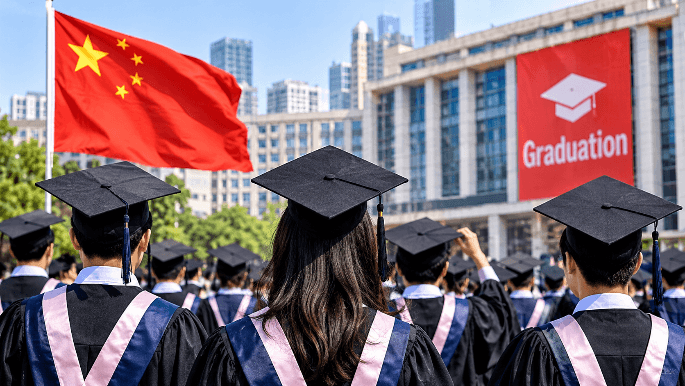
China is expected to produce a record 13 million university graduates in 2027, intensifying competition for jobs as the world's second-largest economy continues to face slowing growth and employment challenges.
The projected number of graduates will be 2.4% higher than the estimated 12.7 million students graduating this year, according to figures released by China's Ministry of Education on Thursday.
The rising graduate population is adding pressure to an already strained labor market, which is struggling to create enough employment opportunities for the growing number of educated young people, according to the South China Morning Post.
The development comes as China continues to experience a steady increase in university graduates following the expansion of higher education enrollment that began in 1999.
The annual number of university graduates crossed the 10 million mark for the first time in 2022 and has continued to increase since then.
While the expansion of higher education has helped supply skilled workers to meet the economy's growing demand for talent, the employment market is facing difficulties absorbing the expanding pool of degree holders.
China university graduates 2027: Numbers expected to reach 13 million
The Ministry of Education's latest projection indicates that approximately 13 million students will graduate from Chinese universities next summer, setting a new record for the country.
The estimated figure represents an increase of around 300,000 graduates compared with the projected 12.7 million for 2026.
The continuous rise in graduate numbers reflects the long-term expansion of China's higher education system. The increase in university enrollment began in 1999, contributing to a substantial growth in the number of students completing higher education over the following decades.
The annual graduate population exceeded 10 million in 2022. Since then, the number has continued to rise, creating a larger supply of educated workers entering the employment market each year.
Although the growing number of graduates has supported the availability of skilled talent, the labor market is finding it increasingly difficult to accommodate the expanding workforce.
China youth unemployment reaches 18.9% amid rising graduate numbers
The growing number of university graduates has coincided with mounting employment challenges among young people in China.
In August, the influx of college graduates contributed to an increase in the urban youth unemployment rate to 18.9%, its highest level since Beijing revised the calculation methodology in 2023.
The unemployment indicator covers people aged 16 to 24 who are not enrolled in education.
The figures highlight the pressure facing China's employment market as a growing number of young people enter the workforce with university qualifications.
The situation has raised concerns about whether the economy can generate sufficient jobs to accommodate the increasing number of degree holders.
The challenge is particularly relevant as China's economic growth slows, domestic demand remains weak and the property market continues to struggle.
China announces employment measures to support university graduates
Chinese officials have pledged additional measures to maintain employment stability among university graduates as the country prepares for another record-breaking graduating cohort. The commitments were made during a national meeting on college graduate employment.
Officials said existing policy measures would be fully utilized, alongside additional support to ensure "overall employment stability" among university graduates.
The employment strategy includes creating more opportunities in advanced manufacturing and modern services, two sectors expected to contribute to the country's evolving employment landscape.
The government also plans to encourage state-owned companies to increase their workforce numbers to accommodate more graduates entering the labor market.
Small and medium-sized businesses are also expected to receive support to expand hiring and provide additional employment opportunities.
In addition, officials have identified entrepreneurship as another potential source of jobs for university graduates.
These measures are intended to expand employment opportunities across different sectors and help address the growing gap between the number of graduates and available jobs.
Chinese students spend thousands of yuan on internships to improve job prospects
The challenging employment environment has also influenced how university students prepare for their careers before completing their degrees.
Some Chinese college students are willing to spend thousands of yuan to secure internship opportunities and strengthen their résumés.
Students are increasingly seeking practical work experience to improve their competitiveness when applying for jobs after graduation.
Internships have become an important consideration for candidates attempting to distinguish themselves in a competitive employment market.
The willingness to pay for internship opportunities also reflects the pressure students face as they prepare to enter a labor market with an expanding pool of university graduates.
With more candidates competing for available positions, students are looking for ways to strengthen their professional profiles and improve their chances of securing employment.
China vocational schools attract students amid concerns over graduate employment
Alongside the growing demand for internships, some students are also considering vocational education as an alternative pathway to employment.
Vocational schools offering practical training and short-term courses are attracting students concerned about their future job prospects.
These institutions teach industry-oriented skills and promise employment opportunities after the completion of selected courses.
The growing interest in vocational education comes as university degrees appear to be losing some of their perceived value in the employment market.
For some students, acquiring practical skills and completing shorter training programs may offer a more direct route to employment than pursuing conventional university qualifications.
The trend reflects changing career considerations among young people as they assess the relationship between higher education, professional skills and available job opportunities.
Artificial intelligence adds to China's employment concerns
China's employment challenges are also being shaped by the rapid development and adoption of artificial intelligence (AI).
As the world's second-largest economy deals with slower growth, weak domestic demand and difficulties in its property sector, the expansion of AI technology has introduced additional concerns about potential job displacement.
The increasing use of AI in different industries has raised questions about how automation could affect existing jobs and the future employment opportunities available to young workers.
In response to these concerns, Beijing issued a guideline late last month outlining measures to reduce the impact of AI adoption on employment.
The policy document pledged to "prudently manage the scope, intensity and pace" of AI deployment in labor-intensive industries.
It also encouraged companies to introduce transition periods for employees whose positions could be affected by the adoption of AI technologies.
Under the guideline, employers have been asked to provide advance notice to workers before implementing large-scale AI deployment.
Companies have also been encouraged to help affected employees undergo retraining or transition into alternative roles within the workforce.
The measures aim to address potential employment disruptions as businesses increasingly adopt AI while ensuring that workers have opportunities to adapt to changing industry requirements.
China's higher education expansion and employment challenges
China's higher education system has undergone considerable expansion since the government began increasing university enrollment in 1999.
This expansion has resulted in a sustained increase in the number of graduates entering the labor market annually.
The graduate population first exceeded 10 million in 2022 and is now projected to reach 13 million in 2027.
While the expansion has increased access to higher education and supplied skilled workers to the economy, employment generation remains a challenge.
The projected record number of graduates, rising youth unemployment and growing concerns about AI-driven job displacement have added pressure on policymakers to strengthen employment support measures.
The government's latest commitments focus on expanding recruitment across advanced manufacturing, modern services and state-owned enterprises, while encouraging small businesses and entrepreneurship to generate additional opportunities.
At the same time, the growing interest in vocational training, internships and practical skills highlights how students are adapting their career strategies to China's changing employment market.
Also read