
Japan improves English proficiency ranking by 10 places, but remains below global average
The EF index reveals regional disparities, weaker English proficiency among 18- to 20-year-olds and persistent gaps in speaking and writing skills despite stronger reading performance.
Written by: Pragya Kumari · Updated:
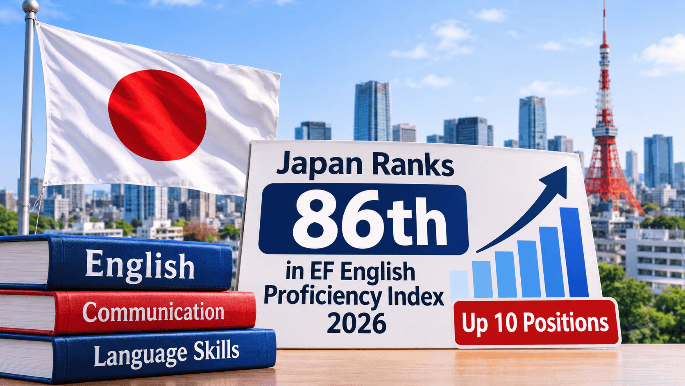
Japan has recorded an improvement in adult English proficiency, climbing 10 positions to secure 86th place in the 2026 global English proficiency ranking released by Education First (EF). The latest results indicate a possible recovery after several years of declining performance.
The 2026 edition of the EF English Proficiency Index (EF EPI), released Wednesday, placed Japan among 117 countries and regions assessed in the latest evaluation. The country ranked 96th in the previous edition, which covered 123 countries and marked its lowest position ever.
The latest improvement also moved Japan out of the "very low" English proficiency category and into the "low" proficiency band. However, the progress has not been enough to close the gap with several other Asian countries and global counterparts.
According to the Japan Times, the latest index was compiled using English test results from approximately 2.3 million participants across 117 countries and regions.
Despite moving up the rankings, Japan's overall performance remained below the global average. The country received 450 points, which was 35 points lower than the overall average score of 485.
Japan English proficiency ranking 2026: Country climbs 10 positions
Japan's rise to 86th place represents a reversal of the declining trend observed in previous editions of the EF English Proficiency Index.
The country's position had fallen to 96th in the 2025 ranking, its lowest recorded standing at the time. That edition continued a pattern of declining English proficiency among Japanese adults over several years.
The improvement in 2026 has therefore indicated some progress in the country's English language performance. Japan has also moved up one proficiency category, shifting from "very low" to "low."
However, the latest results suggest that considerable challenges remain in improving English communication skills among the country's population.
Japan continues to perform below several other countries in Asia, indicating that its recent improvement has not translated into a stronger position against regional competitors.
Japan ranks below South Korea in global English proficiency index
Despite gaining 10 positions in the latest ranking, Japan continues to trail several Asian countries in adult English proficiency.
South Korea secured 50th place in the 2026 EF English Proficiency Index, placing it 36 positions ahead of Japan.
The difference highlights the gap between the English language performance of the two neighboring countries.
Japan's overall score of 450 points also remained below the index's global average of 485 points. The 35-point difference indicates that the country still has considerable room to improve its adult English proficiency levels.
At the global level, European countries dominated the highest positions in the 2026 ranking.
Sweden secured the first position, followed by Austria in second place and Denmark in third.
The strong performance of these European countries placed them ahead of other participants in the international assessment.
Japan English proficiency: Reading skills stronger than speaking and writing
The EF assessment also highlighted differences in English language abilities across individual skill areas among Japanese learners.
Participants from Japan performed better in reading compared with speaking and writing. The findings point to an imbalance in language proficiency, with receptive skills showing stronger performance than productive communication abilities.
The difference suggests that while Japanese learners may be relatively more comfortable understanding written English, expressing themselves through spoken and written communication remains a challenge.
The results also draw attention to the importance of developing practical communication skills alongside reading ability.
Tokyo, Yokohama and Kyoto lead Japan in regional English proficiency
English proficiency levels also varied across different regions of Japan, according to the EF assessment.
Major urban centers, including Yokohama, Tokyo and Kyoto, recorded stronger English proficiency levels than several other cities.
Learners in Hiroshima, Shizuoka and Kochi performed comparatively lower in the assessment.
The regional differences indicate that English language proficiency is not uniform across the country. Performance varies depending on the location of learners, with some major urban centers recording better results than other regions.
The findings also highlight the differences in English language performance within Japan, beyond the country's overall position in the international ranking.
Young Japanese people record lowest English proficiency scores
One of the key findings of the 2026 EF English Proficiency Index was the relatively weak performance of younger people in Japan.
The assessment found that participants aged 18 to 20 recorded the lowest English proficiency scores among all age groups in the country.
The trend is not limited to Japan, as younger populations in several other countries covered by the index also demonstrated comparatively low English language abilities.
EF suggested that the COVID-19 pandemic may have contributed to the decline in English proficiency among younger people worldwide.
According to the organization, students who had to attend online English classes instead of in-person lessons between 2019 and 2022 may still be experiencing the effects of disrupted language learning.
The impact of the pandemic on classroom-based education and opportunities for direct communication could have affected the development of practical English skills among this age group.
EF indicated that the consequences of this period are still visible in Japan and other countries included in the assessment.
EF Japan official highlights importance of improving young people's English skills
Masato Suzuki, business development manager for EF Japan, highlighted the importance of improving English proficiency among younger generations.
He said that strengthening their language abilities could also contribute to better English communication skills across the workforce in the coming years.
"Raising the English proficiency of this (young) generation will create a bottom-up effect that elevates proficiency levels when they enter the workforce."
His remarks underline the potential long-term impact of improving English language education among young people.
Developing stronger communication skills at an early stage could help students carry those abilities into their professional lives and contribute to higher English proficiency across the working population.
EF recommends real-life communication to improve English proficiency in Japan
EF officials have also emphasized the need to strengthen practical English communication rather than depending entirely on digital learning platforms.
Nana Gronning Ito, EF country manager, recommended that Japanese learners focus on real-life communication opportunities to improve their language abilities.
She said that digital learning should not become the only method of acquiring English proficiency and encouraged learners to practice expressing themselves in everyday situations.
"We believe the next step is very clear: it is to build on the foundation there already. We want people to experience the joy of expressing their feelings — even if they make mistakes along the way," she said.
Her recommendation focuses on developing confidence in using English through direct communication, rather than concentrating exclusively on theoretical knowledge or digital lessons.
The suggestion also highlights the importance of allowing learners to communicate freely, even when they make grammatical or pronunciation mistakes.
Japan faces challenges despite improvement in 2026 English proficiency ranking
Japan's improved position in the 2026 EF English Proficiency Index marks a positive development after several years of declining rankings. However, the country continues to face challenges in strengthening English language abilities across different age groups and regions.
Its score of 450 remains below the global average of 485, while its position at 86th places it considerably behind South Korea, which ranked 50th.
The comparatively weak performance of 18- to 20-year-olds, differences between reading and communication skills, and regional variations have also emerged as areas of concern.
EF's recommendations emphasize building on existing language learning foundations while creating more opportunities for practical communication.
For Japan, improving English proficiency among younger generations could play an important role in strengthening the country's overall performance in future global assessments.
Also read