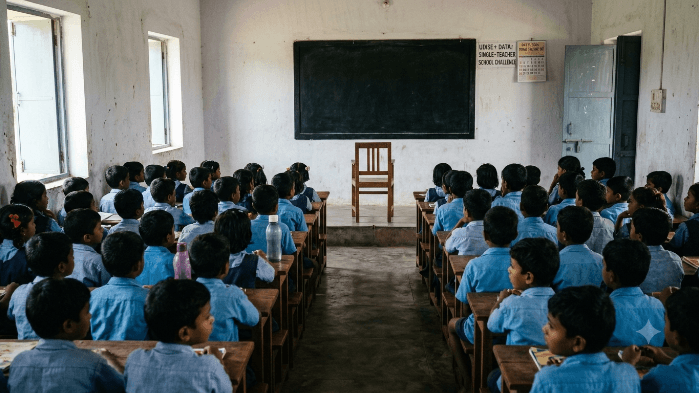
The empty chair, the blank blackboard: Inside India’s classrooms
India's teaching workforce has expanded across schools and universities, but staffing disparities, vacant faculty positions and uneven teacher distribution continue to challenge access to quality education nationwide.
Written by: Pragya KumariUpdated:
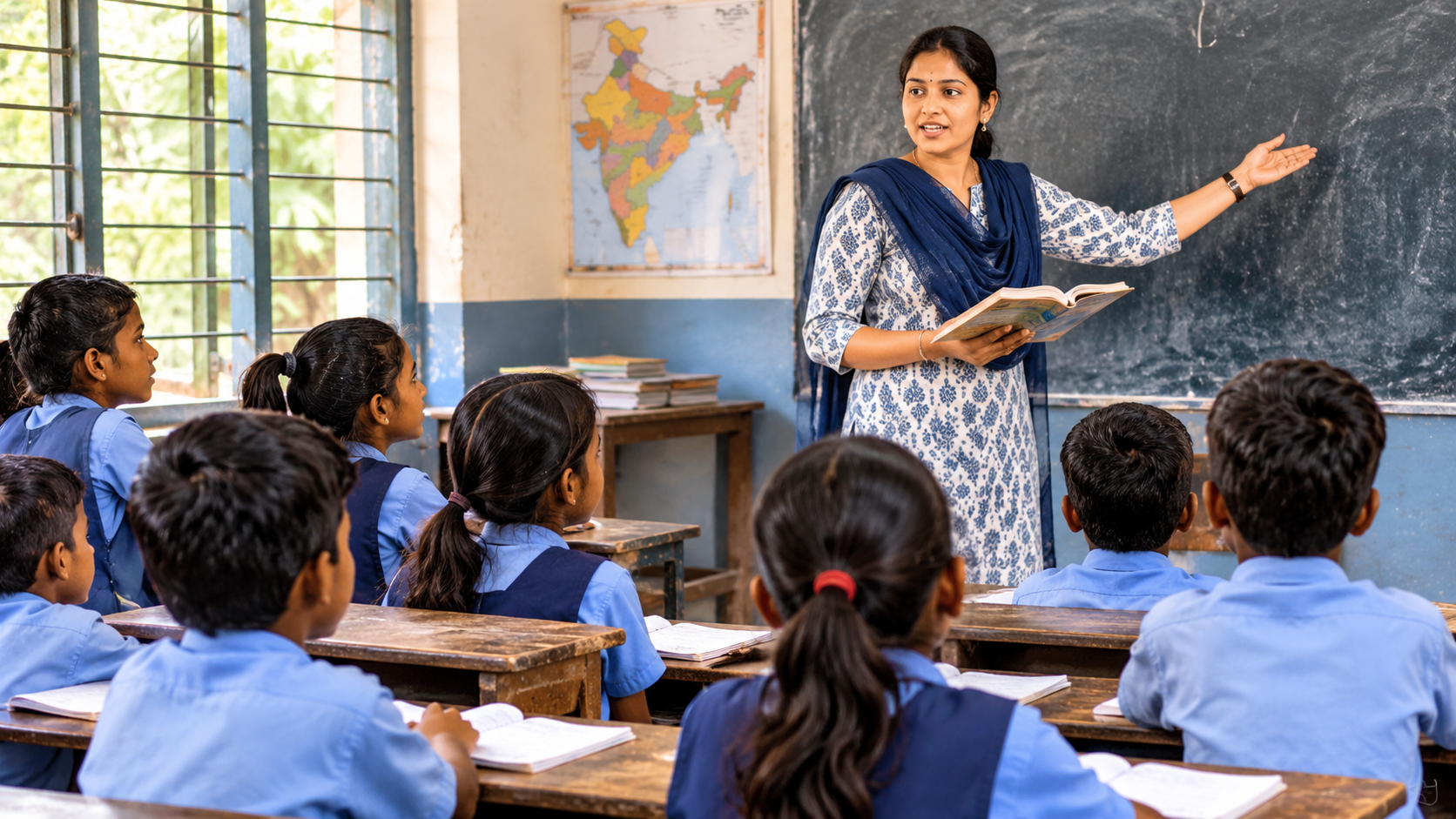
India’s teaching workforce has grown across school and higher education over the past decade, but the expansion has not translated into uniform access to teachers. Differences in pupil-teacher ratios, thousands of single-teacher schools and vacancies in higher education institutions continue to shape the country’s education landscape.
The latest data from the Unified District Information System for Education Plus (UDISE+) and an SBI Research report based on the All India Survey on Higher Education (AISHE) reveal a system that has expanded considerably but continues to face challenges in distributing educators where they are needed most.
World Teachers’ Day, observed on October 5, 2026, brought renewed attention to the people at the center of education systems worldwide. India’s figures offer a useful starting point for examining the scale of its teaching workforce, the disparities within it and the conditions that determine how effectively teachers can support students.
India’s school teaching workforce exceeds 10.27 million
India had 10,273,020 school teachers across 1,466,682 schools in the 2025-26 academic year, serving 247,219,766 students, according to UDISE+ data. The national pupil-teacher ratio (PTR) stood at 24, with schools averaging approximately seven teachers each.
The size of the workforce, however, varies substantially across states. Uttar Pradesh employed the largest number of school teachers at 1,642,764, followed by Rajasthan with 793,158, Maharashtra with 750,272 and Bihar with 728,945. Chandigarh had the smallest total among the states and union territories listed, at 10,477 teachers.
Large teacher counts do not necessarily indicate that every school has adequate staffing. Bihar, Uttar Pradesh and West Bengal generally average between six and eight teachers per school, while Chandigarh averages 50 and Delhi 29.
These differences reflect the varying scale of school systems, enrollment patterns and institutional structures across the country. They also demonstrate why national workforce totals alone cannot establish whether students have adequate access to teachers at their individual schools.
Bihar illustrates the pressure on school staffing
Bihar had 95,285 schools, 20,696,191 students and 728,945 teachers. Its pupil-teacher ratio was 28, above the national figure of 24. The average school served 217 students and employed eight teachers.
The state also had 2,006 single-teacher schools serving 162,393 students. In such institutions, one educator may have to manage several grades, making classroom organization and individual attention more difficult.
The problem extends beyond Bihar. Across India, 100,843 schools operated with only one teacher. Uttar Pradesh had the largest number of these schools at 7,874, followed by Rajasthan with 7,200 and West Bengal with 6,769.
At the other end of the staffing imbalance, 20,667 teachers were deployed in schools with zero student enrollment. West Bengal accounted for 19,502 of these teachers.
Taken together, these figures point to a challenge that cannot be addressed simply by increasing recruitment. Teacher deployment, enrollment changes and school-level staffing requirements also need attention to ensure that available personnel are aligned with student needs.
How teachers are distributed across school levels
The composition of India’s school teaching workforce varies according to the classes teachers serve. In 2025-26, higher secondary teachers accounted for the largest share at 33.2%, followed by upper primary teachers at 28%, primary teachers at 23% and secondary teachers at 15.9%.
State-level patterns differ considerably. West Bengal had the highest proportion of teachers in the primary category, at 51.2%, while Gujarat recorded the largest share at the upper primary level, with 54.1% of its teachers working in that category.
Goa had the highest concentration of secondary teachers at 51.3%. Chandigarh recorded the largest proportion of higher secondary teachers, at 66.9%.
The distribution also reflects the fact that some educators teach across multiple stages rather than working exclusively at one level. Nationally, 2% of teachers taught only pre-primary classes, while 4% taught both pre-primary and primary classes.
Teachers working exclusively at the primary level accounted for 35%, while 12% taught both primary and upper primary classes. Another 16% taught only upper primary, and 8% covered both upper primary and secondary levels.
Secondary-only teachers represented 11% of the workforce. Those teaching both secondary and higher secondary classes accounted for 5%, while 7% taught only higher secondary classes.
These patterns matter because staffing requirements differ across stages of education. Schools need to balance teacher availability with subject specialization, the number of grades served and the learning needs of students at different levels.
Social composition and school management
UDISE+ data also provide a picture of the social composition of the teaching workforce. General-category teachers accounted for 40%, while OBC teachers represented 39%. Scheduled Caste (SC) teachers made up 13% and Scheduled Tribe (ST) teachers accounted for 8%.
School management is another important dimension of teacher distribution. Government schools employed 50% of teachers, while private schools accounted for 40%. Government-aided institutions employed 7.4%, and other management categories represented 2.6%.
State Government schools alone employed 5,062,773 teachers. Across the broader government category, including central government systems, the workforce numbered 5,134,623.
This included 50,315 teachers in Kendriya Vidyalayas, 15,774 in Jawahar Navodaya Vidyalayas and 5,761 in other Central Government schools.
Government-aided institutions employed 760,462 teachers, while private unaided recognized schools employed more than four million. Other schools accounted for 270,703 teachers.
The private recognized category also includes specialized institutions such as the IAF E&C Society, with 2,149 teachers, and the Navy Education Society, with 1,110 teachers.
Why the pupil-teacher ratio matters
The pupil-teacher ratio is one of the indicators used to assess whether schools have sufficient teaching staff relative to enrollment. A lower ratio can give educators more opportunities to monitor individual progress, identify learning difficulties and engage students in classroom activities.
The Right to Education framework and the National Education Policy (NEP) 2020 emphasize appropriate teacher availability. NEP 2020 recommends a PTR of 30:1 at all levels of school education to support interactive learning and improve educational outcomes.
India’s overall school PTR of 24 appears favorable against that benchmark. However, the national average conceals substantial differences among states, school levels and individual institutions. Some states continue to experience higher ratios, particularly at the higher secondary level.
The number of students served by each school also varies considerably. Chandigarh and Delhi have among the highest student counts per school, alongside PTR levels within Right to Education norms. This suggests comparatively high utilization of school infrastructure.
Ladakh, Mizoram, Himachal Pradesh, Sikkim and Meghalaya, by contrast, have substantially fewer students per school. In such areas, the challenge may involve making effective use of school infrastructure and deploying teachers appropriately across smaller or geographically dispersed student populations.
The distinction is important. A school with too few teachers may struggle to meet students’ needs, while a school with very low enrollment may require a different approach to staffing and infrastructure planning.
How India compares with other education systems
International comparisons provide another perspective on teacher availability, although the figures must be interpreted carefully because countries classify their education systems differently.
The latest internationally comparable OECD data report 27 students per teaching staff member in India at the primary level, compared with an OECD average of 14. At the lower-secondary level, India’s ratio is 19, against an OECD average of 13. At the upper-secondary level, the respective figures are 21 and 13.
Among major economies, the primary-level ratio stands at 21 in the United States, 25 in the United Kingdom, 18 in France, 15 in Germany and 15 in Spain. India’s reported figure is higher than those of most of these countries.
At lower secondary, the ratios are 14 in the United Kingdom, 15 in the United States, 12 in France, 13 in Germany and 11 in Spain. At upper secondary, they are 14 in the UK, 16 in the US, 13 in France, 13 in Germany and 11 in Spain.
Other English-speaking systems show a varied picture. The United States reports ratios of 21 at primary, 16 at lower secondary and 20 at upper secondary. The UK reports 25, 25 and 33, respectively.
Australia records 14 at primary level, although the cited OECD table does not provide figures for its secondary levels. Canada reports 16 at primary and 13 at upper secondary, with lower-secondary data unavailable. Ireland records 13 at primary and 14 at upper secondary, while New Zealand reports 16, 13 and 14 across the three levels.
The OECD average primary-level student-to-teaching-staff ratio declined from 15 in 2015 to 14 in 2024.
These comparisons should not be directly substituted for India’s domestic UDISE+ figures. The datasets use different classifications and methodologies, which affect the reported ratios.
For 2024-25, UDISE+ recorded India's PTR at 20 in primary education, 17 in upper primary, 15 in secondary and 23 in higher secondary. The OECD dataset, using its own internationally standardized classification, reported ratios of 27 in primary, 19 in lower secondary and 21 in upper secondary education for 2024.
The figures therefore describe the system through different statistical frameworks. Understanding those differences is essential before drawing conclusions about India's performance relative to other countries.
Higher education teaching workforce grows by 27%
The expansion of India’s teaching workforce is also evident in higher education. According to an SBI Research report based on AISHE data, the number of teachers in universities and colleges rose from 1,367,535 in 2013-14 to 1,732,294 in 2023-24.
The increase of nearly 365,000 teachers represents growth of approximately 27% over the decade. This expansion accompanied a wider increase in higher education infrastructure, including universities, colleges and standalone institutions.
In 2023-24, India had 1,289 universities, 48,246 colleges and 15,221 standalone institutions. Together, these brought the total number of higher education institutions to 64,756.
The composition of the teaching workforce also changed during the period. Women accounted for 39% of higher education teachers in 2013-14, a share that increased to 45% in 2023-24.
Representation of teachers from reserved social categories rose as well. The proportion of SC teachers increased from 6.9% to 10%, while the share of ST teachers grew from 2% to 3%. OBC representation increased from 23.5% to 32%.
These changes show that the growth of higher education teaching has involved both an increase in overall numbers and shifts in workforce composition. However, aggregate growth does not establish whether institutions have sufficient staff in every subject, department or academic rank.
Higher education PTR ranges from 14 to 57 across states
SBI Research puts India's higher education pupil-teacher ratio at 23 for 2023-24 when universities and colleges operating in regular mode are considered together.
The report describes the national figure as broadly comparable with international levels, noting that ratios of approximately 25:1 to 30:1 are often found in leading institutions in the United States and Europe, depending on the program of study.
The state-level figures reveal a much wider variation. Tamil Nadu, Kerala and Goa have higher education PTRs of around 14, while Bihar records 57. Jharkhand has a ratio of 48 and Uttar Pradesh 33.
The Parliamentary Standing Committee on Education has cited 15:1 as an ideal pupil-teacher ratio for higher education. Against this benchmark, the differences between states raise questions about how effectively teaching capacity is distributed across institutions.
A national ratio of 23 does not necessarily indicate that every university or college operates at a comparable level. Institutional size, course structure, subject requirements and faculty availability can all influence the experience of students.
These higher education figures must also be distinguished from the OECD comparisons of school education. SBI Research examines universities and colleges, whereas the OECD figures discussed earlier cover primary, lower-secondary and upper-secondary education.
Vacancies persist in centrally funded institutions
Despite the increase in higher education teacher numbers, staffing shortages remain a concern in centrally funded institutions.
SBI Research, citing parliamentary data, reports that 14,042 of 41,351 sanctioned teaching posts across central universities and centrally funded institutions were vacant. This represents a vacancy rate of approximately 34%.
The situation varies across institution types. Central universities had a vacancy rate of 33%, while IITs reported 39% of teaching posts vacant. The figure stood at 54% in IIITs, 29% in NITs and 31% in IIMs. IISERs had a comparatively lower vacancy rate of 7%.
Vacancies were particularly high at the professor level, where 56.2% of sanctioned positions were unfilled.
These shortages have implications beyond the number of faculty members listed in institutional records. Faculty availability can affect teaching responsibilities, academic supervision, research guidance and the ability of institutions to maintain their planned academic activities.
The data present a contrast between workforce expansion and institutional staffing requirements. India has added hundreds of thousands of higher education teachers over a decade, but a substantial proportion of sanctioned positions in centrally funded institutions remains vacant.

The global teacher shortage extends beyond India
India's staffing challenges form part of a broader international concern. UNESCO estimates that the world will need 44 million additional primary and secondary teachers by 2030 to achieve universal basic education.
Sub-Saharan Africa accounts for approximately 15 million of the projected requirement. Southern Asia, which includes India, faces an estimated gap of 7.8 million teachers.
The problem is not confined to developing regions. Countries across Europe and North America also face difficulties recruiting and retaining educators.
UNESCO has identified heavy workloads, modest pay and insufficient professional recognition among the factors affecting the attractiveness and long-term sustainability of teaching.
The challenge therefore extends beyond increasing the number of people entering the profession. Education systems must also train teachers, place them where they are needed and create conditions that encourage them to remain in the profession.
Professional development, appropriate remuneration, manageable workloads and institutional support all influence whether teachers can sustain their work over time.
The 2026 theme focuses on protecting the teaching profession
UNESCO announced the 2026 World Teachers’ Day theme as “Standing with teachers: 60 years of protecting the profession, advancing its status and shaping our futures.”
The theme places the emphasis on more than public recognition. It highlights the professional, financial and institutional support required to help educators perform their roles effectively.
Teaching has changed considerably since the 1966 recommendation was adopted. Digital technologies, changing student needs, climate change, inclusion, migration and displacement have introduced new demands for education systems.
The 2026 observance also coincides with UNESCO's review of the recommendation after six decades. The review examines issues including professional autonomy, teachers' participation in policymaking, salaries, workloads and working environments.
These questions reflect the changing responsibilities of educators. Teachers are increasingly expected to integrate technology into learning, respond to diverse student needs and address wider social and environmental challenges alongside their classroom duties.
The review also draws attention to the relationship between teachers' professional status and the effectiveness of education systems. Recruitment alone cannot resolve shortages if working conditions make it difficult to retain experienced educators.
Beyond teacher numbers: the need for better distribution and support
India's latest school and higher education data reveal two parallel developments. The country has built a teaching workforce of more than 10.27 million in school education and increased its higher education teacher strength by nearly 365,000 over a decade.
Yet these gains coexist with substantial disparities. India's school PTR stands at 24 nationally, compared with 28 in Bihar. Uttar Pradesh has the country's largest school-teaching workforce but also 7,874 single-teacher schools. West Bengal accounts for 19,502 teachers deployed in schools with no enrolled students, while more than 100,000 schools nationwide operate with only one teacher.
Higher education presents a similar contrast. The national PTR of 23 conceals ratios of 57 in Bihar and 48 in Jharkhand. Meanwhile, approximately one-third of sanctioned teaching posts across central universities and centrally funded institutions remain vacant, and professor-level vacancies exceed half of sanctioned positions.
These figures underline the limits of measuring educational capacity through national headcounts alone. A growing workforce does not automatically guarantee that teachers are available in the right locations, that institutions have sufficient faculty in specialized subjects or that students receive adequate individual attention.
The policy challenge is to align recruitment with local requirements, improve teacher deployment, address institutional vacancies and strengthen the conditions that support professional retention. School infrastructure must also be planned around enrollment patterns, particularly in regions with small or geographically dispersed student populations.
The global teacher shortage reinforces the importance of this approach. UNESCO's projection of a 44-million-teacher requirement by 2030 shows that expanding access to education will depend on both workforce growth and the long-term sustainability of the profession.
Six decades after the adoption of the ILO-UNESCO recommendation, the central question remains whether education systems can provide teachers with the resources, recognition, working conditions and institutional support they need. For India, the next stage of progress will depend not only on adding more educators but also on ensuring that existing and future teachers can reach students effectively and sustain meaningful learning.