


The technological singularity may transform human intelligence, but Sanatan philosophy offers a deeper perspective on consciousness, wisdom, and the unity that connects all existence.
Few ideas have captured the technological imagination as powerfully as the prospect of the Singularity.
In contemporary discussions of artificial intelligence, the term usually points to a hypothetical future threshold: a time when machine intelligence, computation, and related technologies advance so rapidly that human civilization enters a condition fundamentally different from what came before.

The idea is usually presented as a technological destination. But perhaps there is another way to look at it. What if Singularity also reflects a much older human search—the search for unity beneath the apparent diversity of existence?
Long before artificial intelligence, supercomputers, or theories of technological acceleration, Sanatan philosophy contemplated a profound question:
Is the universe fundamentally many—or fundamentally One?
The Vedantic answer points toward Brahman.
Brahman should not be confused with Brahmā, the creator deity of the Sanatan sacred tradition. Brahman, particularly in the Upanishadic and Vedantic traditions, refers to ultimate reality—the foundational reality within and beyond the multiplicity of existence.
The distinction matters because the philosophical idea of Brahman is not simply about a divine being among other beings. It concerns the deepest nature of reality itself. The ancient proposition is extraordinary in its simplicity:
Behind multiplicity may lie unity.
The Ancient Search for the One
The Rig Veda expresses this insight in the celebrated phrase Ekam sat viprā bahudhā vadanti—Reality is One, though the wise describe it in many ways.
The Chāndogya Upanishad goes further: Sarvam khalvidam Brahma—All this is Brahman.
These statements emerged in a world vastly different from ours. Yet the philosophical question they raise remains remarkably contemporary.
We experience reality through distinctions.
We see individuals, species, nations, religions, cultures, objects, ideas, and civilizations. We distinguish mind from matter, humanity from nature, self from other, and one community from another.
Such distinctions are necessary for everyday life. But are they ultimately fundamental? Sanatan philosophical thought asks us to consider whether multiplicity represents the final nature of reality, or whether it exists within a deeper unity.
Seen from this perspective, the modern fascination with Singularity becomes especially interesting. Perhaps humanity's movement toward greater integration is not merely technological.
Perhaps it also reflects a recurring civilizational impulse to discover relationships where we previously perceived separation.
A Civilization Becoming Connected
Modern civilization is already experiencing extraordinary forms of convergence.
Knowledge that once remained isolated within particular cultures, universities, libraries, laboratories, or professional disciplines can now move across the world almost instantly.
Artificial intelligence is beginning to bring together vast bodies of information that no single human mind could absorb.
Fields that once appeared separate increasingly overlap. Biology intersects with computation. Neuroscience meets philosophy. Physics encounters questions about information. Medicine becomes intertwined with data science. Ecology reveals relationships among organisms, environments, and planetary systems.
Human societies themselves are becoming more interconnected and interdependent.
That does not mean humanity has reached philosophical unity.
Far from it.
But it does raise an interesting question: Is technological convergence revealing something deeper about the interconnected character of reality?
This is where the comparison between technological Singularity and Brahman becomes useful, but only if we also recognize their fundamental difference.
Singularity as Destination; Brahman as Reality
The technological Singularity is usually imagined as a future event. Humanity moves toward it. At some point, according to this vision, machine intelligence may equal or exceed human intelligence, technological development may accelerate dramatically, and civilization may cross a threshold from which there is no simple return.
Brahman represents a very different proposition. In Advaita Vedanta, Brahman is not something humanity creates, reaches, or discovers at the end of technological progress. It is already the foundational reality. The famous Upanishadic statement Tat Tvam Asi—“That Thou Art” expresses the radical nature of this claim.
The individual does not simply journey toward ultimate reality as though traveling toward a distant destination. Rather, realization consists in recognizing that the deepest separation was never absolute.
That changes the question completely. Instead of asking only, “Where is technological progress taking us?” We may also ask: “What are we becoming capable of recognizing?”
Intelligence Is Not the Same as Wisdom
Modern civilization often defines progress quantitatively. More computing power. More information. More automation. More productivity. More technological capacity. More control over the physical world.
The technological Singularity is, in one sense, the ultimate expression of this trajectory: intelligence amplified to a scale far beyond ordinary human capability. But greater intelligence does not necessarily produce greater wisdom.
An artificial intelligence system may one day process information millions of times faster than a human mind. It may solve scientific problems that presently appear impossible. It may discover medicines, design machines, analyze entire libraries, or develop technologies beyond our present imagination. Yet none of these capabilities automatically answers the oldest questions of human existence.
Who are we?
What is consciousness?
What makes life meaningful?
What responsibilities do human beings have toward one another?
What is our relationship with other living beings and with nature?
What does knowledge ultimately serve?
And what is the relationship between the individual and the totality of existence?
Technological sophistication alone cannot settle these questions. They are questions of philosophy, ethics, consciousness, and civilization.
From Intelligence to Realization
This is where the Sanatan philosophical perspective may add something important to contemporary discussions of Singularity. If technological Singularity concerns the expansion of intelligence, a deeper philosophical Singularity might concern the expansion of understanding.
One could describe that movement symbolically as:
The One → the Many → Consciousness → Knowledge → Recognition of the One
Or, in Vedantic language:
Brahman → Multiplicity → Human Experience → Knowledge → Realization
For the purpose of this discussion, we might call that realization Brahmatva—the recognition of Brahman, or of the deeper unity underlying existence.
This is not a scientific formula. Nor should it be treated as one. It is a philosophical framework for thinking about the trajectory of human understanding. Interestingly, many developments in modern knowledge reveal patterns of increasing interconnectedness.
Physics seeks common explanations for phenomena once considered unrelated. Biology shows that the diversity of life emerged through shared evolutionary ancestry. Ecology demonstrates that living organisms exist within intricate systems of dependence. Cosmology traces the observable universe toward a common early history. Information technology increasingly connects individuals and societies into planetary networks.
None of this proves the metaphysical claims of Vedanta. Science and metaphysics are not interchangeable. But the philosophical resonance remains striking. Again and again, deeper inquiry reveals relationships beneath apparent separations.
The Real Risk of the Coming Age
There is another reason this distinction matters. Humanity may be approaching an age of extraordinary technological power without comparable development in moral maturity.
That combination should concern us.
If advanced artificial intelligence emerges within civilizations still dominated by greed, fear, hatred, domination, tribalism, and violence, superior intelligence will not automatically create a superior civilization.
It may simply give old human weaknesses more powerful instruments. The central challenge of the technological age may therefore not be merely whether machines become more intelligent than human beings.
It may be whether human wisdom develops fast enough to govern the capabilities we create.
Sanatan thought offers a profoundly different measure of advancement. The highest achievement of intelligence may not be domination. It may be understanding.
The highest achievement of knowledge may not be control. It may be realization.
And the most consequential Singularity may therefore not arrive when a machine surpasses human intelligence. It may arrive when human consciousness begins to recognize more fully the unity beneath apparent separation.
We emerge into multiplicity. We learn through distinction. We build knowledge through specialization. And, perhaps, through that very knowledge, we gradually rediscover interconnectedness.
If so, humanity may not simply be moving toward Singularity. We may, in another sense, be rediscovering an idea that Sanatan wisdom contemplated thousands of years ago:
Behind the many stands the One.
And in the language of Vedanta, that One is Brahman.
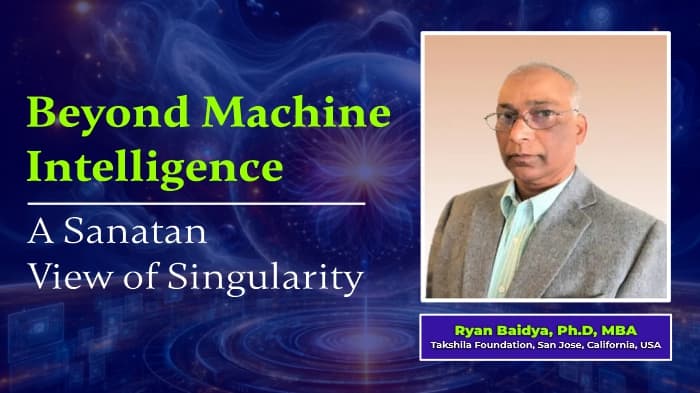
(This article is written by Ryan Baidya, Ph.D., MBA, Takshila Foundation, San Jose, California, USA. This is an opinionated article; EPN has nothing to do with this editorial.)

Connecting Talent and Industry Will Define India’s Next Decade

UGC seeks governors’ intervention as 82 Tamil Nadu institutions face 150 fee-refund complaints

Engineering Must Build Foundations, Not Chase Every Trend: Dr. Arya Kumar Bhattacharya
Beyond Machine Intelligence: A Sanatan view of Singularity

Seven days to reopen Hormuz? Iran puts the ball in Trump's court as US standoff deepens
UGC seeks governors’ intervention as 82 Tamil Nadu institutions face 150 fee-refund complaints
Engineering Must Build Foundations, Not Chase Every Trend: Dr. Arya Kumar Bhattacharya

France protests escalate as Macron rejects minister’s resignation, students block Louvre

France protests turn violent as Paris reports 855 arrests, fresh clashes erupt

A whale’s death inspired him at four, now 11-year-old is set for Earth Medal

Connecting Talent and Industry Will Define India’s Next Decade
UGC seeks governors’ intervention as 82 Tamil Nadu institutions face 150 fee-refund complaints
Engineering Must Build Foundations, Not Chase Every Trend: Dr. Arya Kumar Bhattacharya
Beyond Machine Intelligence: A Sanatan view of Singularity
Seven days to reopen Hormuz? Iran puts the ball in Trump's court as US standoff deepens
UGC seeks governors’ intervention as 82 Tamil Nadu institutions face 150 fee-refund complaints
Engineering Must Build Foundations, Not Chase Every Trend: Dr. Arya Kumar Bhattacharya
France protests escalate as Macron rejects minister’s resignation, students block Louvre
France protests turn violent as Paris reports 855 arrests, fresh clashes erupt
A whale’s death inspired him at four, now 11-year-old is set for Earth Medal
Copyright© educationpost.in 2026 All Rights Reserved.