


Newcastle University’s decision to confer a Professorship of Practice in Sustainability on Anant Ambani may be defensible on professional experience, but it also raises uncomfortable questions about expertise, corporate influence and what universities expect students to learn about sustainability.
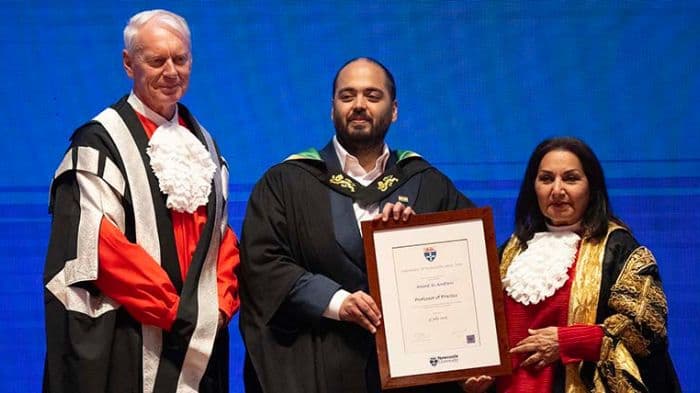
Newcastle University’s decision to confer a Professorship of Practice in Sustainability on Anant Ambani is likely to generate debate not simply because of the individual involved, but because of what the appointment says about the relationship between wealth, corporate influence, practical experience and academic credibility.
The university announced the appointment on Sep 14, describing Ambani as an international sustainability and clean-energy leader and citing his work in conservation, biodiversity protection, animal welfare and environmental stewardship. His association with Vantara, the wildlife conservation and rescue initiative in Jamnagar, as well as his role in Reliance’s clean-energy transition, form the institutional basis for the honour.

There is nothing inherently unusual about universities recognising practitioners. A Professorship of Practice is, by design, intended to bring professional experience and applied knowledge into an academic environment.
Sustainability is also no longer a narrowly academic subject. It intersects with energy, business, technology, conservation, public policy and finance, making engagement with industry an important part of the conversation.
The central issue is what kind of authority the university believes Ambani brings to that discussion.
Ambani’s work through Vantara gives him an identifiable connection to conservation and animal welfare. Newcastle has chosen to foreground precisely those areas in explaining the appointment. His involvement in Reliance’s transition towards renewable and clean energy provides another dimension to the university’s rationale.
But sustainability is not simply the accumulation of large-scale environmental projects. It is a field built on scientific research, ecological understanding, public policy, resource management and difficult questions about how economic systems affect the environment.
A university that confers an academic title in the field is also making a statement about what it considers meaningful sustainability expertise.
Anant Ambani, son of business tycoon Mukesh Ambani, is closely associated with Reliance Industries, a conglomerate with deep roots in oil, refining and petrochemicals that has in recent years invested heavily in renewable energy and other areas of the energy transition.
Reliance’s stated transition towards solar manufacturing, green hydrogen, circular materials, carbon capture, clean fuels and other new-energy technologies gives Ambani a direct connection to one of the biggest challenges facing large industrial companies. Newcastle says he is a key force behind the group’s transition towards a new energy future and its ambition to become a net-zero enterprise by 2035.
But corporate sustainability is itself a subject that demands scrutiny. The shift from fossil fuels to cleaner energy involves questions about scale, investment, technology, resource consumption and whether companies can fundamentally change their environmental footprint while continuing to pursue rapid economic growth.
That is a potentially valuable case study for students. It is also a complicated one.
The same applies to Vantara.
The wildlife initiative has become an important part of Ambani’s public association with conservation. According to media reports, the facility houses more than 150,000 animals and has attracted scrutiny from conservation organisations over the sourcing of some animals, particularly endangered species.
The Supreme Court’s examination of the matter found no merit in allegations of animal smuggling or laundering after considering the statutory approvals and permits involved.
The scale of Vantara is undoubtedly significant. But conservation is a field that extends far beyond the size of a wildlife facility. It encompasses ecology, biodiversity research, species protection, habitat management, animal welfare and environmental policy.
There is another development that makes the academic dimension of Ambani’s growing involvement in this field worth watching. In April, he launched Vantara University, which is being promoted as a university dedicated to wildlife conservation and veterinary science.
Taken together with the Newcastle appointment, it marks a substantial expansion of Ambani’s presence in the education and knowledge space around conservation.
That expansion is part of what has unsettled some academics.
The Guardian reported criticism from environmental historian Ramachandra Guha, who questioned why Newcastle had chosen Ambani when, in his view, numerous scientists, conservationists and environmental practitioners could have been considered. Newcastle staff also raised objections to the appointment.
The criticism is about what universities signal when they confer academic authority on people whose prominence comes primarily from business, family wealth and large-scale private initiatives.
Universities benefit from people who have worked outside traditional academic structures. A practitioner who has actually dealt with energy systems, conservation projects, infrastructure, investment or environmental regulation can offer students perspectives that textbooks cannot.
But practical experience should not become a substitute for expertise. Nor should visibility, wealth or institutional access be confused with intellectual authority.
That concern becomes sharper when the institution itself is facing questions about corporate influence. Newcastle University academics and environmental campaigners warned that the growing role of billionaire and corporate money could influence academia.
Universities increasingly operate within an ecosystem of corporate partnerships, philanthropy, industry collaborations and private funding. Such relationships can provide resources and real-world opportunities, but they also require clear boundaries.
Academic institutions derive their credibility from being able to question powerful institutions, including the companies and individuals with whom they collaborate.
The appointment also raises a question about the distinction between recognition and teaching authority.
What matters now is what students will actually gain from his presence.
If Ambani’s role involves helping students understand how sustainability operates at the intersection of business, conservation and energy, there is a legitimate educational proposition here.
If the professorship functions primarily as an honorary platform attached to his public profile, it becomes harder to see what students gain academically from the title.
His 2024 wedding and pre-wedding celebrations, which included events at Vantara and attracted global attention, have also become part of the public discussion around his sustainability credentials. The contrast between extraordinary consumption and environmental responsibility is difficult to ignore when assessing how sustainability is presented to the public.
Sustainability is, after all, fundamentally concerned with how societies consume resources and balance economic activity with environmental limits.
Ambani’s appointment could prove valuable if it creates a serious forum for examining the contradictions within modern sustainability, the transition from fossil fuels to cleaner energy, the role of private capital in conservation, the economics of environmental protection and the limits of corporate-led solutions.
But that requires more than a title.
It requires a willingness to engage with the difficult questions surrounding the very projects and industries that have made Ambani a prominent figure in the sustainability conversation.
If that happens, students may get something genuinely useful from the appointment: not a polished account of corporate sustainability, but an opportunity to examine how sustainability works when environmental ambitions meet money, industry and power.
That is ultimately the standard by which this professorship should be judged.

UAE flags 88 education advertising violations in AI-led review of 3,970 adverts
.jpg&w=256&q=75)
Who will shape India’s 6G future? C-DOT and IIT BHU join forces on next-gen networks

UP Board Sets October 26 Deadline for 940 Schools to Submit Classes 9–12 Student Lists

Dundee University calls off strike as compulsory redundancies are paused

Telangana SSC Exams 2027: Fee Payment Dates Announced, Check Late Fees and Deadlines
.webp&w=256&q=75)
Abu Dhabi aims to bring 2,000 Emirati teachers into private schools within five years
.jpg&w=256&q=75)
Australian schools record thousands of student sexual misconduct reports as child safety concerns grow
.jpg&w=256&q=75)
Egypt insists international schools include Arabic, history in final scores

China’s Chery unveils AI companion robot designed to ease loneliness
.jpg&w=256&q=75)
New Zealand reforms could leave more students without school qualifications

UAE flags 88 education advertising violations in AI-led review of 3,970 adverts
Who will shape India’s 6G future? C-DOT and IIT BHU join forces on next-gen networks
UP Board Sets October 26 Deadline for 940 Schools to Submit Classes 9–12 Student Lists
Dundee University calls off strike as compulsory redundancies are paused
Telangana SSC Exams 2027: Fee Payment Dates Announced, Check Late Fees and Deadlines
Abu Dhabi aims to bring 2,000 Emirati teachers into private schools within five years
Australian schools record thousands of student sexual misconduct reports as child safety concerns grow
Egypt insists international schools include Arabic, history in final scores
China’s Chery unveils AI companion robot designed to ease loneliness
New Zealand reforms could leave more students without school qualifications
Copyright© educationpost.in 2026 All Rights Reserved.