The Missing 41: Inside rural India’s unfinished story of girls’ education
India has made remarkable strides in bringing girls into classrooms. But a new UNESCO report exposes a troubling divide: for every 100 boys in rural India who complete upper-secondary education, only 59 girls reach the same milestone. The challenge is no longer simply getting girls into school, it is ensuring they can stay, learn and finish
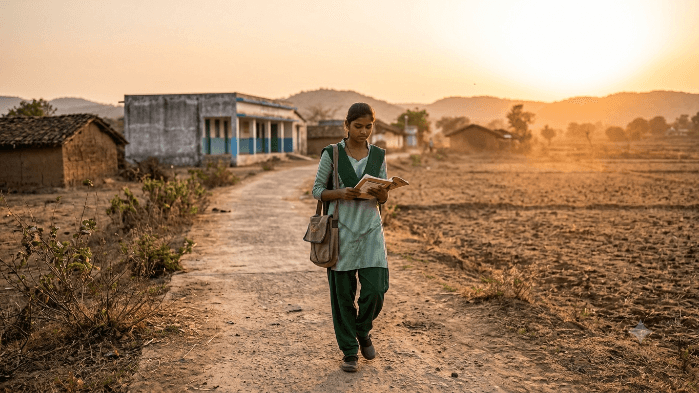
For millions of girls in India, education begins with a promise. A school uniform, a bag of books and the daily walk to class represent the possibility of a future beyond the limits imposed by poverty, geography and gender. Yet, for too many girls, that journey ends before school does.
A new UNESCO report, Gender Equity in Access to Education, accompanying the 2026 Global Education Monitoring (GEM) Report, has brought this unfinished story into sharp focus. Its central finding is stark, in rural India, only 59 girls complete upper-secondary education for every 100 boys who reach the same level. In urban India, the gender gap has closed, with girls and boys achieving parity in completion.
The contrast reveals a fundamental contradiction in India's education story. The country has made substantial progress in expanding access to schooling, but the benefits of that progress remain unevenly distributed. A girl growing up in a city may have a reasonable chance of completing school alongside her male peers; a girl in a rural community may face a very different set of choices and constraints.
India's adjusted gender parity index (GPI) for upper-secondary completion stands at 0.89 nationally, falls to 0.59 in rural areas and reaches 1.0 in urban areas. A GPI of 1 indicates equality between girls and boys. Put simply, the national figure represents approximately 89 girls completing upper-secondary education for every 100 boys, while the rural figure exposes a much deeper divide.
These are not merely statistics about school attendance. UNESCO's completion indicator measures the proportion of people aged three to five years above the official graduation age who have reached the final grade of an education level. It therefore captures whether students make it through a stage of education, not simply whether they enroll or attend classes.
That distinction matters. A child can enter school at the right age, attend for years and still fail to complete secondary education. For girls in rural India, the barriers that emerge during adolescence can turn an early educational opportunity into an unfinished journey.
India's progress should not be dismissed. The country has expanded schooling opportunities, invested in educational infrastructure and introduced programs intended to reduce the financial burden on families. UNESCO classifies India among countries making rapid progress towards gender parity, having closed more than 65% of the initial gender gap under its assessment.
The country was among the 47 nations with the largest disadvantages for girls in upper-secondary completion in 2000. Its subsequent improvement demonstrates that sustained policy action can change educational outcomes.
But progress at the national level can conceal serious inequalities within the country.
The Annual Status of Education Report (ASER) 2024 provides another perspective on the problem. Its rural household survey found that 8.1% of girls aged 15–16 were not enrolled in school, up slightly from 7.9% in 2022. Across boys and girls in the same age group, 7.9% were out of school in 2024, compared with 13.1% in 2018.
The broader picture is encouraging: non-enrollment among older children has fallen considerably over time. Yet the slight increase among adolescent girls between 2022 and 2024 is a reminder that gains are not always permanent.
State-level differences make the challenge even clearer. ASER 2024 reported that the proportion of girls aged 15–16 who were not enrolled stood at 16.1% in Madhya Pradesh, 15% in Uttar Pradesh and 12.7% in Rajasthan. The corresponding figures were 10.5% in Gujarat and 10% in Chhattisgarh.
These numbers measure non-enrollment, not upper-secondary completion, and should not be confused with UNESCO's parity figures. Together, however, they reveal how adolescent girls' educational opportunities vary across India's regions.
For policymakers, the implication is clear: a national average cannot serve as a complete measure of educational equality. The experience of a girl in a well-connected urban neighborhood differs considerably from that of a girl in a remote village, where a secondary school may be far away and household resources are limited.
When poverty becomes a gender barrier
The rural education gap is not caused by geography alone. It reflects the interaction of poverty, social expectations, household responsibilities and the availability of public services.
For low-income families, keeping a child in school involves costs that extend beyond tuition. Uniforms, textbooks, transport, examination fees and other expenses can make continued education difficult, even when schooling itself is officially free.
As children grow older, these costs become more consequential. Families may have to choose between paying for a daughter's continued education and meeting immediate household needs. Girls may also be expected to undertake domestic work, care for younger siblings or contribute to family livelihoods.
Such pressures do not affect every household equally. UNESCO's analysis across countries where girls face educational disadvantages found a median gender parity index of 0.66 among the poorest households, compared with 0.92 among the richest 20%.
The difference suggests that economic disadvantage can intensify gender inequality. A family with greater financial resources may be able to absorb transport costs, arrange safer travel or pay for additional academic support. A poorer household may have fewer alternatives when the nearest secondary school is distant or when a daughter's education competes with immediate responsibilities.
Social norms can reinforce these financial pressures. In some communities, girls face restrictions on mobility as they enter adolescence. Concerns about safety, family honor, and interaction with boys can influence decisions about whether daughters should continue studying, particularly when schools are far from home.
Early marriage can further interrupt education, while pregnancy and motherhood may make returning to school difficult. These are not isolated personal decisions; they are shaped by the economic and social environments in which families live.
The result is a pattern in which the opportunity to start school becomes more widespread, but the freedom to complete it remains unequal.
Infrastructure is not a minor detail
One of the most important lessons from India's experience is that educational access depends on practical conditions as much as on formal policy.
School sanitation is a case in point. A school may have classrooms and teachers, but inadequate toilets can make attendance difficult for adolescent girls, particularly during menstruation. Privacy, cleanliness and safety are essential elements of an environment in which students can attend regularly and learn with confidence.
ASER 2024 found that the proportion of rural schools with usable girls' toilets rose from 66.4% in 2018 to 68.4% in 2022 and 72% in 2024. The improvement is significant, but it also means that the survey still found nearly three in every ten rural schools without a usable girls' toilet.
The distinction between constructing a facility and ensuring that it remains functional is crucial. Toilets that lack water, are poorly maintained or cannot be used safely do not fully address the problem.
Research cited in UNESCO's report also points to the positive effects of India's national latrine-construction initiative on adolescent girls' enrollment, particularly in schools with separate toilets for boys and girls.
School meals offer another example of how seemingly straightforward interventions can have wider consequences. Free lunches can ease household food expenses, support children's nutrition and provide families with an additional reason to keep children in school. Evidence cited by UNESCO suggests that free school lunches had nearly twice the effect on primary-school enrollment for girls as for boys in disadvantaged rural communities.
The lesson is that girls' education cannot be separated from the conditions in which education is delivered. A school is not accessible in any meaningful sense if a student cannot afford to reach it, use its facilities or attend regularly.
Beyond enrollment: the importance of staying in school
India's education debate often focuses on getting children into classrooms. That remains essential, but the UNESCO findings suggest that the next phase must concentrate more sharply on retention and completion.
The challenge becomes particularly urgent as girls transition from primary to secondary and then upper-secondary education. At each stage, the demands of schooling increase. Students must travel farther in some areas, manage more complex subjects and prepare for examinations that can determine access to higher education and employment.
For girls from disadvantaged households, these years may coincide with growing domestic responsibilities or pressure to marry. Even a temporary interruption can make returning to school difficult.
UNESCO's regional figures underline the scale of the wider challenge. In Central and Southern Asia, which includes India, upper-secondary completion in 2024 stood at 57% for girls and 60% for boys. Across the region, girls' primary completion rose from 42% in 2000 to 90% in 2024. Lower-secondary completion increased from 30% to 83%, while upper-secondary completion climbed from 12% to 57%.
These gains represent a profound expansion of educational opportunity over roughly a quarter-century. Yet the remaining gap at the upper-secondary level illustrates why progress through one stage cannot be taken as evidence that the next is secure.
Globally, 63% of girls and 60% of boys completed upper-secondary education in 2024, according to UNESCO. India's rural figures demonstrate why global and national averages need to be examined alongside the experiences of specific populations.
A country can move towards parity overall while some communities continue to leave girls behind.
What India can learn from its neighbors
India is not alone in confronting the gap between school access and completion. Experiences from neighboring countries show that sustained public investment, targeted financial support and reforms that address social barriers can produce lasting improvements.
Nepal offers an instructive example. In 1990, only 8% of girls completed lower-secondary education, compared with 41% of boys. By 2024, the completion rate had risen to 89% for both groups, bringing them to parity.
The transformation was supported by a combination of measures, including constitutional recognition of education as a right, free and compulsory basic education, targeted scholarships, free textbooks, expanded secondary schooling and improvements to school facilities. Examination reforms also helped students progress through the education system.
Bangladesh offers another relevant lesson through its girls' stipend programs, which have been associated with higher educational attainment and delayed marriage. Financial incentives can help families manage the costs of keeping daughters in school, particularly where poverty and social expectations otherwise encourage early withdrawal.
These examples do not suggest that India can simply replicate another country's model. Each education system operates within a different social, economic and institutional context. They do, however, demonstrate that gender disparities are not inevitable. When governments combine financial assistance, infrastructure, legal protections and sustained implementation, educational outcomes can change dramatically.
For India, the priority should be to identify which combinations of interventions work best in different settings, from remote villages and tribal communities to districts where adolescent non-enrolment remains high.
Why one policy cannot solve the problem
A scholarship may reduce the cost of education, but it cannot compensate for an unsafe journey to school. A new toilet may improve the school environment, but it cannot prevent early marriage if community expectations continue to push girls out of education. Free textbooks cannot solve the problem if a student is expected to spend her school hours caring for younger siblings.
UNESCO's report argues for coordinated policies that address these obstacles together. Such an approach could include affordable transport, reliable school meals, functional sanitation facilities, safe school environments, counselling services and flexible pathways for students who have interrupted their education.
Re-entry policies are particularly important for girls who leave school because of pregnancy or motherhood. Without childcare, flexible learning arrangements and protection from discrimination, the formal right to return to education may mean little in practice.
India's existing programs provide a foundation on which to build. The challenge is to ensure that support reaches the girls who need it, that facilities remain functional and that local education authorities can identify and respond to emerging dropout risks.
Better monitoring is equally important. Governments need to track not only enrollment but also attendance, transition between school levels, completion and the reasons students leave. Data should be disaggregated by sex, location, household wealth and other relevant indicators so that disadvantages are not concealed by national averages.
Schools and communities must also be part of the response. Teachers, parents, local organizations and school management committees can help identify students at risk of dropping out and challenge assumptions that a girl's education is less valuable than a boy's.
From gender parity to genuine equality
There is an important distinction between gender parity and gender equity. Parity measures whether girls and boys achieve similar numerical outcomes. Equity asks whether they have a fair opportunity to learn, participate and succeed.
A parity index can improve because girls' completion rates rise. But a ratio can also change if boys' outcomes deteriorate. Numerical equality, therefore, does not automatically indicate that an education system is improving for everyone.
Nor do completion figures capture the full quality of students' educational experiences. Girls may complete school but still face gender stereotypes in textbooks, limited encouragement to pursue science and technology, discriminatory classroom practices or unsafe environments.
For India, this means that the next stage of reform must look beyond the number of girls entering or completing school. It must also examine what they learn, whether they feel safe, what choices education makes possible and whether they can translate their qualifications into further study or meaningful employment.
The wider stakes are considerable. When girls leave school prematurely, the consequences extend beyond individual careers. Communities lose potential teachers, health professionals, entrepreneurs, and public leaders. Families lose opportunities to improve their economic security across generations. The country loses part of its human potential.
Keeping girls in school is therefore not simply a matter of social justice. It is also an investment in India's economic development, public health and democratic participation.
The unfinished journey
India's education story contains reasons for both optimism and concern. Rising completion rates, expanded infrastructure and targeted welfare programs demonstrate that long-standing barriers can be reduced. UNESCO's classification of India as a fast-progressing country acknowledges these gains.
Yet the figure of 59 girls for every 100 boys in rural upper-secondary completion demands attention. It represents a substantial gap between the promise of education and the reality experienced by many girls.
ASER 2024 reinforces the urgency of that challenge: although non-enrolment among older children has declined over the longer term, 8.1% of rural girls aged 15–16 remained outside school, with considerably higher proportions in some states.
The policy response must be as varied as the barriers themselves. Some girls need transport to a nearby secondary school. Others need financial assistance, functional sanitation, protection from early marriage or a realistic opportunity to return after leaving school. Many need several forms of support at once.
The ultimate measure of success will not be whether India can announce another improvement in its national gender parity index. It will be whether a girl's chances of completing school depend less on where she is born, how much her family earns or what her community expects of her.
For every 100 boys who complete upper-secondary education in rural India, 41 girls are missing from the equivalent count. Closing that gap will require more than getting girls through the school gate. It will require building an education system in which they can remain, progress and finish.
The next milestone in India's educational journey should be clear: not merely more girls in school, but more girls completing their education with the freedom and opportunity to decide what comes next.