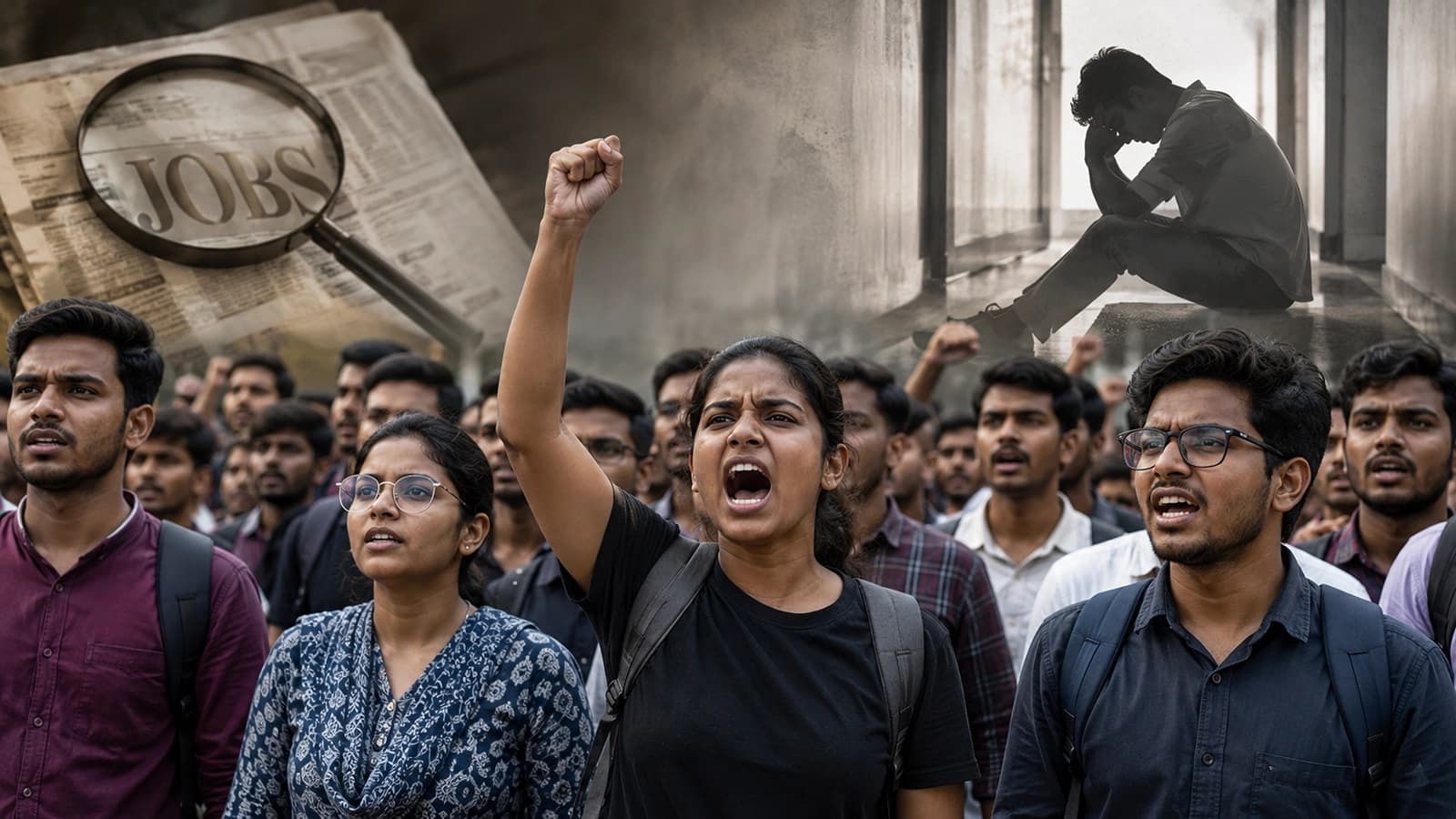
Every year, on August 12, the world pauses to celebrate its young people. Governments issue statements. Institutions organize programs. Universities hold seminars. Politicians speak of the energy of the next generation.
The language is almost universal: youth are the future; young people are the country's greatest strength; India's demographic dividend will drive the economy; innovation belongs to the young.

But there is an uncomfortable question beneath the celebration this International Youth Day:
Are young Indians actually being heard?
The question is not whether the government has programs for young people. It does. Nor is it correct to say that the state has done nothing for education, skilling, employment or entrepreneurship.
The more difficult question is whether the aspirations of India's young population are being translated into institutions that work for them.
And here, the picture is considerably less reassuring.
The United Nations has chosen “Different Contexts, Common Aspirations” as the theme for International Youth Day 2026. It recognizes that young people live in different economic, cultural and political circumstances but share fundamental aspirations — quality education, decent work, meaningful participation, dignity, security and the opportunity to build a better future.
India's young people are asking for precisely these things.
The difficulty is that the country's political vocabulary often speaks about youth more readily than it speaks with them.
A demographic dividend that is waiting for its dividend
For years, India's young population has been presented as an economic opportunity.
The argument is straightforward: a large working-age population can generate higher productivity, consumption, innovation and economic growth if it is adequately educated and employed.
But demographics do not create prosperity by themselves.
A young population without sufficient productive employment can become a source of frustration rather than a dividend.
That distinction is becoming increasingly important.
A recent report from the International Labor Organization (ILO) found that global youth unemployment rose to 12.4% in 2025, with 67 million young people unemployed. It also identified a much larger group — more than 257 million young people globally — who were neither employed nor in education or training. The ILO has warned that technological change, including artificial intelligence, could further reshape the employment prospects of young workers.
India's challenge must be understood within this global transformation, but it has its own particular features.
The country is producing millions of educated young people who are competing for a limited number of secure, well-paying jobs. At the same time, the nature of work is changing rapidly, leaving many young people uncertain about which skills will remain valuable five or 10 years from now.
The result is a generation caught between enormous ambition and considerable uncertainty.
The examination has become the economy
For a large section of India's youth, the gateway to a secure future has become an examination.
UPSC. SSC. Banking. Railways. State public service commissions. Teaching recruitment. Medical entrance examinations. Engineering entrance examinations.
The list is long.
The examination system itself is not the problem. Competitive examinations are a legitimate way of selecting candidates for scarce positions.
The problem arises when the examination becomes the principal symbol of economic security in a labour market where secure public-sector opportunities are limited relative to demand.
A young person can spend years preparing for a government examination, often postponing employment, marriage and other life decisions, only to encounter delays, cancelled examinations, paper leaks, disputed results or prolonged recruitment processes.
The recent protests surrounding examinations and recruitment have repeatedly demonstrated that these are not merely administrative complaints.
They are expressions of something deeper: A crisis of trust.
When an examination is delayed, compromised or cancelled, the cost is not simply the inconvenience of taking another test.
For a young candidate, it can mean another year of preparation.
Another year without a stable income. Another year dependent on family. Another year in an increasingly competitive examination cycle. The economic cost is real. So is the psychological cost. And yet, public debate frequently reduces such protests to political mobilization.
That is an easy explanation. It is not necessarily a sufficient one.
When protest becomes the only language left
There is another uncomfortable feature of India's youth politics.
Young people are increasingly visible when they protest but comparatively less visible when policies are being formulated.
That is a structural problem.
A democracy cannot claim to listen to its youth merely because young people are allowed to protest. The more meaningful test is whether institutions provide them with credible channels to be heard before frustration reaches the streets.
The distinction matters.
If students protest because an examination has been cancelled, the question should not only be who is politically supporting the protest.
The first question should be: why did these students feel compelled to protest in the first place?
Recent political reactions to youth protests have themselves revealed how contested the space has become. On Aug. 11, BSP leader Mayawati urged students and Gen Z protesters not to allow either the BJP or Congress to “hijack” their demonstrations for political purposes.
The statement reflects a larger problem.
Once young people enter the streets, political parties often begin competing to interpret their anger.
The young protesters, however, may have started with a much simpler demand.
A fair examination, a recruitment calendar, a job, a functioning institution and an answer.
The government is not the only institution being questioned
It would be unfair to place the entire burden on the government. The crisis of youth opportunity is also a crisis of institutions. Universities are under pressure to improve employability. Employers complain about skill gaps. Families continue to place enormous emphasis on conventional degrees. Students are often encouraged to collect qualifications without necessarily receiving adequate exposure to practical work.
And the technology revolution is moving faster than many educational systems can adapt.
This is why the debate over youth cannot be reduced to government recruitment or unemployment statistics. It begins much earlier — in the classroom.
What should education mean now?
For generations, education was largely understood as the acquisition of knowledge. That model is being challenged by the changing economy. A degree remains important, but young people increasingly need the ability to apply knowledge, communicate, solve problems, work with technology and adapt to new occupations.
This has led to growing emphasis on internships, experiential learning, research, entrepreneurship and industry exposure.
Dr. Ashok Kumar Mittal, Member of Parliament (Rajya Sabha) and Founder Chancellor of Lovely Professional University, argues that young people should have greater ownership over their education.
He said, “If we trust an 18-year-old to make an important decision about the future of our country, why should we not trust that young person to make informed choices about their own education? We believe in the wisdom, competence, and potential of our students. Education should give them the freedom to explore what they want to learn and the opportunity to learn through real-world experiences, not just through books and laboratories. This is the essence of our Education Revolution - empowering students to take greater ownership of their learning and prepare themselves for the future they want to build.”
The argument is significant beyond any single university.
India's higher education system needs to confront a basic question: “Are students being educated merely to obtain credentials, or are they being prepared to navigate an uncertain economy?”
At LPU, the university says more than 15,000 students have participated in experiential learning initiatives and that student-led ventures have generated more than ₹20 crore in earnings and contributed to the launch of more than 400 startups.
Such institutional initiatives illustrate one possible response: allowing students to combine classroom education with internships, live projects, research, innovation, freelancing, consultancy and entrepreneurship.
But they should not be treated as a substitute for broader systemic reform.
The responsibility cannot be shifted entirely to universities.
The AI generation enters an uncertain labor market
Today's young Indians are also entering the workforce at the precise moment artificial intelligence is beginning to alter the nature of work.
This generation will probably work alongside machines that can write, analyze, code, design, translate and increasingly perform complex cognitive tasks.
That creates extraordinary opportunities.
It also creates uncertainty.
The World Economic Forum and other global institutions have repeatedly identified technological change as a major force reshaping employment. The ILO has similarly warned that AI exposure could affect youth employment, particularly as automation changes middle-skilled occupations.
The question for India is therefore not whether AI should be stopped.
It is whether young Indians will be adequately prepared for an economy in which AI becomes a basic workplace tool.
A student who spends three years earning a degree but graduates without digital literacy, critical thinking or practical experience may find that the labor market has moved ahead of the curriculum.
That is not simply a student problem.
It is an institutional problem.
The young woman is still waiting for an equal opportunity
There is another dimension that cannot be ignored.
India's youth are not a homogeneous group.
A young woman and a young man may enter the labor market with very different social expectations. A student from a metropolitan university may have access to opportunities unavailable to a young person from a rural district. A first-generation college student may lack the professional networks that others inherit.
Recent data and analysis continue to highlight gender disparities in India's youth employment landscape, with young women facing greater barriers to labor-market participation.
A country cannot claim to have fully realized its demographic dividend while a substantial section of its young population remains unable to participate equally in economic life.
The issue is not charity.
It is economic efficiency.
A young person who is educated but unable to participate in the workforce represents not merely an individual loss of opportunity, but a loss of productive capacity for the country.
Youth participation cannot end at the voting booth
India's youth are often invoked as a political constituency. They are courted during elections. Their aspirations appear in manifestos. Their employment concerns feature in campaign speeches. But political participation cannot begin and end with voting.
Young people should have meaningful opportunities to influence public policy, educational reform, employment policy and decisions concerning technology and the future of work.
The UN's own framing of International Youth Day 2026 places meaningful participation alongside education and decent work as a shared aspiration of young people across different contexts.
That distinction is crucial. Representation is not the same as participation.
A politician speaking about young people is not the same as a young person having a seat at the table where decisions affecting young people are made.
A generation increasingly sceptical of promises
Perhaps the most significant change taking place among India's youth is psychological. Young Indians are increasingly exposed to the world beyond their immediate surroundings.
Through smartphones and social media, a student in a small town can compare salaries, universities, lifestyles and opportunities across countries within minutes.
Expectations have risen faster than many institutions have changed. The young person today does not necessarily accept “this is how things have always been” as an adequate explanation.
That can be uncomfortable for institutions. It should not be. A democracy should be capable of answering difficult questions from its youngest citizens. Why did the examination fail? Why has recruitment been delayed? Why does a degree not guarantee employability?
Why is a particular opportunity unavailable to students outside major cities? Why is technology transforming jobs faster than education systems are adapting? Why are young women still finding it harder to enter and remain in the workforce? These are not unreasonable questions. They are questions of governance.
India cannot afford a silent youth
The greatest danger is not that India's young people will become angry. It is that they will become cynical. Anger can produce protest. Cynicism produces disengagement.
A young person who believes that merit does not matter, examinations cannot be trusted, education does not lead to employment and political institutions do not listen may eventually stop believing that participation can change anything.
That would be a far more serious problem than any single protest.
The UN's message for International Youth Day 2026 is that young people across very different contexts share common aspirations — dignity, opportunity, education, decent work, participation and a sustainable future.
India's young people are no exception. They are not asking for a special place in the national story. They are asking for a fair chance to write their own part of it.
The real test of India's demographic dividend
India does not need another speech telling its young people that they are the future. They already know that. What they need is evidence that the present belongs to them as well. That means examinations that are credible. Recruitment processes that are predictable. Universities that teach skills as well as subjects. Employers that create pathways for inexperienced graduates. Technology policies that prepare rather than frighten workers. Opportunities that are not restricted by geography, gender or economic background and institutions that listen before young people are forced to shout.
The government has an important role in this process, but so do universities, employers, political parties, families and civil society.
The responsibility is collective.
Yet government remains uniquely accountable because it controls the institutions and policies that shape much of the environment in which young people study, work and participate.
That is why the question of whether India's youth are being heard cannot simply be dismissed as political rhetoric.
It deserves an answer.
Beyond the slogans
International Youth Day is an occasion for celebration but a mature democracy should also use it for self-examination. India has spent years describing its youth as its greatest strength. The next step is to demonstrate that commitment through institutions that young people can trust. A demographic dividend is not created by demographics alone.
It is created when education becomes opportunity, when skills become employment, when innovation becomes enterprise and when participation becomes influence. And above all, it is created when a young citizen can raise a legitimate question and reasonably expect an institution to listen.
The theme of International Youth Day 2026 speaks of different contexts and common aspirations. India's context is its own. Its young people's aspirations, however, are not difficult to understand.
They want to study, they want to work, they want to build, they want to participate and they want to be heard.
The question confronting India this Youth Day is therefore not whether its young people have a future. It is whether the country is prepared to give them a meaningful voice in deciding what that future looks like.
That is the real test of the demographic dividend.