


The directive covers government and private institutions across six NCR cities, allowing primary students to choose online or physical lessons while Stage III pollution-control restrictions remain in force.
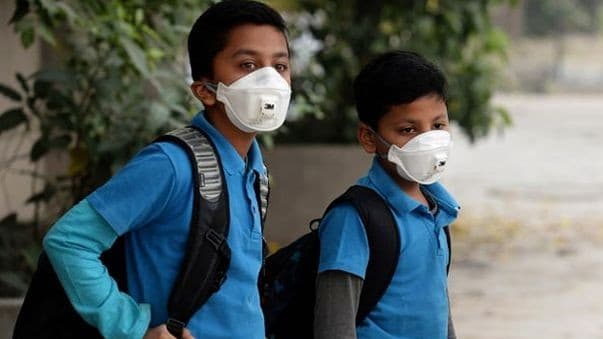
Schools across Delhi and five neighboring National Capital Region (NCR) cities have been directed to conduct classes up to Class 5 in hybrid mode as air pollution levels continue to deteriorate. The arrangement will allow primary school students to attend lessons either physically or online.
Delhi Environment Minister Manjinder Singh Sirsa announced the decision on Friday, Nov 6, 2026. The directive covers government and private schools in Delhi, Noida, Ghaziabad, Gurugram, Faridabad and Sonipat.

The decision comes after the Commission for Air Quality Management (CAQM) invoked Stage III restrictions under the Graded Response Action Plan (GRAP) in view of worsening air quality across the national capital and adjoining areas.
The hybrid learning arrangement is intended to limit children's exposure to polluted outdoor air while ensuring that their education continues without disruption.
Delhi-NCR schools hybrid mode: Which classes will be affected?
The latest government directive applies to students studying up to Class 5 in all government and private schools across the six affected areas.
Schools have been instructed to offer both physical and online learning facilities, allowing students to attend classes according to the arrangements made by their respective institutions.
The hybrid system is mandatory for the schools covered under the order. Individual school administrations cannot independently decide whether to introduce the arrangement.
The directive will remain applicable as long as GRAP Stage III restrictions are in force. Schools must follow the government's instructions throughout this period.
Parents should contact their respective schools to confirm the availability of online classes, attendance arrangements, daily schedules and other details related to the revised learning system.
The government has not announced similar instructions for students studying in Classes 6 to 12. Schools catering to higher grades have not been directed to introduce hybrid learning under the current order.
Any extension of the arrangement to additional classes will depend on further government announcements and changes in the pollution-control restrictions.
Why has GRAP Stage III been invoked in Delhi-NCR?
The CAQM activated Stage III of GRAP on Nov 6, 2026, as air quality deteriorated across Delhi and neighbouring NCR areas.
According to the Central Pollution Control Board (CPCB), Delhi's Air Quality Index (AQI) stood at 364 on the morning of Saturday, November 7, placing it in the 'very poor' category.
However, several air quality monitoring stations across the city recorded pollution levels in the 'severe' category, indicating the extent of the deteriorating situation.
The worsening air quality has raised health concerns, particularly for children, older people and individuals with respiratory conditions. Prolonged exposure to polluted air can increase health risks, making precautionary measures important for vulnerable groups.
Delhi Environment Minister Manjinder Singh Sirsa also cautioned that unfavorable weather conditions could further worsen the situation.
He said wind speeds were expected to fall sharply, potentially approaching zero. Such conditions could prevent pollutants from dispersing and cause them to accumulate in the atmosphere.
According to the minister, the India Meteorological Department's assessment indicated that weak wind conditions could contribute to a further rise in pollution levels across Delhi and neighbouring NCR areas.
The deterioration comes ahead of Diwali, a period when authorities remain particularly concerned about pollution levels in the national capital. The government has introduced precautionary measures to reduce exposure, especially among schoolchildren.
What are the restrictions under GRAP Stage III?
The implementation of GRAP Stage III has brought additional pollution-control measures across Delhi-NCR. The restrictions target major sources of pollution, including vehicular emissions, construction dust, industrial activities and other contributors to deteriorating air quality.
Some of the key restrictions under Stage III include:
These restrictions are intended to reduce emissions and dust generation while preventing further deterioration in air quality across the National Capital Region.
Are schools completely closed in Delhi-NCR?
No. The government has not announced a complete closure of schools across Delhi-NCR under the latest GRAP-related directions.
Instead, schools have been asked to continue academic activities through a hybrid learning arrangement for students up to Class 5.
Primary school students can attend physical classes or participate in online lessons, depending on the facilities and arrangements provided by their respective schools.
The current directive is limited to primary classes. Students studying in Classes 6 to 12 are not covered by the hybrid learning order announced so far.
Therefore, the decision does not amount to a blanket school shutdown across Delhi and the five neighbouring NCR cities.
Parents and students should follow official notifications issued by school administrations and the respective state governments for information about attendance, online learning, school timings and any subsequent changes.
What is GRAP and how does it work?
The Graded Response Action Plan (GRAP) is a set of emergency pollution-control measures implemented by the Commission for Air Quality Management (CAQM) to address deteriorating air quality in Delhi-NCR.
The plan operates through four stages, with restrictions becoming progressively stricter as pollution levels rise.
The measures are introduced based on prevailing AQI levels and air quality forecasts to control pollution sources and limit public exposure.
GRAP stage | AQI category | AQI range |
| Stage I | Poor | 201–300 |
| Stage II | Very Poor | 301–400 |
| Stage III | Severe | 401–450 |
| Stage IV | Severe Plus | Above 450 |
Each stage introduces additional restrictions depending on the severity of pollution. The measures cover different sources of emissions, including vehicles, construction activities, industrial operations and other pollution-generating activities.
The latest Stage III restrictions have also led to changes in school operations, with primary classes shifting to a hybrid learning arrangement across Delhi and five neighbouring NCR cities.
Students, parents and school authorities should continue monitoring official government announcements for updates on pollution-control measures and any changes to the existing academic arrangements.

India Wins Five Medals at Junior Astronomy Olympiad 2026; Students Secure Two Golds

Want to speak Japanese with anime characters? Japan is developing an AI-powered language education app
India’s Race to the Bottom of the Ocean: MATSYA-6000 Aims to Take Three Indians 6,000 Metres Deep

Why are 3 in 4 Singapore parents turning to private tuition despite trust in schools?
Delhi-NCR schools go hybrid: Which classes are affected and what parents should know?
Want to speak Japanese with anime characters? Japan is developing an AI-powered language education app
Why are 3 in 4 Singapore parents turning to private tuition despite trust in schools?
Delhi-NCR schools go hybrid: Which classes are affected and what parents should know?

One in three New Zealand students more than a year behind at school
Australia launches free disability resources to help teachers build inclusive classrooms

India Wins Five Medals at Junior Astronomy Olympiad 2026; Students Secure Two Golds
Want to speak Japanese with anime characters? Japan is developing an AI-powered language education app
India’s Race to the Bottom of the Ocean: MATSYA-6000 Aims to Take Three Indians 6,000 Metres Deep
Why are 3 in 4 Singapore parents turning to private tuition despite trust in schools?
Delhi-NCR schools go hybrid: Which classes are affected and what parents should know?
Want to speak Japanese with anime characters? Japan is developing an AI-powered language education app
Why are 3 in 4 Singapore parents turning to private tuition despite trust in schools?
Delhi-NCR schools go hybrid: Which classes are affected and what parents should know?
One in three New Zealand students more than a year behind at school
Australia launches free disability resources to help teachers build inclusive classrooms
Copyright© educationpost.in 2026 All Rights Reserved.