


Canada is seeking to attract more postgraduate researchers after international student numbers declined, while New Zealand is pursuing enrolment growth and Australia and the US face questions over policy uncertainty and global competitiveness, discussions at an international education conference have indicated.
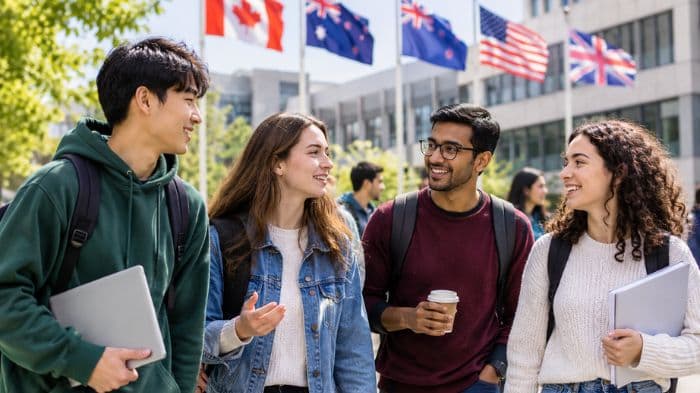
Major study destinations are adopting different approaches to international student recruitment as governments and universities reassess the role of overseas students, research partnerships and graduate outcomes in their higher education strategies.
The contrasting approaches emerged during a global dialogue at the Australian International Education Conference (AIEC) 2026, where representatives from Canada, New Zealand, Australia and the US discussed the changing international education landscape.

Canada has shifted its focus from expanding international student numbers to attracting students who can contribute to research and advanced skills. The change follows a decline in its international student population after the government introduced restrictions on study permits and tightened immigration requirements.
Larissa Bezo, president and chief executive of the Canadian Bureau for International Education (CBIE), said international student numbers had fallen to just under 700,000 at the end of 2025, compared with more than one million at the end of 2023.
However, Canada has recorded an increase in graduate-level study permits. The country issued 6,455 new study permits to graduate students in the second quarter of 2026, more than double the 3,085 issued during the corresponding period in 2025.
Graduate students are exempt from the provincial or territorial attestation letter requirement, while other applicants face higher financial requirements. The policy shift reflects Canada's effort to attract more master's and doctoral students while managing overall international student numbers.
Bezo also pointed to affordability concerns, changes to post-study work opportunities and uncertainty over immigration policies as factors affecting prospective students' decisions.
Australia seeks to rebuild confidence among international students
Australia is facing a different challenge, with the sector seeking greater certainty after several rounds of changes to international student policies.
Phil Honeywood, chief executive of the International Education Association of Australia (IEAA), said the country needed to address the tension between universities' reliance on international student fees and the wider public benefits of international education.
Australia has introduced restrictions affecting student dependants, course transfers and some pathways for students already in the country. In October 2026, the government also opened a consultation on possible changes to the Genuine Student requirement and financial-capacity rules.
The proposed changes include stronger financial verification and, under some models, requiring applicants to hold relevant study funds in Australian bank accounts.
Honeywood said Australia needed to demonstrate that its international education offering extended beyond migration policies and university revenue, with greater emphasis on research collaboration, global citizenship and opportunities for students.
US universities face changing global competition
The US, meanwhile, is being urged to reconsider its position in international higher education as students explore a wider range of study destinations.
Professor John Hudzik of Michigan State University said American institutions could no longer assume they would remain the default choice for international students. He highlighted the emergence of a more multipolar higher education environment in which US universities would need to build stronger international partnerships.
Policy uncertainty is also affecting the sector. A proposal by the US Department of Homeland Security would charge universities US$70,000 for an initial Optional Practical Training (OPT) recommendation and US$30,000 for subsequent recommendations, including a STEM extension.
The proposed fees are not in force. However, advisers have warned that they could affect the financial calculations of international students, particularly those from India who may need to consider alternative study destinations.
Hudzik also argued that universities needed to communicate the wider value of international students and cross-border research to the public, rather than focusing mainly on measurable outputs.
New Zealand positions itself for international student growth
Unlike Canada, New Zealand is seeking to expand its international education sector while maintaining safeguards around quality and student experience.
David Downs, chief executive of Education New Zealand Manapou ki te Ao, said the country's international education strategy was centred on using overseas student recruitment to support national growth.
New Zealand is on track to record around 99,000 international enrolments in 2026, although the figure remains below its 2019 pre-pandemic peak. Its export earnings from international education, however, have moved beyond pre-pandemic levels.
A national survey found that 90% of international students rated their overall experience positively, with 47% describing it as excellent. However, only 55% gave a positive rating to their work experience, while just 33% said finding part-time employment alongside their studies was easy.
Downs said the country needed to maintain student confidence and ensure that its growth ambitions were supported by a positive experience for international learners.
Students look beyond traditional study destinations
The discussions also highlighted a shift in how students compare overseas education options. Rather than limiting their choices to a few established English-speaking destinations, applicants are increasingly considering several countries before making a decision.
Indian education advisers told the conference that students were comparing tuition and living costs, visa certainty, employment prospects and the potential return on their investment.
Germany, France, Ireland, Italy, the Netherlands, Malaysia, Japan, South Korea, Singapore and the United Arab Emirates are among the destinations attracting greater attention.
The changing preferences are also prompting universities to rethink internationalisation. Conference participants said institutions needed to look beyond recruitment numbers and focus on academic partnerships, research collaboration, graduate outcomes and long-term engagement with international markets.

Canada shifts focus to research talent as New Zealand targets growth in international education

Delhi to Attempt Artificial Rain Again as Pollution Chokes Capital; New Aircraft to Be Deployed

Karnataka Introduces AI Curriculum for Class 9 Students in 1,800 Government High Schools

Anbil Mahesh Poyyamozhi Denied Bail in Tamil Nadu Private Schools Approval Scam Case

Bangladesh HSC 2026 re-evaluation draws 1.08 million applications, results on Nov 23
Canada shifts focus to research talent as New Zealand targets growth in international education
Delhi to Attempt Artificial Rain Again as Pollution Chokes Capital; New Aircraft to Be Deployed

Want to speak Japanese with anime characters? Japan is developing an AI-powered language education app

Why are 3 in 4 Singapore parents turning to private tuition despite trust in schools?
Delhi-NCR schools go hybrid: Which classes are affected and what parents should know?

Canada shifts focus to research talent as New Zealand targets growth in international education
Delhi to Attempt Artificial Rain Again as Pollution Chokes Capital; New Aircraft to Be Deployed
Karnataka Introduces AI Curriculum for Class 9 Students in 1,800 Government High Schools
Anbil Mahesh Poyyamozhi Denied Bail in Tamil Nadu Private Schools Approval Scam Case
Bangladesh HSC 2026 re-evaluation draws 1.08 million applications, results on Nov 23
Canada shifts focus to research talent as New Zealand targets growth in international education
Delhi to Attempt Artificial Rain Again as Pollution Chokes Capital; New Aircraft to Be Deployed
Want to speak Japanese with anime characters? Japan is developing an AI-powered language education app
Why are 3 in 4 Singapore parents turning to private tuition despite trust in schools?
Delhi-NCR schools go hybrid: Which classes are affected and what parents should know?
Copyright© educationpost.in 2026 All Rights Reserved.