


Dr. Rekha Kashyap explores transforming engineering classrooms into dynamic AI ecosystems, balancing timeless computer science fundamentals with emerging technologies, and preparing graduates to critically evaluate AI tools.
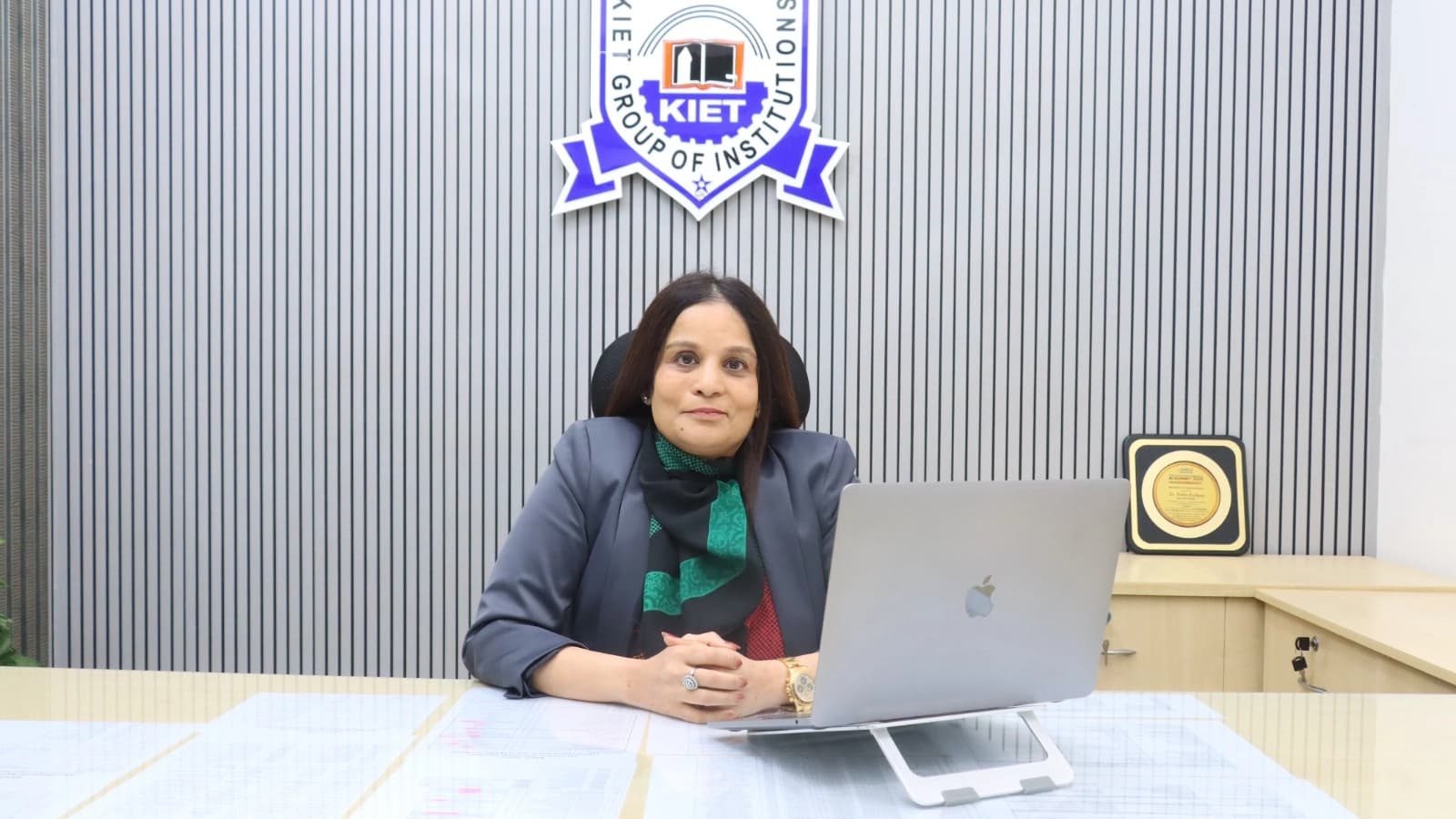
Dr. Rekha Kashyap, Dean of CSE at KIET University, discussing AI curriculum transformation and engineering education
As Artificial Intelligence continues to redefine industries, the role of engineering institutions is evolving from knowledge providers to innovation enablers. In this conversation, Dr. Rekha Kashyap, Dean, CSE (AI) & CSE (AI & ML), KIET University, shares her perspective with Euducation Post’s Prabhav Anand on building an AI-first academic ecosystem that goes beyond classroom learning. She discusses the importance of strong fundamentals, industry integration, project-based learning, and responsible use of AI tools in education. Dr. Kashyap also highlights the growing need for problem-solving, adaptability, and communication skills among engineering graduates while emphasizing the value of research, open-source contributions, entrepreneurship, and interdisciplinary learning. Looking ahead, she envisions a shift towards intelligence-based education, where critical thinking, innovation, and real-world experiences will define the future of engineering and prepare students for an increasingly AI-driven world.
Q1. Many engineering colleges have introduced AI and Machine Learning programs, but very few have been able to create a complete AI ecosystem around them. At KIET, what have been the biggest challenges in moving from simply teaching AI as a subject to making it a culture of innovation and problem-solving?

One of the biggest challenges was changing the mindset from “learning AI” to “living AI.” In many institutions, AI remains confined to classrooms, assignments, or isolated projects. At KIET, our vision was to make AI part of the academic culture, research ecosystem, industry engagement, and student innovation journey.
The first challenge was faculty readiness. AI evolves rapidly, so continuous faculty development became essential. We encouraged faculty members not only to teach AI, but also to engage in research, certifications, industry collaboration, and interdisciplinary innovation.
The second challenge was creating the right infrastructure. AI education cannot be effective without computational resources and exposure to real-world environments. Establishing the NVIDIA DGX A100 powered Centre of Excellence helped us provide students and researchers access to advanced AI computing infrastructure similar to what is used in industry and research labs.
Another important challenge was breaking the traditional separation between theory and practice. At KIET, we consciously built a teaching-learning environment where there is minimal demarcation between classrooms and laboratories. Students work on datasets, projects, hackathons, research problems, and industry use cases alongside theoretical learning.
We also realized very early that AI education cannot remain limited to coding alone. AI is transforming healthcare, finance, agriculture, manufacturing, and education itself. Therefore, we shifted toward interdisciplinary problem-solving where students understand both technology and the domain in which it is applied.
Finally, innovation culture develops only when students feel encouraged to experiment and take ownership of ideas. We actively promote hackathons, open-source participation, startup initiatives, research groups, and industry collaborations so that students begin to see AI not merely as a subject, but as a tool to solve meaningful real-world problems.
Q2. The AI industry is evolving so quickly that what students learn in their first year may become outdated by the time they graduate. How do you ensure that the curriculum remains relevant without constantly chasing every new trend that appears in the market?
This is one of the most important questions in engineering education today. If institutions start chasing every new trend, the curriculum becomes unstable and fragmented. Our approach at KIET is to build strong foundations first and then layer emerging technologies on top of them.
Core computer science fundamentals such as programming, algorithms, operating systems, databases, mathematics, and computational thinking remain timeless. A student with strong fundamentals can adapt to future technology shifts, whether it is generative AI, agentic AI, quantum computing, or technologies we have not yet imagined.
At the same time, curriculum today cannot remain static. AI has forced higher education to become more dynamic and industry-responsive. Autonomy gave us the flexibility to continuously evolve the curriculum in alignment with industry requirements.
At KIET, industry integration starts early. In the autonomous batch, industry exposure begins from the third semester, while in the university batch we introduced it from the first semester itself. We embedded certifications in cloud computing, data analytics, and machine learning directly into the credit structure, significantly improving student participation and outcomes.
Instead of redesigning the curriculum every few months, we focus on creating lifelong learners. In AI, tools and frameworks may change rapidly, but analytical thinking, problem-solving ability, adaptability, and learning agility remain constant.
The objective is not to prepare students only for today’s technologies, but to prepare them for continuous evolution throughout their careers.
Q3. There is a growing concern that students are becoming highly dependent on AI tools for coding, assignments, and even learning itself. As an academic leader, where do you draw the line between using AI as a learning assistant and becoming overly dependent on it?
AI is a powerful assistant, but it should never replace thinking. I believe the real question is not whether students should use AI tools, because industry itself is becoming increasingly AI-driven. The real concern is whether students understand what the AI is generating and whether they can critically evaluate it.
Today, there is a growing “specification-to-code” mindset where students believe AI can generate complete solutions automatically. However, without strong fundamentals, students cannot debug intelligently, validate outputs, or identify flawed logic. They may continue modifying prompts without truly understanding the underlying system.
At KIET, we encourage responsible AI usage. Students are allowed to use AI for ideation, debugging support, productivity enhancement, and research assistance. However, they are also expected to explain their logic, justify their decisions, and demonstrate conceptual clarity.
Our assessment philosophy has evolved accordingly. For development-oriented subjects, we increasingly use project-based evaluations, code walkthroughs, viva discussions, implementation-based assessments, and hackathons. In several AI and machine learning subjects, students also participate in Kaggle competitions and real-world problem-solving exercises.
The future belongs not to those who avoid AI, but to those who can collaborate intelligently with AI while retaining independent thinking, creativity, and ethical judgment.
Q4. One interesting aspect of your department is the focus on emerging areas such as blockchain, cloud technologies, computer vision, and agentic AI alongside traditional engineering fundamentals. How do you balance teaching core computer science concepts with these rapidly emerging technologies?
We view emerging technologies as applications of strong fundamentals rather than replacements for them.
For example, students cannot build scalable AI systems without understanding operating systems, databases, networking, software engineering, and distributed computing. Similarly, blockchain relies heavily on cryptography and distributed systems, while computer vision depends on mathematics, algorithms, and machine learning foundations.
Therefore, our philosophy is “fundamentals first, innovation next.”
The early stages of the curriculum focus on computational thinking and core engineering principles. As students progress, they begin applying those concepts to emerging domains through electives, labs, projects, research, and industry-integrated learning experiences.
We also strongly emphasize interdisciplinary learning. AI today is impacting healthcare, finance, agriculture, manufacturing, and education. Engineers create meaningful impact when they combine technical expertise with domain understanding.
Our objective is not to overload students with every new technology trend, but to develop engineers who possess strong foundations, adaptability, and the ability to learn continuously.
Q5. Industry leaders often say that engineering graduates possess theoretical knowledge but struggle with real-world problem solving. From your interactions with recruiters and technology companies, what are the three skills that today's engineering students are still missing despite the AI boom?
From my interactions with industry leaders, I believe three major gaps still exist.
The first is problem-solving ability. Many students understand concepts theoretically but struggle to apply them to open-ended real-world challenges where there are no predefined solutions.
The second gap is communication and collaboration. Modern engineering is highly interdisciplinary and team-driven. Students who can communicate ideas effectively, work collaboratively, and present solutions clearly stand out significantly during placements.
The third gap is adaptability and self-learning. Technology is evolving faster than ever before, and companies increasingly value engineers who can continuously learn, explore new technologies independently, and adapt quickly to changing environments.
At KIET, we try to bridge these gaps through project-based learning, interdisciplinary exposure, hackathons, open-source participation, research initiatives, and industry-aligned certifications. This year alone, our students made nearly 1,500 contributions on open-source platforms like GirlScript Summer of Code along with multiple Google Summer of Code contributions. More than 2,000 students also earned global certifications aligned with industry needs.
Technical skills remain important, but increasingly, industry is looking for engineers who combine technical competence with innovation mindset, professionalism, communication skills, and learning agility.
Q6. A student from KIET recently credited you for introducing him to blockchain ecosystems and supporting his entrepreneurial journey. Many institutions talk about innovation, but few actively support unconventional student paths. How can engineering colleges create an environment where students feel encouraged to build products, startups, and research projects while still pursuing their academics?
Innovation grows when institutions create trust-based ecosystems rather than fear-based academic environments.
Students should feel encouraged to experiment, explore unconventional ideas, and even fail during the learning process. At KIET, we try to provide mentorship, infrastructure, research opportunities, industry exposure, and academic flexibility for students pursuing innovation-oriented paths.
We actively encourage participation in hackathons, startup competitions, open-source communities, patent initiatives, and collaborative research groups. Students working on serious ideas are connected with faculty mentors, industry experts, and technical communities that help them refine and scale their work.
One of the most important changes we introduced was integrating innovation into academics instead of treating it as an extracurricular activity. Capstone projects, interdisciplinary labs, certifications, and industry-linked projects are aligned with the academic structure itself.
I strongly believe engineering institutions should not only prepare students for jobs, but also empower them to become innovators, researchers, entrepreneurs, and creators of technology.
When students are trusted with responsibility, resources, and mentorship, they often exceed expectations.
Q7. Looking ahead to the next five years, what major transformation do you foresee in engineering education because of AI? More importantly, what is the one change that engineering institutions should start implementing today if they do not want to become irrelevant in the future?
The biggest transformation will be the shift from information-based education to intelligence-based education.
Earlier, institutions focused primarily on delivering information. But in the age of AI, information is instantly accessible. The role of universities will increasingly shift toward developing higher-order capabilities such as critical thinking, creativity, ethical reasoning, interdisciplinary problem-solving, innovation, and leadership.
AI will also significantly personalize learning. Adaptive learning systems, AI tutors, intelligent assessment platforms, simulation-driven education, and skill analytics will reshape how students learn and how institutions evaluate learning outcomes.
Assessment itself is undergoing major transformation. Traditional theory-heavy examinations alone are no longer sufficient for many technology subjects. At KIET, we are increasingly moving toward project-oriented assessments, hackathon-based evaluations, open-source participation, Kaggle competitions, and implementation-driven learning models.
However, the most important change institutions must implement today is integrating industry, research, and experiential learning deeply into the curriculum from the early semesters.
Traditional static education models are becoming obsolete. Students must work on real-world projects, emerging technologies, interdisciplinary challenges, and innovation ecosystems continuously throughout their academic journey.
The institutions that will remain relevant in the future are those that can successfully combine academic rigor, technological adaptability, ethical responsibility, industry integration, and innovation culture into one unified educational ecosystem.

Schools urged to make relationship education central to fight domestic violence in Australia

The Future Belongs to Those Who Can Collaborate Intelligently with AI

Diljit Dosanjh Delhi Concert Today: Traffic Restrictions from 1 PM, Check Roads to Avoid, Metro Timings and Parking Details
Why Are Women Still Only 20% of IIT Admissions? JEE Advanced 2026 Data Explained

Australia weighs screen time curbs and AI restrictions in schools
The Future Belongs to Those Who Can Collaborate Intelligently with AI
Diljit Dosanjh Delhi Concert Today: Traffic Restrictions from 1 PM, Check Roads to Avoid, Metro Timings and Parking Details
Why Are Women Still Only 20% of IIT Admissions? JEE Advanced 2026 Data Explained

Google adds hundreds of free textbooks to Gemini Notebook for students in India and US

NBEMS opens NEET Super Specialty 2026 applications: Check eligibility, dates and registration steps

Schools urged to make relationship education central to fight domestic violence in Australia
The Future Belongs to Those Who Can Collaborate Intelligently with AI
Diljit Dosanjh Delhi Concert Today: Traffic Restrictions from 1 PM, Check Roads to Avoid, Metro Timings and Parking Details
Why Are Women Still Only 20% of IIT Admissions? JEE Advanced 2026 Data Explained
Australia weighs screen time curbs and AI restrictions in schools
The Future Belongs to Those Who Can Collaborate Intelligently with AI
Diljit Dosanjh Delhi Concert Today: Traffic Restrictions from 1 PM, Check Roads to Avoid, Metro Timings and Parking Details
Why Are Women Still Only 20% of IIT Admissions? JEE Advanced 2026 Data Explained
Google adds hundreds of free textbooks to Gemini Notebook for students in India and US
NBEMS opens NEET Super Specialty 2026 applications: Check eligibility, dates and registration steps
Copyright© educationpost.in 2026 All Rights Reserved.