


The merger agreement will bring Cranfield's expertise in technology, engineering and management into King's College London, with Cranfield becoming the university's tenth faculty.

King's College London and Cranfield University have agreed to merge on August 1, 2027, bringing the specialist postgraduate institution into King's as its tenth faculty. The agreement, confirmed by both universities on November 2, marks the next stage in a plan first announced in May 2026.
The merger will combine King's strengths in education and research with Cranfield's expertise in technology, engineering, applied research and management, along with its established partnerships with business and industry. The institutions said the move would expand their combined academic and research capabilities and strengthen their contribution to areas of national importance.

Following the merger, Cranfield will become part of King's College London. Its original title, the Cranfield Institute of Technology, will be restored to preserve its history and heritage. Cranfield will no longer operate as an independent university, but its name, specialist identity and areas of expertise will be retained within King's.
The agreement also sets out how some of Cranfield's existing academic units will fit into the merged institution. Cranfield Defence and Security, based at Shrivenham, will continue its applied research work and collaborate with King's School of Security Studies. The two units will work together to develop research and capabilities in the security and defence sector.
Cranfield's School of Management will join King's Business School as the Cranfield School of Management. The arrangement is intended to bring together the two schools' expertise, resources and networks across the public and private sectors.
Research and industry partnerships
The merger is expected to strengthen collaboration across several areas where the institutions have complementary expertise. Cranfield specialises in applied research and has longstanding links with industry, while King's has a broader academic base spanning disciplines across the humanities, social sciences, health and sciences.
When the proposed merger was announced in May, the universities identified engineering and technology, aerospace, advanced manufacturing, artificial intelligence, robotics, environmental research, energy and security as areas where their combined capabilities could support research and innovation.
Cranfield's work in areas such as hydrogen, batteries, net-zero systems, water, food systems and climate research was also highlighted as part of the proposed collaboration. The institutions said the combined academic strengths would support research addressing challenges facing industry, government and society.
King's Vice-Chancellor and President Professor Shitij Kapur said the focus would now shift to detailed planning for the merger. He said the university intended to take the time needed to complete the process properly and minimise disruption to students and staff.
“Our goal in starting this process was to enhance the impact that King’s and Cranfield already have on our society. Whether that is through research that responds to the challenges facing the UK or education that equips our students with the skills needed to succeed in whatever walk of life they choose,” Shijit said.
"I’m confident that welcoming Cranfield with all its unique strengths, world class facilities and deep industry partnerships into our community will help us achieve that and support our Strategy 2030 to build a bigger, better King’s. Our focus now will be on the detail of how that merger will happen and there is no intention to rush that process. Our guiding principle will be to take the time it needs to get it right and minimise disruption to the service we provide our students and staff," he added.
Cranfield Chief Executive and Vice-Chancellor Professor Dame Karen Holford said the institution's 80-year history had been shaped by advanced research, specialist teaching and close collaboration with industry. She said joining King's would bring Cranfield's specialisms together with the larger university's education, research and scale.
“Cranfield has a very proud history, and for 80 years our people have created a legacy of impact through their advanced research using deep subject matter expertise, their world-renowned teaching and by working very closely with industry to enable progress and change. We now embark on a new chapter, joining our specialisms with King's world-class education, research and scale. Together, we'll build a nationally significant asset and a global university that will bring even more positive impacts to people's lives,” Dame said.
What the merger means for students
The universities have outlined different arrangements for students depending on when they join Cranfield.
Students enrolled at Cranfield when the merger takes effect, along with prospective students who have accepted an offer before August 1, 2027, will have the option of receiving either a King's degree certificate or a Cranfield University degree certificate.
Students accepting offers to study at Cranfield after the merger is completed will receive a King's degree certificate.
The universities have said that students and staff may see some immediate changes once the merger takes effect, but the full integration will be phased over a longer period. This is intended to ensure that the transition does not affect the quality of services provided to students.
Cranfield's campuses will also continue to operate following the merger. The institution's specialist facilities and industry links are among the resources expected to become part of King's wider academic and research network.
Further steps before the merger
Although the universities have agreed on the merger, the process is not yet complete. King's has clarified that further legal and regulatory steps, along with the necessary approvals, must be completed before the institutions formally become one.
The signing of the agreement allows more detailed integration planning to begin. The universities will now work on the arrangements required to bring their academic, operational and administrative structures together ahead of the proposed August 2027 completion date.
Until the merger takes effect, King's College London and Cranfield University will continue to operate as separate institutions.

From digital pets to AI robots: How Hong Kong schools are reshaping classroom learning

Why Are Nearly 2,000 MBBS Seats Still Vacant After NEET Counselling 2026?
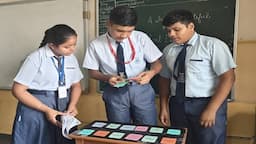
Ghaziabad School Introduces Global Lexile Framework to Assess Reading Skills of Students

SRMIST to Host National Conference on Regenerative Biology and Bioengineering from November 3

King's College London, Cranfield University agree to merge in August 2027
From digital pets to AI robots: How Hong Kong schools are reshaping classroom learning
Why Are Nearly 2,000 MBBS Seats Still Vacant After NEET Counselling 2026?
King's College London, Cranfield University agree to merge in August 2027

Hong Kong plans weekly AI and coding lessons for children: Is India ready for the shift?

Who handles student discipline? Singapore schools look beyond teachers, lessons India can learn

From digital pets to AI robots: How Hong Kong schools are reshaping classroom learning
Why Are Nearly 2,000 MBBS Seats Still Vacant After NEET Counselling 2026?
Ghaziabad School Introduces Global Lexile Framework to Assess Reading Skills of Students
SRMIST to Host National Conference on Regenerative Biology and Bioengineering from November 3
King's College London, Cranfield University agree to merge in August 2027
From digital pets to AI robots: How Hong Kong schools are reshaping classroom learning
Why Are Nearly 2,000 MBBS Seats Still Vacant After NEET Counselling 2026?
King's College London, Cranfield University agree to merge in August 2027
Hong Kong plans weekly AI and coding lessons for children: Is India ready for the shift?
Who handles student discipline? Singapore schools look beyond teachers, lessons India can learn
Copyright© educationpost.in 2026 All Rights Reserved.