


The six-year curriculum introduces age-based learning in generative AI, prompt writing, robotics and digital safety, while encouraging students to identify biased information and think independently.
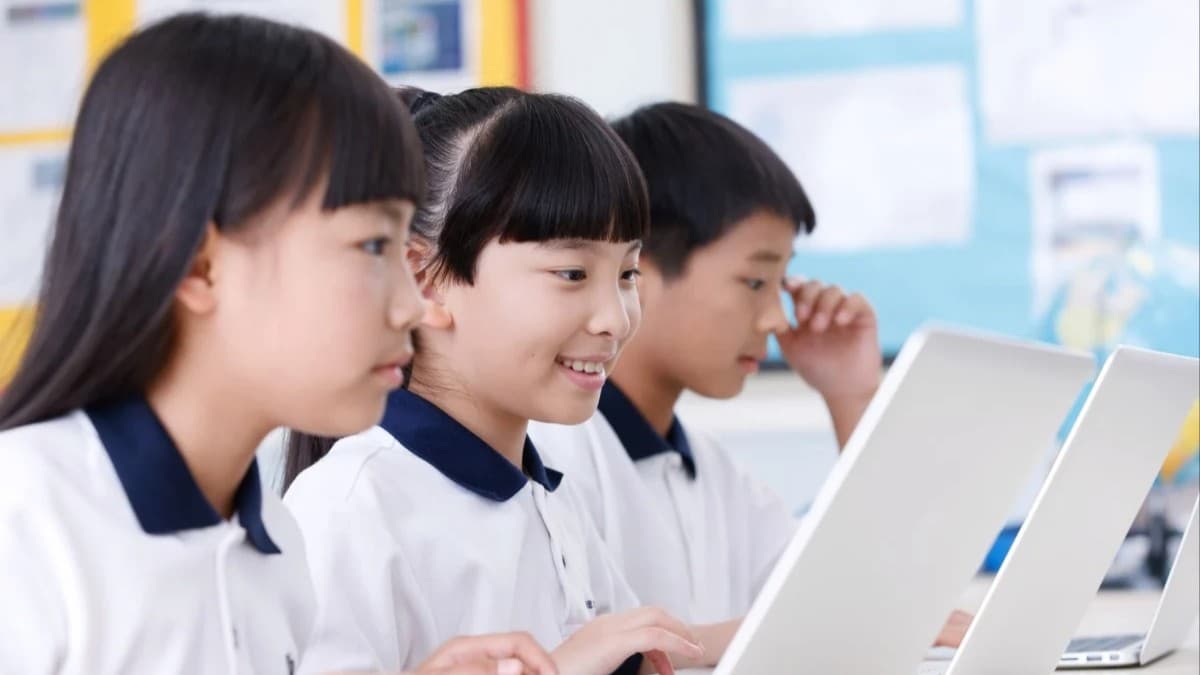
Hong Kong plans to introduce a new information and innovation technology subject in primary schools from September 2028, giving students structured lessons in artificial intelligence (AI), coding, robotics and digital literacy from their early school years.
Under the proposed curriculum, children as young as seven will learn how to interact with AI systems using simple prompts and instructions. The new subject is designed to develop students' technological knowledge, curiosity, creativity and ability to use digital tools responsibly.

The Education Bureau announced the provisional draft of the Information and Innovation Technology Curriculum Framework for Primary Schools on Friday. The framework aims to strengthen pupils' interest in innovative technologies while building their digital literacy and creative skills.
Students from Primary One through Primary Six will receive one 35-minute lesson each week. Each grade will have at least 28 classes, equivalent to 16 hours of instruction annually.
Across the six years of primary education, students are expected to complete 168 lessons under the new subject.
The rollout will take place in phases. Primary One and Primary Four students will be the first groups to study the subject in the 2028-29 school year, with full implementation planned for 2030-31.
Schools that are sufficiently prepared will have the option to introduce the complete curriculum in 2028-29. Institutions may also test parts of the proposed syllabus during the next school year.
The bureau said it would provide support to schools and teachers during the transition. This will include two briefing sessions on the curriculum framework scheduled for next month.
Hong Kong's new curriculum puts AI and coding at the center
The proposed subject is divided into five areas: information technology concepts and applications; computational thinking and coding; artificial intelligence; fundamental engineering and robotics technology; and technology and society.
AI and computational thinking and coding will receive substantial attention. Each area will account for 41 of the 168 lessons planned across the six years of primary education.
The curriculum also emphasizes the importance of independent thinking. Schools are expected to help students understand that AI is an auxiliary tool rather than a replacement for their own reasoning.
The draft specifically advises schools to prevent children from becoming so dependent on AI that they end up “outsourcing their thinking”.
William Lam Wai-lim, the bureau's principal education officer, said the curriculum had been developed with reference to science and technology education practices in different countries and regions, including mainland China.
“In the age of AI, students not only need to master information technology knowledge and skills from a young age, but also need to cultivate digital literacy including media and information literacy and AI literacy, the abilities required for human-computer collaboration, and correct values and attitudes,” he wrote in the bureau’s online blog, Insider’s Perspectives.
What children will learn from Primary One to Primary Six
The curriculum introduces technology concepts gradually, beginning with everyday examples before moving toward AI applications, prompt writing and the limitations of machine-generated information.
1.Primary One: Understanding how technology works
Primary One pupils, some of whom are just six years old, will be introduced to the concept of input-processing-output through familiar objects and activities.
Examples include a juicer, toaster, rice cooker and taking pictures. These examples are intended to help children understand how information or inputs are processed to produce an outcome.
Students will also learn to recognize and use common internet applications, including email, search engines and streaming platforms. The draft suggests teaching them how to use search engines to locate specific information.
2. Primary Two: Beginning to interact with AI
AI instruction will begin in Primary Two, when pupils are around seven years old.
Students will be expected to identify examples of AI applications and develop a basic understanding of intelligence. Under teachers' guidance, they will also practice simple conversations with AI systems using basic prompts or instructions.
The aim is to introduce children to how AI tools work and how they can interact with them in a guided learning environment.
3. Primary Five: Learning to write prompts and understand AI
By Primary Five, students will explore more advanced AI concepts, including generative AI.
They will learn to construct complete prompts using a basic structure. The draft encourages teachers to introduce prompt frameworks that students can use to create story illustrations, short descriptions, posters and other materials.
Students will also study the relationship between computing power, chip technology and tokens. They are expected to understand three fundamental components of AI systems: data, algorithms and computing power.
4. Primary Six: Independent prompting and recognizing AI errors
In Primary Six, pupils will be expected to write prompts independently to complete different tasks.
They will be encouraged to design and test prompts, then compare how different writing styles affect AI-generated results. This will help them understand how instructions can influence the output produced by an AI system.
The curriculum also addresses the limitations of artificial intelligence. Students will learn that AI can generate incorrect or biased information and judgments, and will be introduced to the concept of AI hallucinations.
The inclusion of these topics signals that the proposed curriculum is not limited to teaching children how to operate AI tools. It also seeks to build awareness of their reliability, potential biases and effects on decision-making.
AI lessons will not affect Primary Five and Six placement assessments
Despite the planned expansion of technology education, the new subject will not be included in the internal assessments conducted in Primary Five and Primary Six.
These assessments contribute to students' secondary school placement rankings. Keeping the new subject outside these evaluations means its introduction will not directly affect the scores used for secondary school placement.
Teachers have been invited to submit feedback on the provisional curriculum through a survey, with responses due by Dec 2.
Is India ready to introduce AI and coding earlier in schools?
Hong Kong's proposed curriculum raises questions for India about how early schools should introduce artificial intelligence, coding and digital literacy, and how teachers can help students use these tools without weakening independent thinking.
India's National Education Policy 2020 emphasizes technology integration, computational thinking and the development of skills suited to a changing world. The Central Board of Secondary Education has also introduced AI-related learning opportunities in schools, while national and state-level initiatives continue to expand digital education.
However, Hong Kong's plan offers a specific point of comparison: a structured technology subject extending from the first year of primary school through the sixth, with defined lesson allocations and age-appropriate learning goals.
Indian education policymakers could examine whether primary school students should receive more systematic instruction in AI literacy, prompt writing, coding, robotics and the ability to identify inaccurate or biased digital information.
Such a shift would also require teacher training, suitable learning materials, access to digital infrastructure and safeguards for children's privacy and online safety. Schools would need to account for differences in access to devices, internet connectivity and trained educators across regions.
The emphasis on preventing students from “outsourcing their thinking” is particularly relevant as generative AI becomes more accessible. Teaching children how to question AI-generated answers, verify information and make independent judgments could be as important as teaching them how to use the technology.
Hong Kong's proposed framework does not establish that India should adopt the same timetable or structure. It does, however, provide an example of how schools can introduce technology concepts progressively, beginning with familiar applications and moving toward more advanced AI skills.
The challenge for India is to determine how AI education can be integrated into its diverse school system while ensuring that access to technology does not come at the expense of foundational learning, critical thinking and equitable educational opportunities.
Why Are Nearly 2,000 MBBS Seats Still Vacant After NEET Counselling 2026?
Ghaziabad School Introduces Global Lexile Framework to Assess Reading Skills of Students

SRMIST to Host National Conference on Regenerative Biology and Bioengineering from November 3

VJIM, CII Institute of Logistics sign MoU to boost supply chain career opportunities

Hong Kong plans weekly AI and coding lessons for children: Is India ready for the shift?
Why Are Nearly 2,000 MBBS Seats Still Vacant After NEET Counselling 2026?
Hong Kong plans weekly AI and coding lessons for children: Is India ready for the shift?
Who handles student discipline? Singapore schools look beyond teachers, lessons India can learn

Can Six Years of MBBS Abroad Still Leave Indian Students Unable to Practise in India?

What kind of future are schools preparing children for? Singapore educators explore question

Why Are Nearly 2,000 MBBS Seats Still Vacant After NEET Counselling 2026?
Ghaziabad School Introduces Global Lexile Framework to Assess Reading Skills of Students
SRMIST to Host National Conference on Regenerative Biology and Bioengineering from November 3
VJIM, CII Institute of Logistics sign MoU to boost supply chain career opportunities
Hong Kong plans weekly AI and coding lessons for children: Is India ready for the shift?
Why Are Nearly 2,000 MBBS Seats Still Vacant After NEET Counselling 2026?
Hong Kong plans weekly AI and coding lessons for children: Is India ready for the shift?
Who handles student discipline? Singapore schools look beyond teachers, lessons India can learn
Can Six Years of MBBS Abroad Still Leave Indian Students Unable to Practise in India?
What kind of future are schools preparing children for? Singapore educators explore question
Copyright© educationpost.in 2026 All Rights Reserved.