


With 60% of schools adopting AI, educators are using customized platforms, interactive tools and companion robots while addressing assessment challenges and accessibility for students with special needs.
Artificial intelligence is moving beyond textbooks and computer screens in Hong Kong schools, where teachers are using digital pets, interactive platforms and companion robots to make classroom learning more engaging and accessible to students.
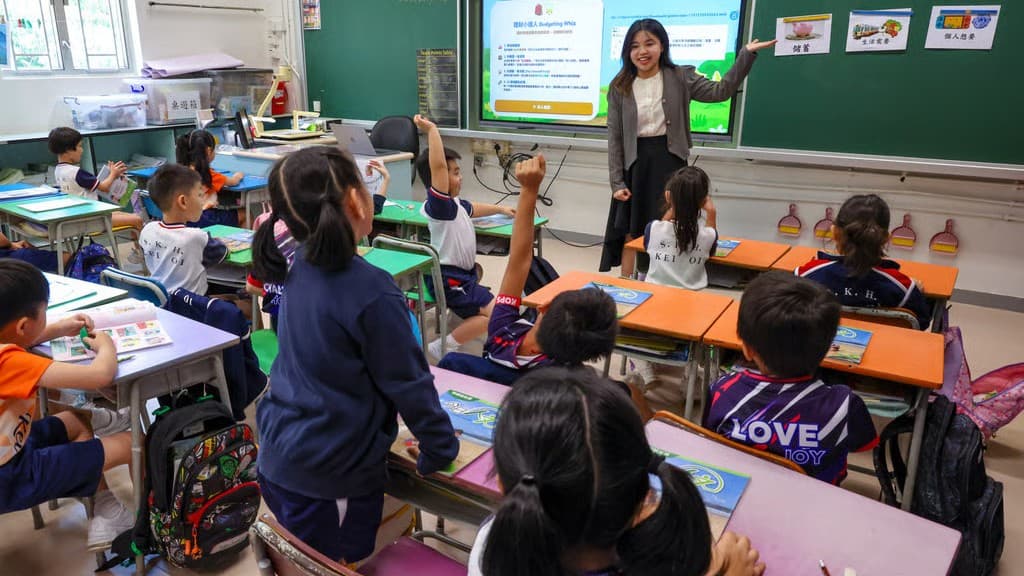
At SKH Kei Oi Primary School in Sham Shui Po, a Primary Two humanities lesson recently turned into a discussion about saving money. Students debated whether their virtual pet needed meal vouchers or the latest game cards, with each choice changing the character's mood and savings.

The teacher, Cynthia Doo Chi-yin, had developed the digital pet using artificial intelligence (AI) and web-based tools to introduce children to budgeting and responsible spending. The activity allowed pupils to see how financial decisions could affect the virtual character.
As students made spending choices, the pet's mood and savings changed on the screen. The exercise helped them understand the consequences of careless spending through an interactive experience.
Such experiments are becoming increasingly common in Hong Kong's education system. Around 60% of primary and secondary schools in the city use AI for teaching or administrative purposes, according to a survey by the Education University of Hong Kong released in June.
The growing adoption is supported by the government's digital education blueprint and financial assistance for schools. Each publicly funded primary and secondary school has received a one-time grant of HK$500,000 to purchase or lease AI-related software, hardware and platforms, as well as organize activities to improve students' AI literacy.
Schools are using the funding to introduce existing technology products, develop customized learning platforms and work with technology companies to adapt AI applications to their students' requirements.
Educators said the technology has created new opportunities for lesson planning and helped address some learning barriers. However, its growing presence has also raised questions about how teachers should assess students' actual abilities when AI can contribute to their assignments.
School leaders have also called for closer cooperation between educational institutions and technology companies, particularly to develop tools that meet the requirements of students with special educational needs.
Hong Kong's digital education blueprint supports AI adoption
The Education Bureau introduced its Blueprint for Digital Education Development in June, setting out measures to expand technology use across schools.
Under the framework, teachers are required to complete at least 30 hours of digital training every three years. Schools must also include AI strategies in their annual development plans.
The government launched its AI for Empowering Learning and Teaching Funding Programme in 2025, providing a one-time HK$500,000 grant to each publicly funded primary and secondary school.
The financial assistance can be used to purchase or lease AI software, hardware and digital platforms. Schools can also use the funds to organize activities that help students develop AI literacy and understand how the technology works.
At SKH Kei Oi Primary School, the adoption of AI began with science and English lessons for students in Primary Four to Six. The institution has since combined commercially available applications with tools developed specifically for its classrooms.
Some ready-made applications allow students to turn their English compositions into comics using image-generation technology. Other platforms assess their speaking and writing abilities, providing additional ways to practice language skills.
However, selecting suitable products from the growing technology market has not been straightforward.
Principal Szeto Kar-ying said the school prioritizes educational requirements rather than adopting technology simply because it is new or popular.
When commercially available products do not meet its needs, the school collaborates with technology companies to develop customized applications.
With assistance from a program run by the Education Bureau and Cyberport, the school partnered with a technology company to create an AI-powered science reading platform. The tool guides students through reading materials and scientific concepts.
Szeto said the school considers curriculum relevance and the long-term viability of a project before allocating funds.
“Funding goes first to projects that fit curriculum needs and can be sustained and scaled up. We also encourage our teachers to experiment with AI in everyday teaching and classroom activities,” Szeto said.
Digital pets and AI tools make lessons interactive
Teachers are also developing their own applications to introduce concepts that students might otherwise find difficult to understand through conventional classroom instruction.
Doo's budgeting activity is one such example. Her Primary Two humanities students manage the monthly expenses of a virtual pet, making decisions about how to spend its available money.
Rather than simply explaining the importance of saving, the activity allows children to experience the consequences of their choices through changes in the digital character.
“I make the spending choices together with them in class. They are excited to explore it first-hand and discover on their own that irrational spending has consequences, affecting the character’s mood,” she said.
While AI has expanded the possibilities for designing classroom activities, teachers said it has also complicated the process of evaluating students' learning.
When pupils can use AI to generate written assignments or other completed work, teachers may find it difficult to determine how much of the final output reflects the students' own understanding.
Chan Yuk, the school's information technology coordinator, said assessment methods should consider how students arrive at an answer rather than focusing only on the final submission.
“If we only assess the final product, students can easily get AI to do the work for them. Assessment should value the process over the result and cover how students collaborate with AI, not just test their knowledge,” said Chan Yuk, the school’s IT coordinator.
He said this approach could increase teachers' responsibilities, making it important for schools to provide adequate training and time for educators to adapt their assessment practices.
Experts call for changes in AI-based student assessment
Dragan Gasevic, chair professor in the Faculty of Education and the School of Computing and Data Science at the University of Hong Kong, also emphasized the need to assess the learning process rather than rely entirely on students' final work.
He compared the approach to how coaches evaluate athletes, explaining that performance cannot be understood only by looking at the final result.
“When a sprinter races, the coach does not just record the finishing time. They replay the whole race step by step to find the moments where performance could improve,” he said.
Gasevic said teachers and students needed tools that could similarly track the stages of an assignment and identify where students encountered difficulties while working with AI.
“We need tools that let teachers and students replay these steps too, and identify the points of weakness when students interact with AI.”
He said such assessment tools should be developed jointly with teachers and children. Students should also have control over their personal data, while schools should encourage a coaching-oriented learning environment.
Gasevic further cautioned schools against treating general-purpose AI platforms as substitutes for systems specifically designed for education.
“Real learning gains require specialised adaptive systems, not simply asking ChatGPT or Gemini to run a Socratic dialogue. These systems, built on more than 50 years of research in AI in education, need components that adapt to the individual needs of each student,” he said.
According to him, educational AI systems should be capable of adjusting to individual students' learning requirements rather than providing the same experience to everyone.
AI robots support students with special educational needs
Beyond mainstream classrooms, Hong Kong schools are also exploring how AI can make education more inclusive for children with special educational needs.
At Hong Chi Winifred Mary Cheung Morninghope School, which serves students between six and 18 years old with intellectual disabilities, robots and AI-powered platforms are being introduced as learning companions.
Principal Chu Pui-man said the school has invested in smart devices and AI applications to familiarize students with technology and help them gain confidence in using it in their everyday lives.
The school has purchased two humanoid robots that students can learn to program. On one occasion, the robots led the entire school in its morning exercise routine.
“We bought two humanoid robots that students can learn to programme, and they once led the whole school in morning exercise,” she said.
The institution also has more than 10 companion robots in its classrooms. These devices interact with students and provide emotional support when they are unhappy.
“In our classrooms we keep more than 10 companion robots, our AI learning buddies, which chat with students when they feel unhappy and comfort them.”
The school has also partnered with a technology company to develop an AI avatar that functions as an assistant on students' tablets.
However, Chu said commercially available applications do not always meet the specific requirements of children with intellectual disabilities. The school therefore maintains its own development team to build a platform suited to its students.
Some students may have difficulty speaking quickly or clearly, while others may struggle to type. The platform is designed to accommodate these differences by allowing students to enlarge text, work through instructions at their own pace and select preset answers.
“Our students might not speak fast or clearly, so we need to adjust the platform to their pace, guide them step by step and not rush ahead, and allow them to enlarge the text. We also preset question choices on the platform for students who cannot type,” she said.
The system also allows students to communicate with the technology through pictures and speech instead of relying exclusively on a conventional keyboard.
Despite these benefits, developing and testing customized AI products requires additional financial resources and time.
Chu said schools could benefit from sharing resources and coordinating purchases rather than independently investing in similar products.
“We hope to see cross-school resource sharing and centralised procurement for special education, so schools do not each end up buying the same thing at a high price,” she said.
She also called for technology companies to help schools identify suitable products and explain how these applications could address specific learning requirements.
“If the tech industry could recommend well-tested products and explain why they suit our students, we could save time searching and customising on our own.”
Hong Kong Education City connects schools with AI developers
Helping schools identify suitable technology products is also part of the work undertaken by Hong Kong Education City (EdCity), a government-funded education portal.
Established in 2000 to support the digitalization of education, EdCity initially focused on providing digital learning content. Its role has expanded in recent years as AI adoption has increased, with the platform now connecting schools and technology companies.
Its executive director, Dr. Tenny Lam Fung, said schools could access AI solutions developed in different parts of the world. However, mainstream institutions often face difficulties deciding which products are appropriate for their requirements.
“Mainstream schools have many choices. The question is which one to pick, how to use it, and how to get clear feedback. We provide a platform, EdMarket, for schools and companies to share their successful cases and help schools choose,” he said.
For special schools, the challenge is different. They have fewer suitable products to choose from, while technology companies may struggle to identify the specific needs of different classrooms.
“Students with special needs have many different learning needs, and it is very hard for one solution to meet them all. So the challenge for special schools is how to find the right solution for each application context,” he said.
Lam said EdCity had increased its assistance to special schools, including through an AI in Education Forum organized jointly with the Education University of Hong Kong. The event provided a platform for researchers in special education to present their work.
He described the government's digital education blueprint as an important step in establishing the overall direction for technology adoption. However, decisions about selecting and implementing individual solutions remain the responsibility of schools and the Education Bureau.
“The blueprint sets out the framework, principles and policies. It will not go into detail on how to choose solutions. That is where execution comes in, and that is the role we play,” he said.
Lam added that implementation would need to evolve as technology develops, although certain principles should continue to guide the use of AI in education.
“In execution, things must keep evolving as technology updates. But some principles will remain unchanged: people first, technology for good and using technology responsibly.”
From digital pets to AI robots: How Hong Kong schools are reshaping classroom learning

Why Are Nearly 2,000 MBBS Seats Still Vacant After NEET Counselling 2026?

Ghaziabad School Introduces Global Lexile Framework to Assess Reading Skills of Students

SRMIST to Host National Conference on Regenerative Biology and Bioengineering from November 3

King's College London, Cranfield University agree to merge in August 2027
From digital pets to AI robots: How Hong Kong schools are reshaping classroom learning
Why Are Nearly 2,000 MBBS Seats Still Vacant After NEET Counselling 2026?
King's College London, Cranfield University agree to merge in August 2027

Hong Kong plans weekly AI and coding lessons for children: Is India ready for the shift?

Who handles student discipline? Singapore schools look beyond teachers, lessons India can learn

From digital pets to AI robots: How Hong Kong schools are reshaping classroom learning
Why Are Nearly 2,000 MBBS Seats Still Vacant After NEET Counselling 2026?
Ghaziabad School Introduces Global Lexile Framework to Assess Reading Skills of Students
SRMIST to Host National Conference on Regenerative Biology and Bioengineering from November 3
King's College London, Cranfield University agree to merge in August 2027
From digital pets to AI robots: How Hong Kong schools are reshaping classroom learning
Why Are Nearly 2,000 MBBS Seats Still Vacant After NEET Counselling 2026?
King's College London, Cranfield University agree to merge in August 2027
Hong Kong plans weekly AI and coding lessons for children: Is India ready for the shift?
Who handles student discipline? Singapore schools look beyond teachers, lessons India can learn
Copyright© educationpost.in 2026 All Rights Reserved.