


All five members of India's junior astronomy team won medals at the international competition held in Thailand, with students from Puducherry, Gujarat, Rajasthan and Maharashtra bringing recognition to the country.
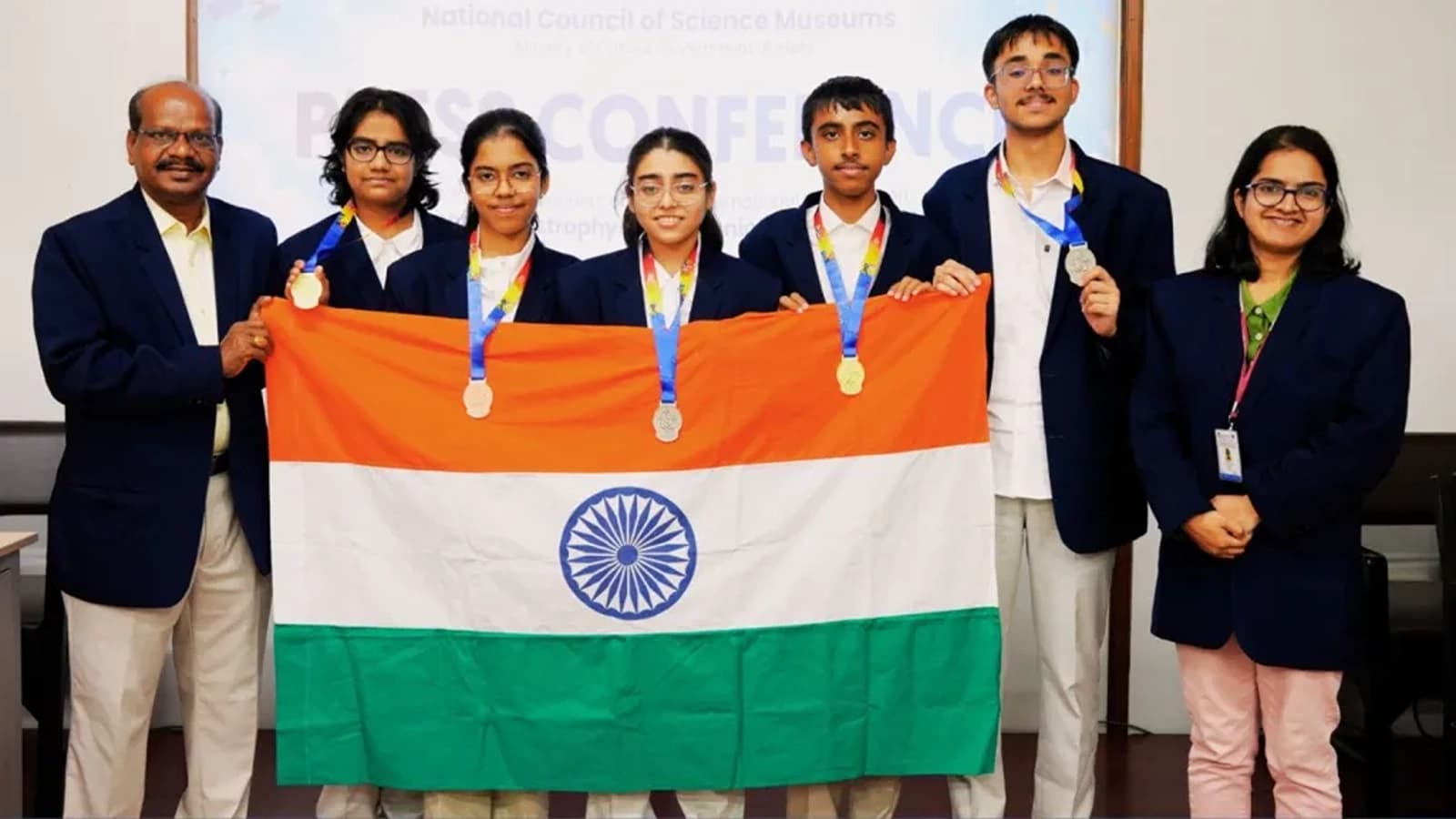
Indian students win five medals at Junior Astronomy Olympiad 2026.
India has secured five medals, including two gold, two silver and one bronze, at the 5th International Olympiad on Astronomy and Astrophysics for Juniors (IOAA-Jr) 2026, held in Thailand from November 1 to 8. All five students representing India won medals, marking an impressive performance at the international science competition. According to the National Council of Science Museums (NCSM), an autonomous organisation under the Ministry of Culture, Government of India, the Indian contingent competed against students from 24 other countries. The achievement highlights the growing interest and talent among young Indian students in astronomy and space science.
Meet India's Five Medal Winners

The Indian team included five students from different schools across four regions of the country. Two students secured gold medals, two won silver, while one brought home a bronze.
The medal winners are:
The achievement is particularly noteworthy because every member of India's five-student contingent secured an international medal.
Gold medallist Swara Srujal Patel described the experience of representing India as enriching and credited the training and guidance provided by NCSM for helping her prepare.
Silver medallist Krish Bhaskar also shared his ambition of becoming an astrophysicist. He highlighted the opportunity to interact with students from different countries as one of the memorable experiences of the competition.
What Is the Junior Astronomy Olympiad?
The International Olympiad on Astronomy and Astrophysics for Juniors (IOAA-Jr) is an international academic competition designed for school students below the age of 16. The competition tests students' knowledge of astronomy and astrophysics through theoretical and practical challenges. Participants are expected to understand astronomical concepts, interpret observations and apply scientific knowledge to solve problems. The 2026 edition was the fifth edition of the competition. It took place in Ubon Ratchathani, Thailand, from November 1 to 8. According to the official competition website, the event brought together 104 student participants from 25 countries, along with 53 team leaders and observers.
How Did India Perform Against Other Countries?
India's five-medal performance placed it among the countries with the highest medal totals at the competition. However, India was not the only country to win five medals. Thailand, China, Romania and Bulgaria also recorded five medals each, although their gold, silver and bronze distributions were different.
The country-wise medal tally included:
| Country | Gold | Silver | Bronze | Total |
| Thailand | 5 | 0 | 0 | 5 |
| China | 3 | 2 | 0 | 5 |
| India | 2 | 2 | 1 | 5 |
| Romania | 2 | 2 | 1 | 5 |
| Bulgaria | 1 | 3 | 1 | 5 |
The official results recorded 66 award recipients from 19 countries, including 16 gold medals, 21 silver medals, 16 bronze medals and 13 honourable mentions. This means India's achievement should be seen as a strong international performance rather than an overall first-place finish.
How Were Indian Students Selected and Trained?
The National Council of Science Museums (NCSM) was responsible for selecting and preparing India's team for the international competition. The selection process takes place through the Indian National Junior Astronomy Olympiad programme and involves multiple stages. Students first participate in the National Standard Examination in Junior Science (NSEJS), organised by the Indian Association of Physics Teachers (IAPT). Successful candidates move to the Indian National Junior Science Olympiad (INJSO), followed by the Orientation-cum-Selection Camp (OCSC).
Students selected through these stages receive specialised training in theoretical and observational astronomy. Their performance during the training process helps determine the final team representing India internationally. Before the 2026 competition, 25 shortlisted students underwent specialised preparation covering astronomy concepts, observation techniques and scientific problem-solving.
Why Is This Achievement Important for Indian Students?
The five-medal achievement goes beyond international recognition. It also highlights the importance of introducing students to scientific subjects at an early age. Astronomy requires students to understand mathematics, scientific principles, celestial objects and observational techniques. Competitions such as IOAA-Jr provide young learners with an opportunity to apply classroom knowledge to real scientific challenges.
The NCSM selection and training programme also offers students a structured pathway to explore astronomy beyond their regular school curriculum. For students interested in space science, such exposure can encourage them to pursue higher education and careers in astronomy, astrophysics and scientific research.
However, individual achievements should also draw attention to the need for wider access to science laboratories, trained teachers, research facilities and specialised learning opportunities across schools. India's performance at IOAA-Jr 2026 demonstrates the potential of its young scientific talent. With continued guidance and opportunities, more students could get the chance to represent the country at international science competitions.
India Wins Five Medals at Junior Astronomy Olympiad 2026; Students Secure Two Golds

Want to speak Japanese with anime characters? Japan is developing an AI-powered language education app
India’s Race to the Bottom of the Ocean: MATSYA-6000 Aims to Take Three Indians 6,000 Metres Deep

Why are 3 in 4 Singapore parents turning to private tuition despite trust in schools?
Delhi-NCR schools go hybrid: Which classes are affected and what parents should know?
Want to speak Japanese with anime characters? Japan is developing an AI-powered language education app
Why are 3 in 4 Singapore parents turning to private tuition despite trust in schools?
Delhi-NCR schools go hybrid: Which classes are affected and what parents should know?

One in three New Zealand students more than a year behind at school

Australia launches free disability resources to help teachers build inclusive classrooms

India Wins Five Medals at Junior Astronomy Olympiad 2026; Students Secure Two Golds
Want to speak Japanese with anime characters? Japan is developing an AI-powered language education app
India’s Race to the Bottom of the Ocean: MATSYA-6000 Aims to Take Three Indians 6,000 Metres Deep
Why are 3 in 4 Singapore parents turning to private tuition despite trust in schools?
Delhi-NCR schools go hybrid: Which classes are affected and what parents should know?
Want to speak Japanese with anime characters? Japan is developing an AI-powered language education app
Why are 3 in 4 Singapore parents turning to private tuition despite trust in schools?
Delhi-NCR schools go hybrid: Which classes are affected and what parents should know?
One in three New Zealand students more than a year behind at school
Australia launches free disability resources to help teachers build inclusive classrooms
Copyright© educationpost.in 2026 All Rights Reserved.