


University of Otago study finds persistent gaps in reading, writing and maths, with achievement declining sharply by Year 8 and significant disparities among student groups.

At least one in three students in New Zealand is more than a year behind expected achievement levels in reading, writing and mathematics, exposing persistent gaps in the country's education system, a new University of Otago study has found.
The latest Curriculum Insights and Progress Study, which assessed more than 6,000 students across 160 schools, found that average achievement levels have remained largely unchanged, despite small improvements in some areas. However, the findings reveal a widening gap between students meeting curriculum expectations and those struggling to keep pace, particularly in the upper year levels.

The research assessed students in Years 3, 6 and 8 in English-medium state and state-integrated schools, providing a nationally representative picture of achievement in the three core learning areas. The findings come at a significant point for New Zealand's education system, as the country prepares for the full implementation of its revised curriculum. The 2025 results represent the final dataset before the new curriculum is fully introduced, offering an important benchmark against which future progress can be measured.
Overall, mathematics showed modest improvement, while reading achievement remained stable. Writing recorded a slight but statistically significant improvement among Year 6 students between 2024 and 2025. However, the overall picture remains concerning, with large numbers of students falling behind as they progress through school.
Mathematics results revealed a particularly sharp decline in achievement across year levels. Only 24 per cent of Year 3 students and 26 per cent of Year 8 students were meeting or exceeding expected curriculum levels. Year 6 recorded a comparatively stronger result, with 36 per cent reaching the expected standard.
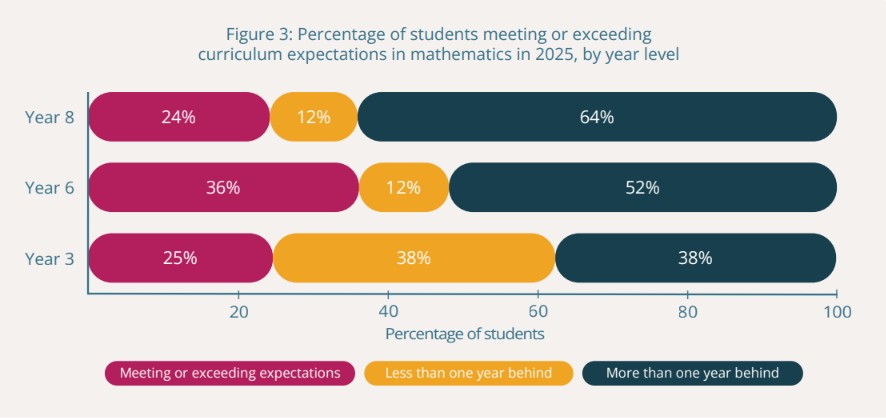
More concerning was the proportion falling significantly behind. Around 38 per cent of Year 3 students were more than a year behind expected levels. This increased to 52 per cent in Year 6 and 64 per cent by Year 8. The study also identified substantial differences in achievement among student groups. Māori and Pacific students recorded lower average scores than their non-Māori and non-Pacific peers, while students attending higher Equity Index (EQI) schools performed less strongly than those in lower EQI settings.
At Year 8, Māori students recorded an average mathematics score of 752, compared with 813 for non-Māori students, a gap of 61 points. Girls also recorded lower average mathematics attainment, although boys' scores showed greater variation within year levels.
Reading presented a relatively stronger picture, but the findings still point to considerable challenges. Just over half of Year 3 students (53 per cent) and Year 6 students (52 per cent) were meeting or exceeding expected reading levels. The proportion fell to 45 per cent by Year 8.
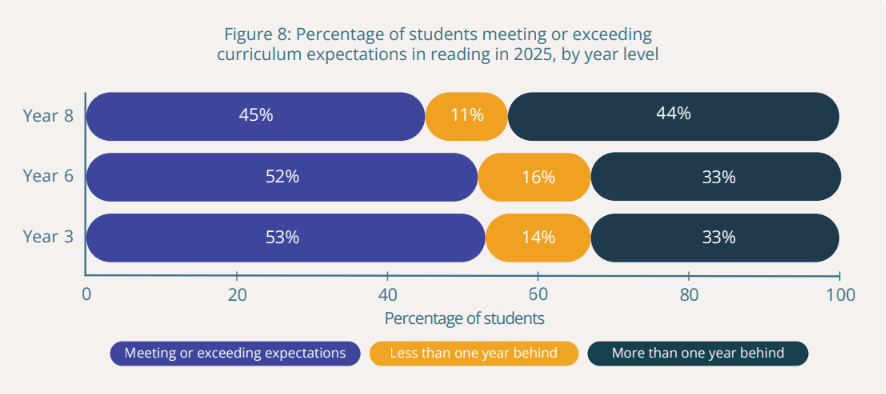
The share of students more than a year behind also increased with age, rising from around one-third in Years 3 and 6 to 44 per cent in Year 8. As in mathematics, Māori and Pacific students and those attending higher EQI schools recorded lower average scores. Girls performed better than boys in reading at Years 3 and 8, although the differences were relatively modest.
Writing recorded the lowest achievement levels across the three learning areas, with performance declining considerably as students progressed through school.
Only 41 per cent of Year 3 students met or exceeded expected writing standards. The figure dropped to 38 per cent in Year 6 and just 28 per cent in Year 8. The gap was particularly pronounced among older students. Nearly three-quarters (72 per cent) of Year 8 students were below expected writing levels, while 56 per cent were more than a full school year behind.
The study also highlighted significant differences between schools serving different socioeconomic communities. Students in lower EQI schools achieved higher average writing scores than their counterparts in higher EQI schools, with the differences described as large and statistically significant. Achievement gaps were also evident between Māori and Pacific students and their peers, although the disparity was smaller for Pacific students than for Māori students.
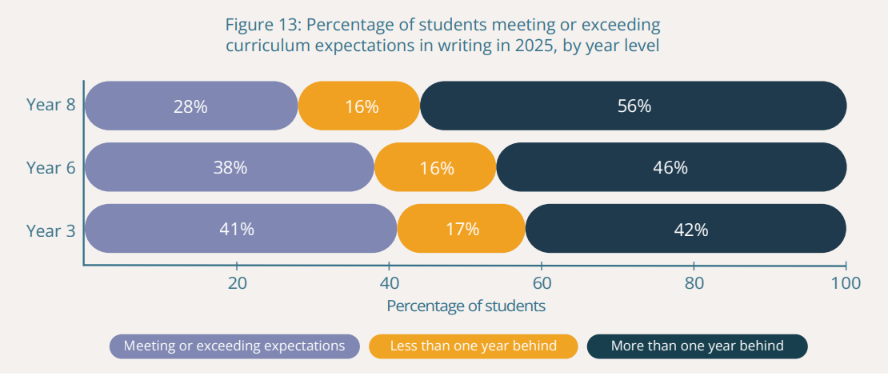
Girls consistently outperformed boys in writing across all three year levels.
While the study recorded some encouraging signs of improvement, particularly in mathematics and Year 6 writing, the overall findings underline the scale of the challenge facing New Zealand schools.
The proportion of students falling behind, especially in writing and mathematics, raises important questions about how effectively schools are identifying learning difficulties and supporting students before achievement gaps become more difficult to close. With the revised curriculum set to shape the next phase of education, the 2025 findings provide a crucial baseline for assessing whether the changes translate into stronger learning outcomes and more equitable opportunities for students.

India Wins Five Medals at Junior Astronomy Olympiad 2026; Students Secure Two Golds

Want to speak Japanese with anime characters? Japan is developing an AI-powered language education app

India’s Race to the Bottom of the Ocean: MATSYA-6000 Aims to Take Three Indians 6,000 Metres Deep

Why are 3 in 4 Singapore parents turning to private tuition despite trust in schools?

Delhi-NCR schools go hybrid: Which classes are affected and what parents should know?
Want to speak Japanese with anime characters? Japan is developing an AI-powered language education app
Why are 3 in 4 Singapore parents turning to private tuition despite trust in schools?
Delhi-NCR schools go hybrid: Which classes are affected and what parents should know?

One in three New Zealand students more than a year behind at school

Australia launches free disability resources to help teachers build inclusive classrooms

India Wins Five Medals at Junior Astronomy Olympiad 2026; Students Secure Two Golds
Want to speak Japanese with anime characters? Japan is developing an AI-powered language education app
India’s Race to the Bottom of the Ocean: MATSYA-6000 Aims to Take Three Indians 6,000 Metres Deep
Why are 3 in 4 Singapore parents turning to private tuition despite trust in schools?
Delhi-NCR schools go hybrid: Which classes are affected and what parents should know?
Want to speak Japanese with anime characters? Japan is developing an AI-powered language education app
Why are 3 in 4 Singapore parents turning to private tuition despite trust in schools?
Delhi-NCR schools go hybrid: Which classes are affected and what parents should know?
One in three New Zealand students more than a year behind at school
Australia launches free disability resources to help teachers build inclusive classrooms
Copyright© educationpost.in 2026 All Rights Reserved.