


With unmanned trials reported in November 2026, India is moving closer to its first human deep-sea mission, targeted for 2028, under the Samudrayaan project.
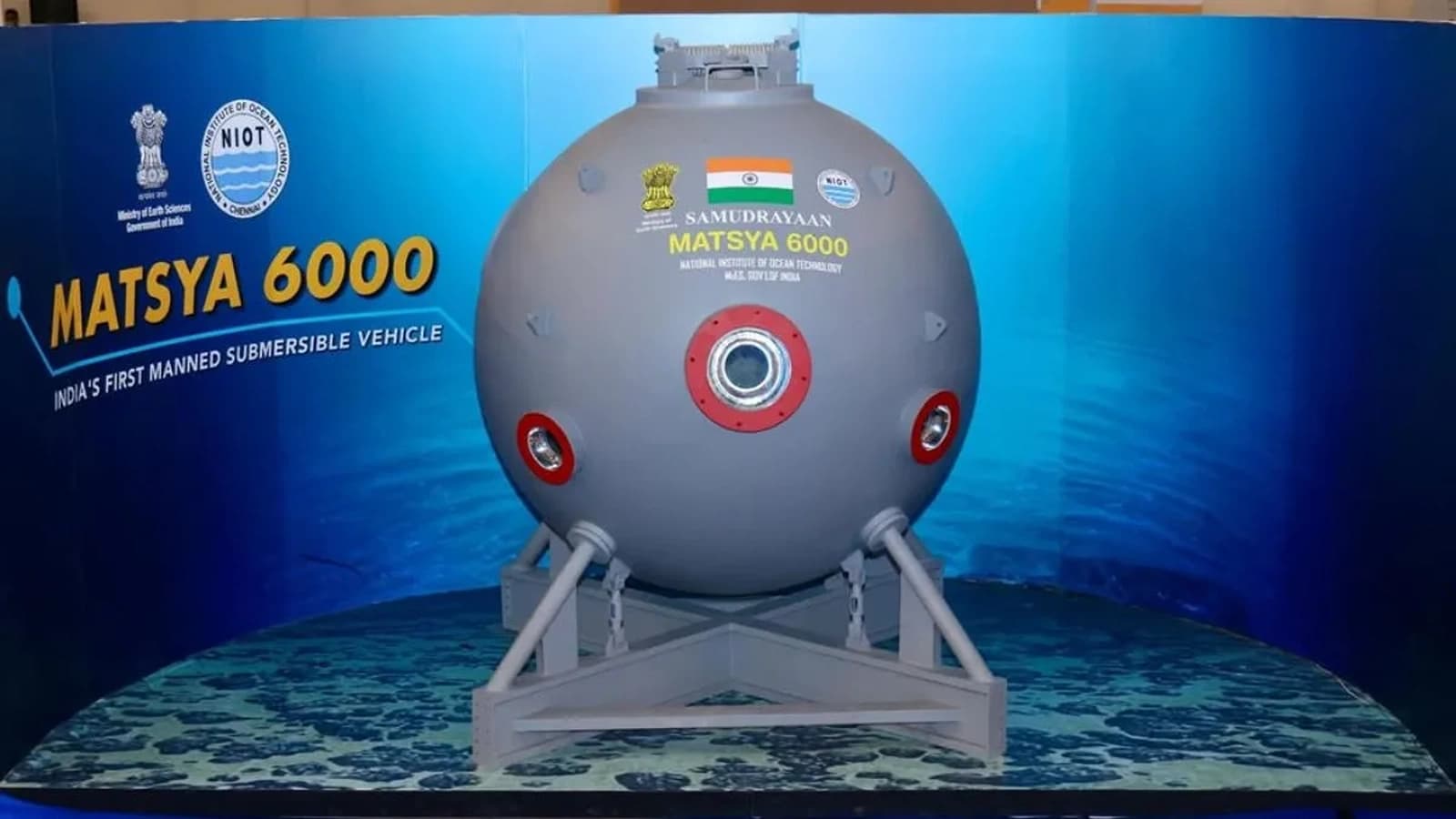
MATSYA-6000 is being developed to carry three aquanauts to a depth of 6,000 metres.
India is preparing to explore one of the least understood parts of the planet: the deep ocean. At the center of this effort is MATSYA-6000, an indigenous submersible designed to carry three people to a depth of 6,000 metres below sea level. The National Institute of Ocean Technology (NIOT), Chennai, is developing the vehicle under the Samudrayaan project, which is part of the government’s Deep Ocean Mission. The project aims to strengthen India's ability to study deep-sea life, map underwater resources and develop technologies for ocean exploration.
According to the report, MATSYA-6000 underwent unmanned trials at the L&T shipyard in Kattupalli, Tamil Nadu, on November 6, 2026. The trials mark progress toward the larger mission, but they do not mean that a crewed dive to 6,000 metres has already taken place. The government has set 2028 as the target for India's first human deep-sea mission to a depth of up to 6,000 metres, Union Minister of State for Earth Sciences Jitendra Singh said on November 4, 2026.

What Is MATSYA-6000 and How Will It Work?
MATSYA-6000 is a human-operated deep-sea submersible designed to take three aquanauts underwater. It is being developed by NIOT under the Ministry of Earth Sciences. Its most important safety feature is a strong spherical cabin made from titanium alloy. According to the Indian Space Research Organisation (ISRO), the sphere has a diameter of approximately 2.26 metres and walls around 80 millimetres thick. It is designed to withstand external pressure of up to 600 bar. At a depth of 6,000 metres, the pressure is roughly 600 times greater than atmospheric pressure at sea level. The submersible must therefore protect its occupants while supporting communication, navigation, power and life-support systems. The vehicle is designed for missions lasting up to 12 hours, with emergency endurance of up to 96 hours, according to government information.
What Lies 6,000 Metres Beneath the Ocean?
At this depth, MATSYA-6000 will enter the abyssal region, where sunlight cannot reach and temperatures are close to freezing. Despite these extreme conditions, the deep ocean is not lifeless. It contains unusual marine organisms, microbes and creatures that produce their own light, a process known as bioluminescence. Some life forms survive around hydrothermal vents, where mineral-rich hot water emerges from the ocean floor. Instead of depending directly on sunlight, certain organisms rely on chemical energy to survive. Studying these environments could help scientists understand marine biodiversity, ocean ecosystems and how life adapts to extreme conditions.
Why Is India Exploring the Deep Ocean?
The mission is not limited to scientific discovery. India is also interested in understanding the mineral resources present on the ocean floor. One area of interest is polymetallic nodules—rock-like deposits that contain minerals such as manganese, nickel, cobalt and copper. These materials are used in several industries, including battery manufacturing, electronics and infrastructure. India has an exploration area in the Central Indian Ocean Basin. However, the presence of mineral resources does not mean that commercial extraction has begun. In a written reply to Parliament in March 2026, the government clarified that commercial deep-sea mining is governed by rules being developed by the International Seabed Authority (ISA). The required exploitation framework had not yet been finalized at that time.
Deep Ocean Mission: More Than a Submarine Project
Launched in September 2021, the Deep Ocean Mission has a broader scientific and economic agenda. According to the Ministry of Earth Sciences, it has six major areas of work:
The mission has an approved outlay of ₹4,077 crore and is intended to build India's long-term capabilities in ocean science and technology.
Reaching 6,000 metres is a major engineering challenge. The submersible must withstand extreme pressure while ensuring that its life-support, navigation, communication and emergency systems work reliably. There are also environmental questions. Deep-sea ecosystems remain poorly understood, and large-scale mining could disturb habitats that may take a long time to recover. Scientific exploration and any future commercial activity will therefore require careful environmental assessment. For now, MATSYA-6000 represents an important step in India's effort to develop its own deep-ocean technology. The next major milestone will be demonstrating that the vehicle can safely complete increasingly demanding underwater tests before carrying a human crew to the ocean floor. The 2028 target is ambitious, but the mission's success will depend not only on reaching the required depth, but also on ensuring the safety of its crew and the protection of the marine environment.

India Wins Five Medals at Junior Astronomy Olympiad 2026; Students Secure Two Golds

Want to speak Japanese with anime characters? Japan is developing an AI-powered language education app
India’s Race to the Bottom of the Ocean: MATSYA-6000 Aims to Take Three Indians 6,000 Metres Deep

Why are 3 in 4 Singapore parents turning to private tuition despite trust in schools?

Delhi-NCR schools go hybrid: Which classes are affected and what parents should know?
Want to speak Japanese with anime characters? Japan is developing an AI-powered language education app
Why are 3 in 4 Singapore parents turning to private tuition despite trust in schools?
Delhi-NCR schools go hybrid: Which classes are affected and what parents should know?

One in three New Zealand students more than a year behind at school

Australia launches free disability resources to help teachers build inclusive classrooms

India Wins Five Medals at Junior Astronomy Olympiad 2026; Students Secure Two Golds
Want to speak Japanese with anime characters? Japan is developing an AI-powered language education app
India’s Race to the Bottom of the Ocean: MATSYA-6000 Aims to Take Three Indians 6,000 Metres Deep
Why are 3 in 4 Singapore parents turning to private tuition despite trust in schools?
Delhi-NCR schools go hybrid: Which classes are affected and what parents should know?
Want to speak Japanese with anime characters? Japan is developing an AI-powered language education app
Why are 3 in 4 Singapore parents turning to private tuition despite trust in schools?
Delhi-NCR schools go hybrid: Which classes are affected and what parents should know?
One in three New Zealand students more than a year behind at school
Australia launches free disability resources to help teachers build inclusive classrooms
Copyright© educationpost.in 2026 All Rights Reserved.