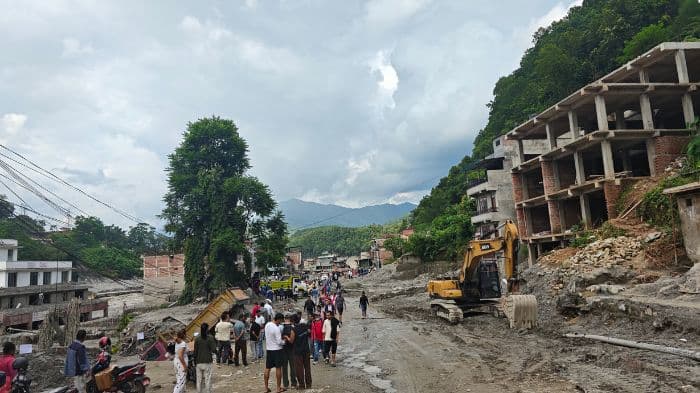
A new study has found that climate change likely contributed to the glacier collapse that triggered deadly floods along the Nepal-Tibet border in August, with rising temperatures, glacier retreat and thawing permafrost adding to the instability of the Himalayan slope.
A World Weather Attribution analysis released on Sep 17 found that the Aug 26 disaster in Nepal’s Rasuwa district involved a chain of geological and climate-related processes.

The study said the disaster was a “compound event” involving climate-related changes as well as geological factors. It found that temperatures in July and August were about 1.5C warmer due to human-induced climate change, while glaciers in the region have been thinning by about half a metre a year.
Researchers said a large section of rock wall on Langtang Lirung collapsed at about 5,150 metres above sea level, taking part of the glacier with it. The resulting rock-ice avalanche transformed into a debris flood and then a water-dominated flash flood.
The collapse released an exceptionally large volume of rock and ice. According to the analysis, the material fell about 1,400 metres to the valley floor and generated seismic waves equivalent to a magnitude 5.5 earthquake. The seismic signal was initially detected as an earthquake, but later evidence linked it to the collapse itself.
The scale and speed of the resulting flood made the disaster particularly difficult to respond to. The World Weather Attribution study said the flow reached the Rasuwagadhi border, about 22 km downstream, within seven minutes, travelling at an average speed of 188 km per hour.
It then moved through the Trishuli valley, carrying water, ice, rocks and sediment into settlements and infrastructure downstream.
Researchers said the underlying geology was central to the collapse. A magnitude 7.8 earthquake in 2015 had previously triggered a major rock-ice avalanche at Langtang Lirung.
The new analysis said that earthquake may have weakened the underlying rock over time, although its specific contribution to the 2026 collapse could not be confirmed.
Climate-related changes, however, may have added further instability. The researchers found that glaciers in the region have been losing mass at a rate equivalent to more than half a metre of thinning each year.
The retreat of the Langtang-Lirung glacier has also accelerated since 2010. Glacier thinning can alter the forces acting on nearby rock walls and potentially weaken existing fractures.
Permafrost degradation is another factor. As temperatures rise, ice within fractures in mountain rock can thaw. The loss of ice that helps bind fractured rock together can reduce its strength, while meltwater can increase pressure within fractures. Researchers said these processes may have contributed to the weakening of the slope.
The analysis also found that the freezing level in the region has shifted upward by about 100 metres per decade in recent decades. This can contribute to permafrost degradation, glacier thinning and changes in the point at which precipitation falls as rain rather than snow.
Temperatures immediately before the disaster were also unusually high. The researchers found that July and August 2026 temperatures near the site were about 1.5 degrees Celsius higher because of human-caused climate change when compared with a hypothetical pre-industrial climate that was 1.4 degrees Celsius cooler. The study also identified a warm 12-month period preceding the collapse.
However, the researchers have drawn a distinction between climate influence and direct causation. They said they did not assess whether the specific rock-ice avalanche would have occurred without human-induced climate change.
Establishing that would require further evidence about subsurface temperatures, water pressure within fractures and the mechanical development of the slope.
The disaster has also exposed the difficulty of protecting communities from rapidly developing hazards in the high Himalayas. The World Weather Attribution analysis said Nepal's existing warning and disaster-risk systems can help with more conventional river floods, but the magnitude, speed and complexity of the August event were beyond the predictive and design limits of existing measures.
Nepal's disaster authorities have continued updating the scale of the tragedy. As of Sep 16, the National Disaster Risk Reduction and Management Authority reported 1,403 deaths and 6,150 people missing in Nepal, after verification increased the missing figure from 5,179. The authority also reported 13,742 people rescued.
The findings therefore do not establish a simple climate-change-to-flood link. Instead, they describe a cascading disaster in which a geologically vulnerable mountain slope was affected by several interacting factors, including an earlier earthquake, glacier retreat, permafrost degradation, changing precipitation and unusually warm conditions. Researchers said warming should be understood as a destabilising factor acting on an existing geological vulnerability.