Nepal floods expose a growing Himalayan climate risk as glaciers, slopes become increasingly unstable
The Nepal flash floods have highlighted how glacier loss, unstable mountain slopes and cascading hazards are increasing disaster risks across the Himalayas, even as scientists continue to assess the precise role of climate change in the devastating Aug 26 flash floods.
EPN Desk29 August 2026 07:52
Photo: IANS
The devastating flash floods along the Nepal-Tibet border have drawn fresh attention to a growing climate risk in the Himalayas, where rising temperatures, retreating glaciers and increasingly unstable mountain slopes are making disaster events more complex and difficult to predict.
The Aug 26 disaster was not a conventional rain-triggered flood. Initial scientific assessments indicate that a large section of glacier and underlying rock detached at an altitude of around 5,200 metres, triggering a massive ice-and-rock avalanche. The avalanche moved into the river system, carrying ice, rock and sediment and temporarily blocking the river. The subsequent failure of the debris blockage sent a powerful surge downstream, a report in The Conversation said.
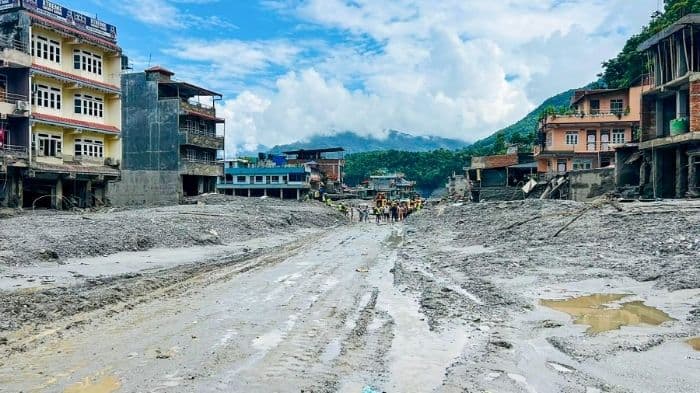
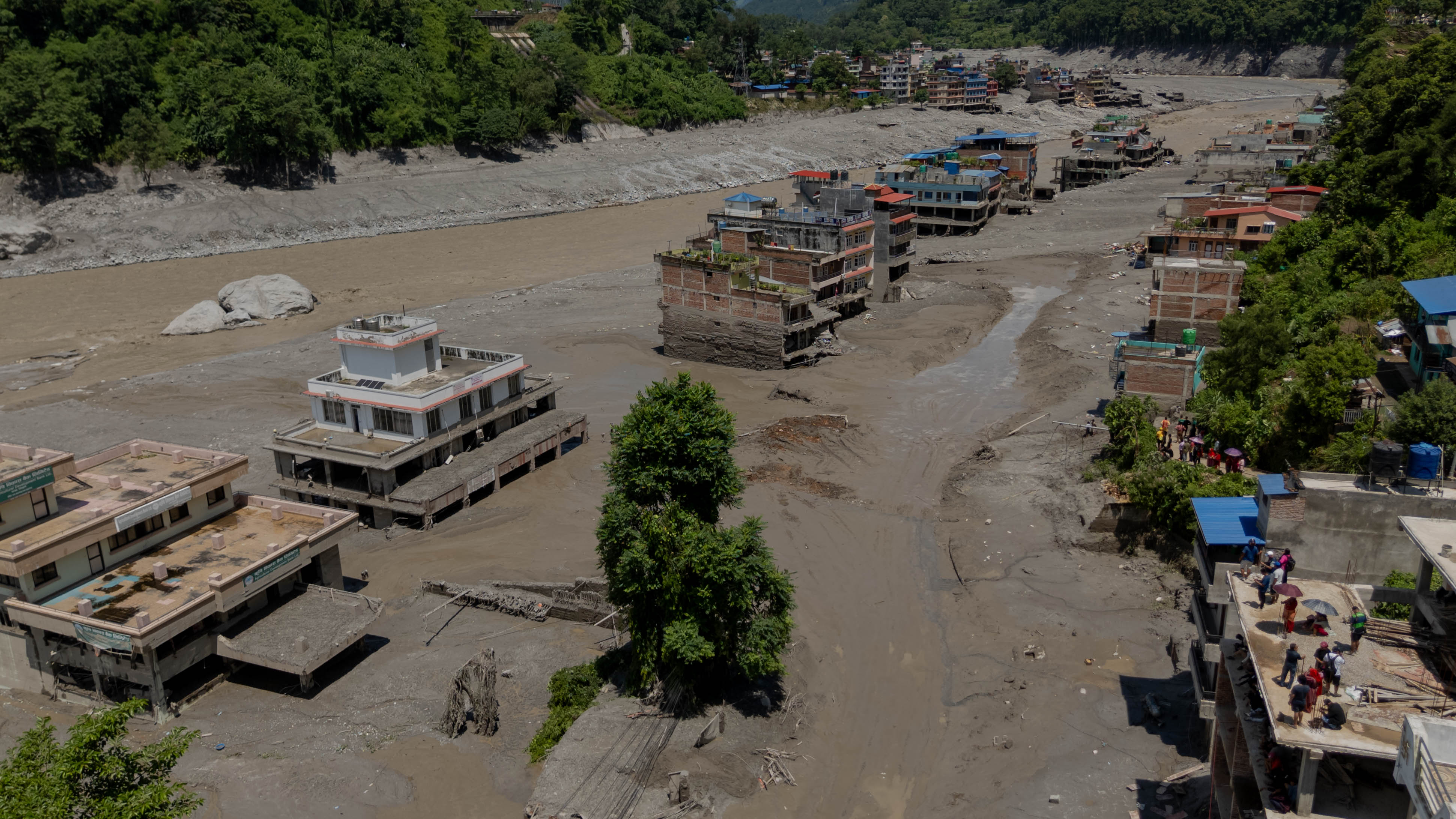
The resulting flood devastated settlements and infrastructure along the river system in Nepal. Water levels in the Trishuli River reportedly rose by as much as nine metres within 30 minutes. Roads, bridges, homes and other infrastructure were swept away, while hundreds of people were killed or reported missing across Nepal and Tibet.
Scientists describe this type of disaster as a cascading hazard, in which one natural event triggers another and the hazard changes as it moves through the landscape, it said.
In this case, the sequence appears to have involved a glacier and rock collapse, an avalanche, a temporary river blockage and its subsequent failure, followed by a destructive flood laden with debris.
The exact sequence is still being investigated. Experts have cautioned that satellite observations provide important evidence, but determining the precise trigger and contribution of individual factors will require further assessment on the ground.
A warming Himalayas
What has made the disaster particularly significant for climate scientists is the environment in which it occurred.
The Hindu Kush Himalaya region is warming rapidly, and its glaciers have been losing ice at an accelerating rate. According to assessments cited by scientists, glaciers across the Hindu Kush Himalaya lost ice 65% faster between 2011 and 2020 than during the previous decade. Nepal's glaciers have also lost close to one-third of their ice volume over roughly three decades.
Climate change does not mean that every glacier collapse or flood can automatically be attributed to global warming. Scientists studying the Nepal disaster have specifically stressed that it is too early to determine how much climate change contributed to this particular event.
However, there is strong scientific evidence that warming is changing the physical conditions of high mountain environments.
As glaciers retreat, mountain landscapes can become less stable. Permafrost, or permanently frozen ground, can also thaw as temperatures rise. Scientists say this frozen ground can act as a form of structural support for steep mountain slopes, meaning its degradation can contribute to greater instability.
This creates the possibility of a chain reaction in which changes occurring high in the mountains can eventually produce severe impacts far downstream.
The danger does not end with the first flood
The Nepal disaster also illustrates why conventional disaster planning can struggle with cascading events.
A community may be prepared for heavy rainfall and river flooding but remain vulnerable to a sudden combination of an avalanche, landslide, temporary river blockage and debris flow. Such events can unfold rapidly and give communities little time to respond.
Researchers at the University of Reading have noted that the time available for warnings can be extremely short close to the source of a high-mountain event. Further downstream, however, the hazard can evolve as floodwaters erode riverbanks, pick up sediment and destabilise slopes. This means that different communities along the same river may face different risks from the same originating event.
The Himalayas also face another major glacial threat: glacial lake outburst floods. As glaciers retreat, meltwater can accumulate in lakes held back by natural dams. If those dams fail, large volumes of water can suddenly move downstream.
Nepal has more than 2,000 glacial lakes, with 21 identified as potentially dangerous, according to figures cited by experts.
These risks are particularly important because Himalayan rivers cross national borders. A disturbance originating in a remote high-altitude area can therefore affect communities, infrastructure and water systems many kilometres away and across national boundaries.
Early warning becomes more important
The disaster has also renewed questions about the ability of existing warning systems to detect rapidly developing high-altitude hazards.
Experts say early warning does not necessarily require authorities to know the precise mechanism of an event before issuing an alert. Monitoring river levels, glacier movement, landslides and other indicators can help identify rapidly developing threats.
But the challenge is especially acute in remote mountain terrain, where monitoring infrastructure is limited and communication networks can be disrupted by the very disasters authorities are trying to respond to.
The Nepal disaster therefore represents more than another devastating flood. It demonstrates how climate-driven changes in the Himalayan environment can interact with geological processes to produce hazards that are difficult to classify, predict and manage.
Scientists are still determining the precise role climate change played in the August 26 collapse. But the wider trend is clear: the Himalayas are losing ice rapidly, mountain environments are changing and communities downstream are increasingly exposed to the consequences.
For countries sharing the Himalayan region, the challenge is not simply to prepare for floods, landslides or avalanches individually. It is to understand how these hazards can interact, strengthen one another and move rapidly from remote mountain areas into populated valleys.











.jpg&w=256&q=75)
.jpg&w=256&q=75)
.webp&w=256&q=75)
