


Centre to Set Up Committee to Review Equity Regulations Following Supreme Court Concerns
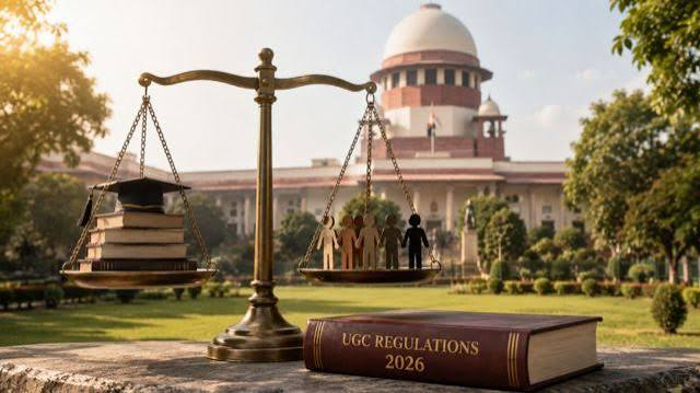
The Centre on Thursday informed the Supreme Court that it is considering setting up a committee to review the University Grants Commission (Promotion of Equity in Higher Education Institutions) Regulations, 2026, which were stayed by the court earlier this year over concerns regarding their neutrality and scope.
Solicitor General Tushar Mehta told a three-judge bench headed by Chief Justice of India Surya Kant that the government was contemplating the formation of a committee to reconsider the provisions. The bench, comprising Justices Joymalya Bagchi and V Mohana, urged the Centre to revisit the regulations to ensure that they protect the interests of all students.

The Chief Justice observed that the rules should be framed in a manner that safeguards every student and addresses the concerns of future generations.
Controversy Over Definition of Caste-Based Discrimination
Notified on January 13, 2026, the regulations triggered widespread criticism from general category groups as well as sections of Dalit and OBC communities.
The main objection concerns Regulation 3(1)(c), which defines caste-based discrimination as discrimination against members of Scheduled Castes, Scheduled Tribes and Other Backward Classes on the basis of caste or tribe.
Petitioners argued that this definition excludes general category students and faculty from specific protection against caste-based discrimination. However, the broader definition of discrimination under the regulations covers unfair treatment based on caste against any stakeholder.
Supreme Court Raises Constitutional Concerns
The regulations originated from a 2019 petition filed by the mothers of Payal Tadvi and Rohith Vemula, who died by suicide following alleged caste-based discrimination.
On January 29, the Supreme Court stayed the regulations and raised questions concerning their constitutional validity. It sought clarity on whether the definition of caste-based discrimination adequately serves the regulations' objectives and whether vulnerable communities receive sufficient protection.
The court also questioned provisions relating to segregation in hostels, classrooms and mentorship groups, examining whether they could violate constitutional guarantees of equality and fraternity under Articles 14 and 15.
Additionally, it raised concerns over the omission of ragging as a specific form of discrimination, questioning whether this could undermine protections available to victims under Articles 14 and 21.

Joint List Extends Support to Eisenkot as Coalition Talks Continue
Centre Plans Committee to Reconsider 2026 UGC Equity Regulations After Supreme Court Questions

CERN experiment captures evidence of a rare particle decay that could test physics theories

Cambridge spinout uses AI and quantum computing to explore new treatments for heart disease

Google invests over US$6 million in AI research and education initiatives in Singapore
Google invests over US$6 million in AI research and education initiatives in Singapore

Cabinet Approves ₹4,371 Crore VISTAR Scheme to Modernize India's Statistical System

AI tutor outperforms classroom learning in US university trial, OECD report finds

Why will students lose Google Search access if schools reject Google's AI tools? Company announces new rules

Australian experts back school digital detox as concerns grow over AI and screen use

Joint List Extends Support to Eisenkot as Coalition Talks Continue
Centre Plans Committee to Reconsider 2026 UGC Equity Regulations After Supreme Court Questions
CERN experiment captures evidence of a rare particle decay that could test physics theories
Cambridge spinout uses AI and quantum computing to explore new treatments for heart disease
Google invests over US$6 million in AI research and education initiatives in Singapore
Google invests over US$6 million in AI research and education initiatives in Singapore
Cabinet Approves ₹4,371 Crore VISTAR Scheme to Modernize India's Statistical System
AI tutor outperforms classroom learning in US university trial, OECD report finds
Why will students lose Google Search access if schools reject Google's AI tools? Company announces new rules
Australian experts back school digital detox as concerns grow over AI and screen use
Copyright© educationpost.in 2026 All Rights Reserved.