


The funding supports Alzheimer's research, AI safety, computing efficiency, regional language processing and a customized platform to strengthen doctoral education, scientific capabilities and responsible technology development.
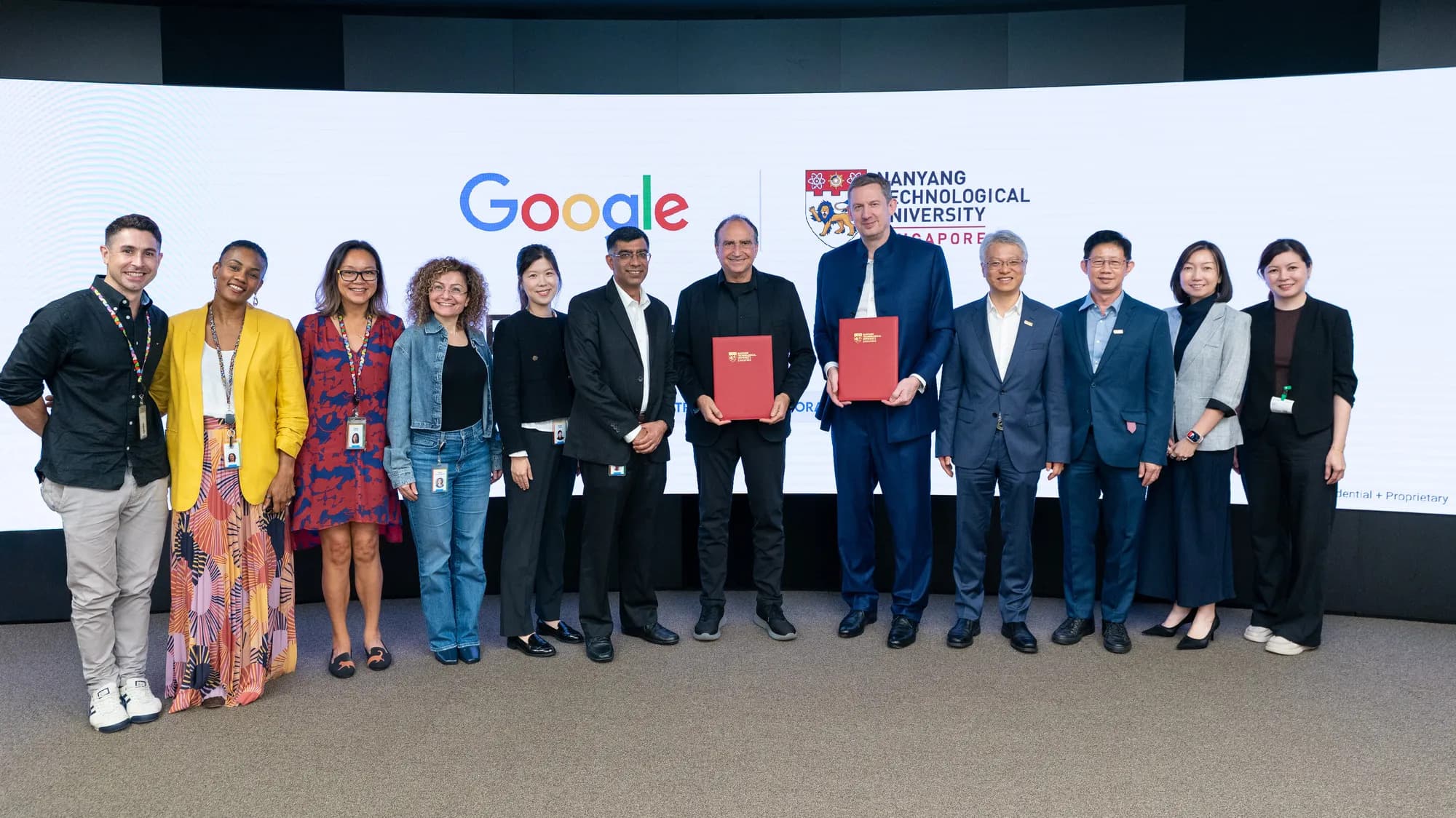
Singapore's universities and research institutions are receiving more than US$6 million in new funding from Google to strengthen artificial intelligence (AI) research, improve computing efficiency and support scientific innovation.
The investment will support research projects at the National University of Singapore (NUS), Nanyang Technological University (NTU) and INSEAD's Thrive Lab in Singapore.

The funding covers research into Alzheimer's disease, AI safety, computing efficiency, regional language processing and the responsible use of AI. It will also support institutional infrastructure, academic capacity-building and research into how people and organizations can adapt to technological changes.
Among the major allocations, NTU has received a US$750,000 grant through Google.org's AI for Science Capacity Fund. The funding will help the university strengthen its AI capabilities in scientific research and graduate education while developing long-term research infrastructure.
The initiative is being led by NTU President Professor Ho Teck Hua and Provost Professor Christian Wolfrum. It aims to establish sustainable research facilities, develop internal AI research agents and introduce ethical frameworks for using artificial intelligence in scientific work.
The project will be implemented through NTU's Graduate College under the leadership of Dean Professor Yonggang Wen. Its initial focus will be on transforming doctoral education and research through a customized AI for Science (AI4Science) platform being jointly developed by Google and NTU.
The platform is intended to strengthen the university's research capabilities and provide graduate students and researchers with AI-based resources for scientific investigation. The initiative will also contribute to building institutional expertise and supporting the wider research community across Southeast Asia.
Google expands AI research funding at Singapore universities
The investment is part of Google's broader effort to strengthen academic partnerships in Singapore and support scientific research through artificial intelligence.
The company is also expanding its research presence in the country through a newly established research hub in Singapore and existing health research initiatives. These efforts include introducing open AI models such as MedGemma to frontline healthcare settings.
Google said its latest funding commitments include more than US$6 million in research grants and capacity-building initiatives at NUS and NTU, alongside support for INSEAD's research activities in Singapore.
The funding addresses both immediate scientific challenges and foundational areas of computing. These include biomedical research, more efficient machine learning systems, regional language technologies and the development of safer AI applications.
NUS receives US$1.5 million for Alzheimer's disease research
The National University of Singapore has received a US$1.5 million Google.org Impact Challenge grant to advance research into Alzheimer's disease and other neurodegenerative conditions.
The university was selected from more than 3,500 applications submitted globally. The project will use artificial intelligence models and data science to support research and explore potential scientific breakthroughs in neurodegenerative disease.
The funding will help researchers strengthen their ability to analyze scientific data and apply AI-based approaches to complex biomedical questions. The initiative forms part of Google's efforts to support foundational research addressing major health challenges.
NUS secures US$500,000 for computing efficiency and regional languages
Another US$500,000 allocation to NUS will support work on machine learning efficiency and regional language processing.
The research will focus on sustainable computing and optimizing model-serving systems. These areas are important for improving the efficiency of AI technologies and reducing the computing resources required to operate machine learning models.
The funding will also support regional language processing, an area aimed at improving AI systems' ability to work with languages used across different communities.
The initiative combines improvements in computing infrastructure with efforts to make AI technologies more inclusive of regional linguistic requirements.
NTU receives US$340,000 for AI safety and security research
NTU will also receive US$340,000 to support four sponsored research studies focusing on AI safety and security.
The projects will examine different aspects of developing reliable and responsible artificial intelligence systems. Their research areas include AI safety frameworks, robust evaluation methodologies, trustworthy multi-agent systems and privacy-preserving large language model (LLM) watermarking.
The studies are expected to contribute to methods for evaluating AI systems, strengthening their reliability and addressing privacy and security concerns.
Together with the US$750,000 AI for Science Capacity Fund grant, the additional funding will support NTU's efforts to develop research infrastructure and advance responsible AI applications.
Google and Google DeepMind provide US$3 million to INSEAD's Thrive Lab
Beyond university-based scientific research, Google.org and Google DeepMind are providing US$3 million to support INSEAD's Thrive Lab in Singapore.
The funding will help the research center examine how individuals, organizations and communities can adapt to rapid technological developments.
The lab will investigate the role of education, workplaces and communities in helping people develop relevant skills, discover a sense of purpose and maintain meaningful relationships as technology changes how they live and work.
Its research will focus on understanding how people and organizations can thrive alongside technological advancements rather than simply adapting to new tools.
The initiative adds a human-centered dimension to Google's wider investment in AI research and capacity-building across Singapore.
AI investment targets scientific research and future scholars
Google's funding initiatives reflect the growing role of artificial intelligence in addressing scientific challenges and strengthening research capabilities.
The projects span several areas, from developing new approaches to neurodegenerative disease research to improving machine learning efficiency and supporting regional languages.
They also place emphasis on establishing institutional infrastructure, training future researchers and developing safeguards for the responsible use of AI.
Through its partnerships with NUS, NTU and INSEAD, Google aims to support faculty members, researchers and students working on scientific innovation and the future applications of artificial intelligence.
The initiatives are expected to strengthen Singapore's academic research ecosystem while contributing to broader scientific and technological development across the region.
Google invests over US$6 million in AI research and education initiatives in Singapore

Bihar Schools to Introduce Maithili, Bhojpuri, Magahi and Four Other Regional Languages from 2027

Bihar Schools to Introduce Six Regional Languages in Classes 1 and 2 From 2026-27: Bhojpuri, Maithili, Magahi Among Them

Delhi High Court Seeks CBSE, NCERT Response on Calculator Use in Class 12 Board Exams

Manipur Board Practical Exam 2027: Class 11, 12 Schedule Released; Exams to Begin in January
Google invests over US$6 million in AI research and education initiatives in Singapore

Cabinet Approves ₹4,371 Crore VISTAR Scheme to Modernize India's Statistical System

AI tutor outperforms classroom learning in US university trial, OECD report finds

Why will students lose Google Search access if schools reject Google's AI tools? Company announces new rules

Australian experts back school digital detox as concerns grow over AI and screen use

Google invests over US$6 million in AI research and education initiatives in Singapore
Bihar Schools to Introduce Maithili, Bhojpuri, Magahi and Four Other Regional Languages from 2027
Bihar Schools to Introduce Six Regional Languages in Classes 1 and 2 From 2026-27: Bhojpuri, Maithili, Magahi Among Them
Delhi High Court Seeks CBSE, NCERT Response on Calculator Use in Class 12 Board Exams
Manipur Board Practical Exam 2027: Class 11, 12 Schedule Released; Exams to Begin in January
Google invests over US$6 million in AI research and education initiatives in Singapore
Cabinet Approves ₹4,371 Crore VISTAR Scheme to Modernize India's Statistical System
AI tutor outperforms classroom learning in US university trial, OECD report finds
Why will students lose Google Search access if schools reject Google's AI tools? Company announces new rules
Australian experts back school digital detox as concerns grow over AI and screen use
Copyright© educationpost.in 2026 All Rights Reserved.