


The fourth edition attracted over 38,000 registrations from 12,000 schools across 705 districts, highlighting student-led solutions in groundwater conservation, water safety, cybersecurity and assistive technology.
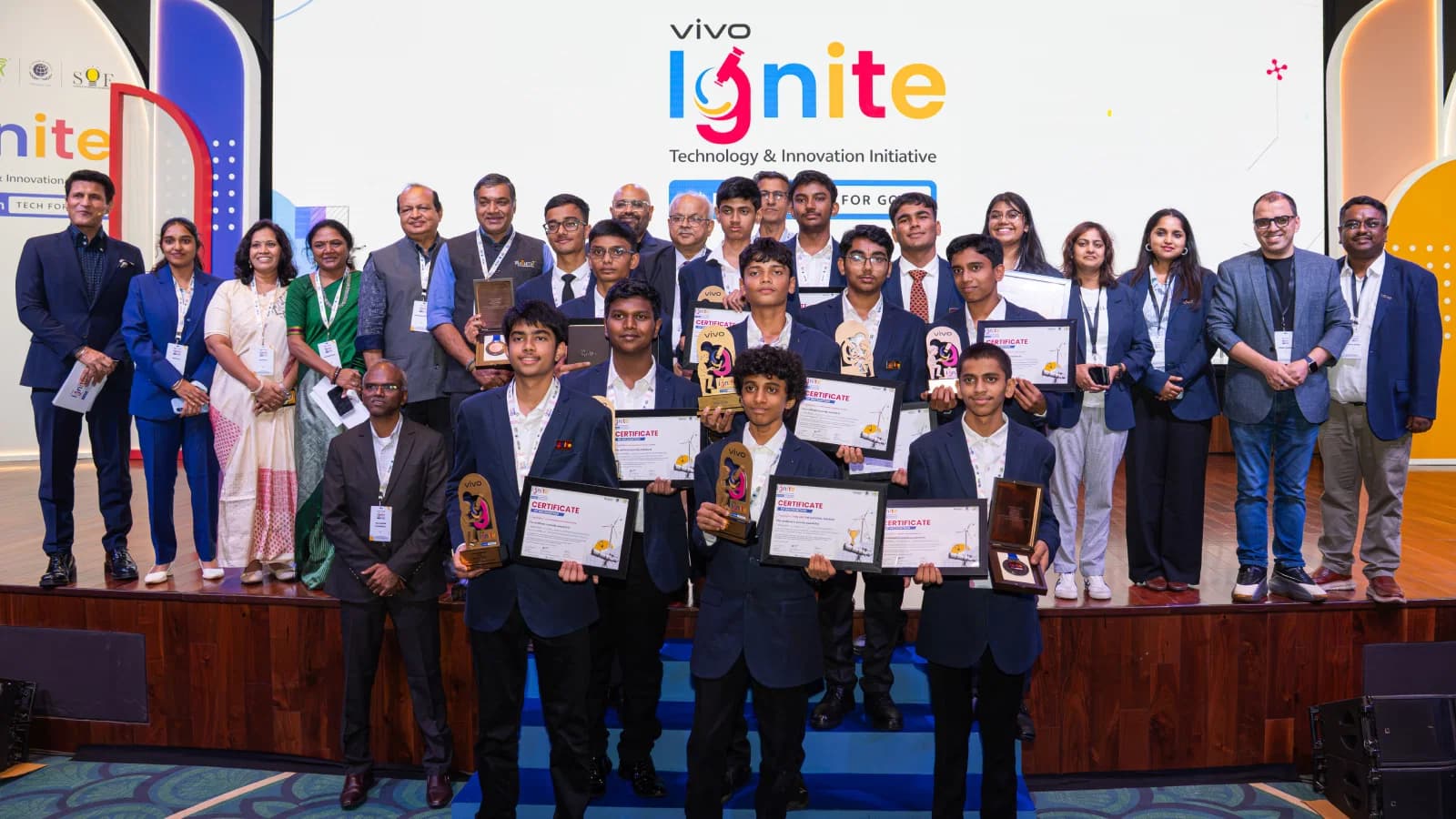
vivo India has announced the national winner and recognized the top 10 student innovations under the fourth edition of vivo Ignite 2026, its nationwide technology and innovation initiative for students in Grades 8 to 12.
Dheyay Shah of RMG Maheshwari English School in Surat, Gujarat, secured the national title for JALAAKAR, a machine-learning-based project designed to estimate groundwater availability.

The winner was announced at the vivo Ignite 2026 National Finale held at Bharat Mandapam in New Delhi on Oct 28, 2026. The initiative offers educational scholarships and rewards worth up to ₹35 lakh to encourage students to develop technology-driven solutions to real-world challenges.
The national finale recognized the creativity, scientific thinking and problem-solving abilities of young innovators. The finalists presented 13 young innovators across eight individual projects and two group projects, with their solutions addressing groundwater conservation, water safety, women's online safety, road safety and assistive technologies.
The fourth edition attracted more than 38,000 registrations from over 12,000 schools across India. Students submitted more than 6,100 ideas, with participation spanning over 4,500 cities and 705 districts across all 28 states and eight Union Territories, including 92 Aspirational Districts.
vivo Ignite 2026 winner develops machine-learning project for groundwater estimation
Dheyay Shah's winning project, JALAAKAR, titled “The Shape of Water: Predict, Alert, & Act,” uses machine-learning techniques and historical groundwater-related data to estimate water availability. The project combines historical borewell records, rainfall data and soil-related information to generate groundwater estimates at the taluka level.
The initiative aims to encourage students to apply scientific knowledge and technology to practical challenges. Through projects such as JALAAKAR, participants explore how data analysis and emerging technologies can support resource management and address community needs.
Commenting on the results, Geetaj Channana, Chief Corporate Communications Officer at vivo India, said, “We congratulate Dheyay Shah, the national winner and all the Top 10 finalists of vivo Ignite 2026 for their remarkable innovations. As we complete the fourth edition, the growing participation from over 12,000 schools across 705 districts reinforces the potential of vivo Ignite to become one of India’s largest school-level STEM innovation platforms.”
“Our ambition is to build on this momentum by expanding our reach, particularly across government schools and Aspirational Districts, while strengthening mentorship and opportunities for students to take their ideas beyond the classroom. We envision vivo Ignite becoming India’s most credible school-level innovation platform, empowering young minds to transform their ideas into meaningful solutions and contribute to India’s long-term innovation ambitions,” Channana added.
vivo Ignite 2026 national finale recognizes student innovators and educators
The national finale brought together student innovators, educators, program partners and other stakeholders to recognize the finalists' achievements. The event was attended by Dr Panneerselvam Madanagopal, CEO of MeitY Startup Hub, Government of India; Shri Ratnesh Jha, Executive Director of UNGC NI; and Dr M J Shankar Raman, CEO of IITM Pravartak Technologies Foundation, the Technology Innovation Hub of IIT Madras.
The event was hosted by India's “Tech Guru,” Rajiv Makhni. The finalists were evaluated by a jury comprising academicians and industry experts, who assessed the projects on creativity, scientific application, feasibility, cost-effectiveness and potential social impact.
The fourth edition of vivo Ignite received support from IITM Pravartak Technologies Foundation, the Technology Innovation Hub of IIT Madras; the Science Olympiad Foundation (SOF); and UN Global Compact Network India (UNGCNI), which served as knowledge partners. Grant Thornton acted as the process validator.
vivo India recognizes 10 educators under National Teacher Innovation Fellowship
Alongside the student awards, vivo India felicitated 10 educators selected under the National Teacher Innovation Fellowship (NTIF). The fellowship is an extension of vivo Ignite that recognizes innovative approaches to science, technology, engineering and mathematics (STEM) education.
The selected educators were chosen from more than 200 applications received across 14 states and 26 districts. They were recognized for their efforts to make science and technology education more practical, inclusive and engaging for students.
The initiative also reported an increase in participation from government schools, with their share rising from 5% to 14%. vivo India has stated that it aims to expand the program's reach, particularly among government schools and students in Aspirational Districts, while strengthening mentorship and opportunities for young innovators.
vivo Ignite 2026: Top 10 student projects
The projects recognized under the fourth edition address challenges ranging from groundwater management and water pollution to women's online safety, accident response and assistive technologies.
1. JALAAKAR: The Shape of Water: Predict, Alert, & Act
Dheyay Shah of RMG Maheshwari English School in Surat, Gujarat, developed the first-ranked project. It combines historical borewell records, rainfall and soil-related data with machine-learning techniques to estimate groundwater availability at the taluka level.
2. JalRakshak: Predicting Borewell Failure Before It Happens
Vidyut Sundar and Shreyan Limaye of Dhirubhai Ambani International School in Mumbai, Maharashtra, developed the second-ranked project. It uses borewell-specific time-series analysis to predict declining water levels by accounting for rainfall recharge and groundwater extraction.
3. HydroPlastiNet
Anish Srinivas, Achyutha Pranav V Subramanian and Akhilesh Ram R of Padma Seshadri Bala Bhavan Senior Secondary School in Chennai, Tamil Nadu, developed the third-ranked project. It combines mechanical filtration with bentonite and activated charcoal to trap microplastics and adsorb dissolved pollutants.
4. Project Unmuted: The Voice of Women
Anushka Bhattacharya of SNBP International School in Rahatani, Maharashtra, developed the fourth-ranked project. The platform combines artificial intelligence, cybersecurity and secure data management to provide structured guidance to women facing cybercrime, drawing on existing deepfake detection technology.
5. Project IRIS: Infrared Reflective Interface System
Ayushman Choudhary of Bhavan's B.P. Vidya Mandir in Ashti, Nagpur, Maharashtra, developed the fifth-ranked project. It combines infrared reflectometry and inertial measurement to track eye direction and head movement, with potential applications in assistive technology.
6. AVRODH: Automated Verification for Restricted Operator Descent into Hazard
Shaurya Dubey of Army Public School in Bareilly Cantonment, Uttar Pradesh, developed the sixth-ranked project. It uses safety interlocks, gas-threshold sensing, radio-frequency identification (RFID)-based presence detection and authorization checks to help prevent unsafe entry into hazardous environments.
7. Smart Device for Instant Helping during Vehicle Accidents
Abhinav Srivastava of SJS Shaktingar Sonbhadra, Uttar Pradesh, developed the seventh-ranked project. The device uses sensors to detect potential vehicle accidents and can switch to a backup power source before initiating a voice call to emergency number 112.
8. Project DrishtiBodh: LiDAR-Based Smart Safety Collar for Visually Impaired
Jitesh Ladda of Scottish Academy in Parbhani, Maharashtra, developed the eighth-ranked project. It uses light detection and ranging (LiDAR) sensors to identify nearby obstacles, while a microcontroller triggers directional vibration alerts to help visually impaired users navigate their surroundings.
9. AquaSentinel AI: Smart Fluoride Safety Device for School
Sai Adhrit Singh of Dr. Virendra Swaroop Education Centre in Kanpur, Uttar Pradesh, developed the ninth-ranked project. The device combines a color-based chemical test, light sensing and an offline machine-learning model to estimate fluoride concentration in water.
10. Neuradrive: Movement for All
Advik Jain of The Emerald Heights International School in Indore, Madhya Pradesh, developed the tenth-ranked project. The project explores the use of electrooculography and electroencephalography signals to translate eye movements and brain activity into commands for assistive applications.
What is vivo Ignite 2026?
vivo Ignite 2026 is the fourth edition of vivo India's nationwide technology and innovation initiative for students in Grades 8 to 12. The program encourages students to apply scientific thinking and technology to develop solutions to real-world challenges aligned with the United Nations Sustainable Development Goals (UN SDGs).
The initiative offers educational scholarships and rewards worth up to ₹35 lakh to recognize student innovation and encourage the development of technology-led solutions.
vivo Ignite 2026 participation and scholarship details
The fourth edition received more than 38,000 registrations from over 12,000 schools across 705 districts and more than 4,500 cities. Students submitted over 6,100 ideas, with participation spanning all 28 states and eight Union Territories, including 92 Aspirational Districts.
Government-school participation increased from 5% to 14%, according to the program details. The initiative also aims to expand access to mentorship and innovation opportunities, particularly for students from government schools and Aspirational Districts.
The scholarship and rewards pool is worth up to ₹35 lakh. The program seeks to help students turn ideas into practical solutions while developing their scientific reasoning, technological skills and problem-solving abilities.
Knowledge partners supporting vivo Ignite 2026
The fourth edition was supported by IITM Pravartak Technologies Foundation, the Technology Innovation Hub of IIT Madras; the Science Olympiad Foundation; and UN Global Compact Network India as knowledge partners. Grant Thornton served as the process validator.
The involvement of these organizations supported the program's focus on student innovation, scientific application and the evaluation of technology-based solutions to real-world challenges.
IIT Delhi Launches 6-Month Agentic AI Certificate Course; Check Eligibility, Fees and Syllabus
vivo Ignite 2026 recognizes 10 student innovations from across India, offers scholarships worth up to ₹35 lakh

Canada’s new asylum rules raise concerns over protection for international students

China’s graduate job crisis fuels paid internship boom as students pay thousands to gain edge
IIM Indore opens admissions for executive program in AI and cybersecurity
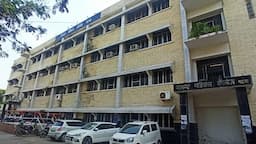
Bihar’s NMCH suspends 146 students over ragging: Wake-up call for medical colleges

Bihar Teacher Salary Scam 2026: ₹1.85 Crore Irregularities Detected in Three Districts

No matter how many enter, how many make it to graduation?

UK universities face £925 annual levy for each international student from 2028

Jamia moves digital: Announces online exams, extends virtual classes amid campus unrest

IIT Delhi Launches 6-Month Agentic AI Certificate Course; Check Eligibility, Fees and Syllabus
vivo Ignite 2026 recognizes 10 student innovations from across India, offers scholarships worth up to ₹35 lakh
Canada’s new asylum rules raise concerns over protection for international students
China’s graduate job crisis fuels paid internship boom as students pay thousands to gain edge
IIM Indore opens admissions for executive program in AI and cybersecurity
Bihar’s NMCH suspends 146 students over ragging: Wake-up call for medical colleges
Bihar Teacher Salary Scam 2026: ₹1.85 Crore Irregularities Detected in Three Districts
No matter how many enter, how many make it to graduation?
UK universities face £925 annual levy for each international student from 2028
Jamia moves digital: Announces online exams, extends virtual classes amid campus unrest
Copyright© educationpost.in 2026 All Rights Reserved.