


Alleged salary manipulation in Nawada, Patna and Bhagalpur has prompted the Bihar government to order a statewide audit of education department payrolls. The cases raise questions about HRMS security, salary verification and the monitoring of public funds.
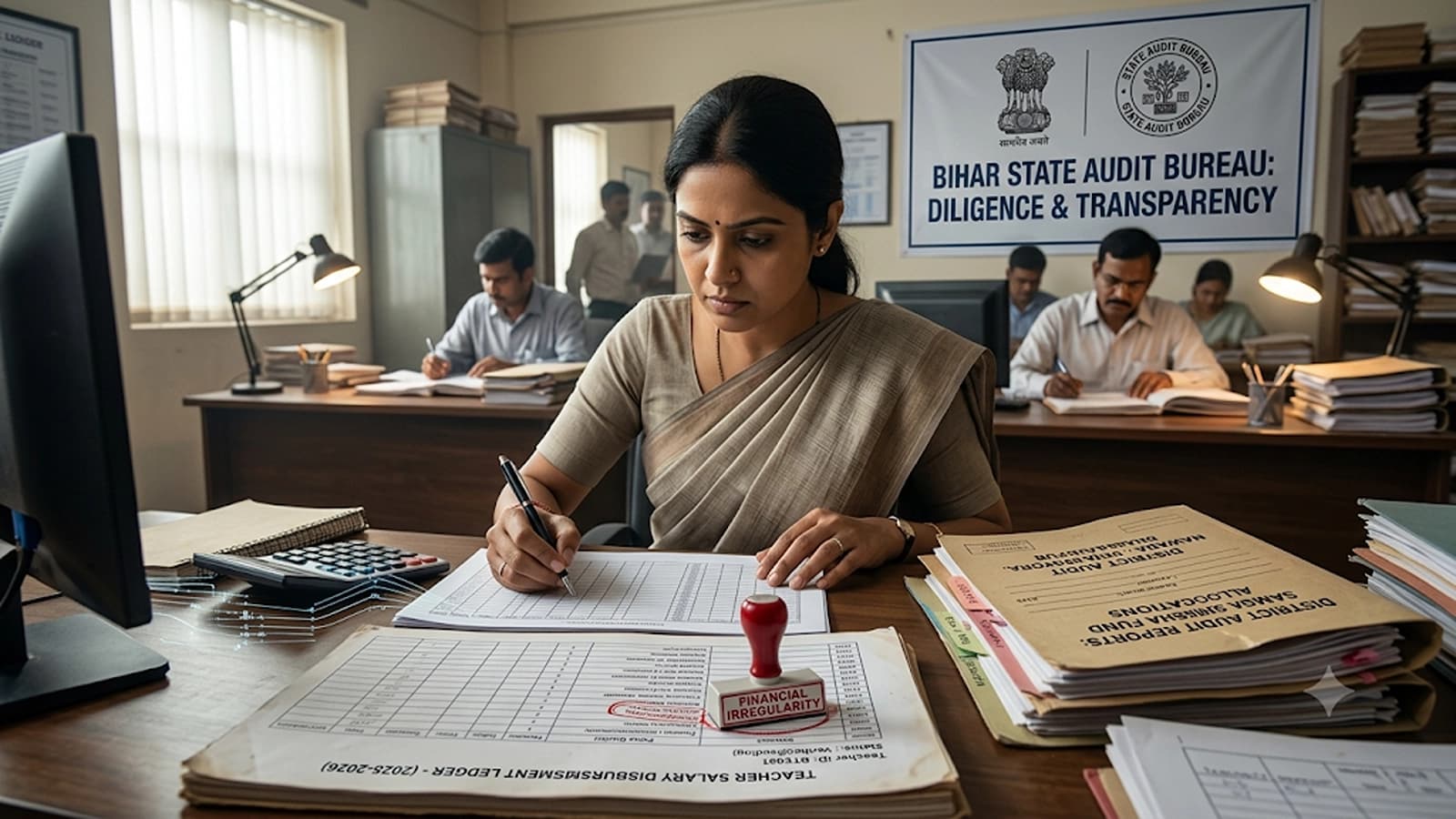
Representational Image
The Bihar government has ordered a wider examination of salary payments in the Education Department after reports of alleged financial irregularities involving government teachers, departmental employees and the state's digital payroll system. Three cases reported in Nawada, Patna and Bhagalpur have brought attention to alleged salary manipulation, unauthorised access to official login credentials and payments made in the name of a purportedly fictitious teacher.
According to The Indian Express, an internal audit identified alleged irregularities involving approximately ₹1.85 crore across the three cases. The reported incidents have prompted investigations and departmental action, while the state government has initiated a broader review of salary records.

The three cases involve different allegations. In Nawada, a teacher's salary was allegedly inflated through unauthorised allowance entries. In Patna, excess payments reportedly involved salary and house rent allowance (HRA) calculations. In Bhagalpur, officials are investigating alleged payments of ₹98.12 lakh in the name of a purportedly fictitious teacher.
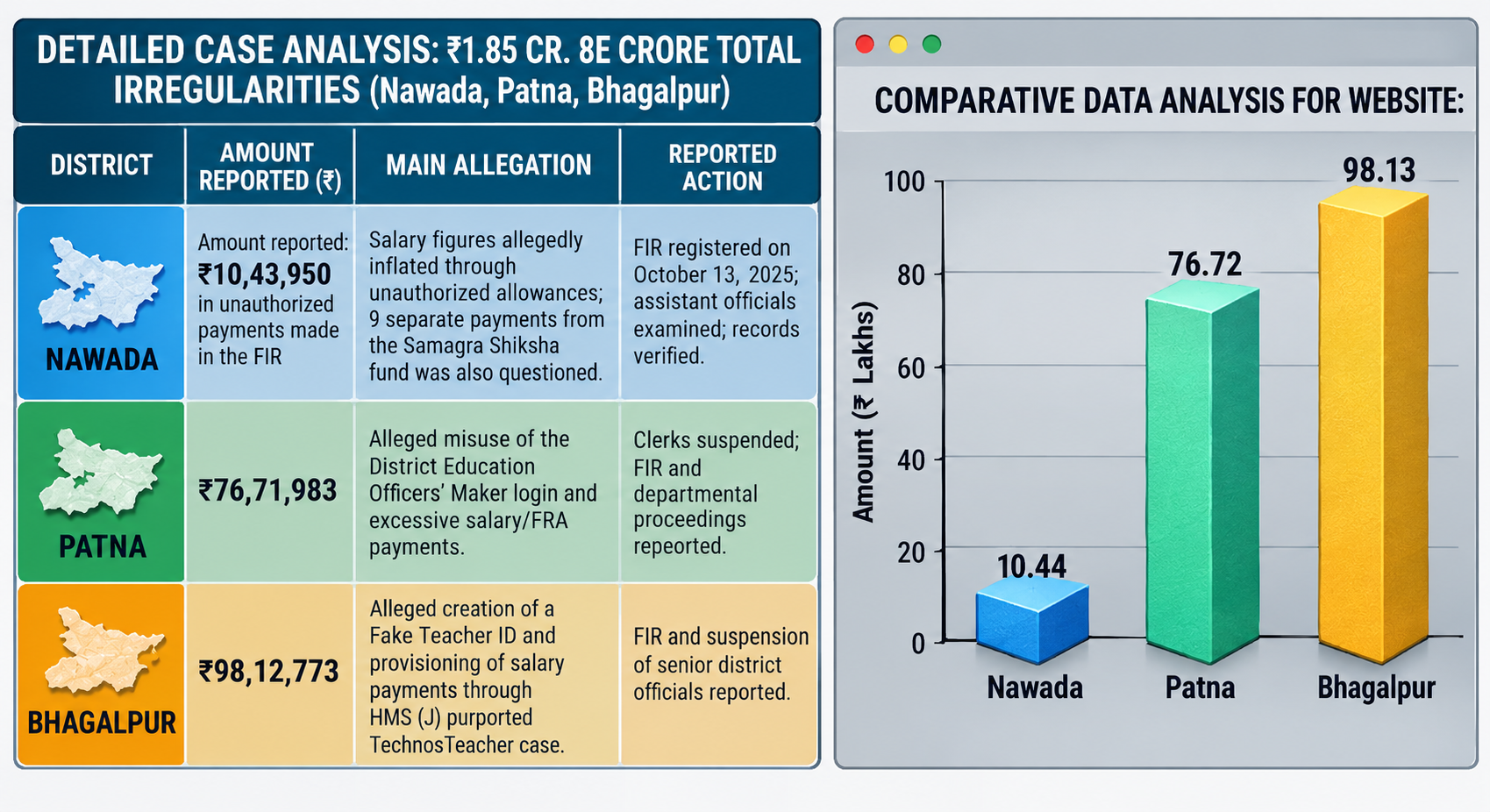
The Bihar teacher salary scam has raised questions about how employee records are created, who can modify salary information and whether the checks required before releasing government payments were effective.
Education Minister Mithilesh Tiwari reportedly told The Indian Express that all 38 districts were being audited, with the government aiming to complete the exercise by mid-November 2026.
However, the final amount of confirmed financial loss, the responsibility of individual employees and the outcome of the investigations have not been established in the publicly available material reviewed.
The reported Bihar teacher salary irregularities concern the processing of employee salaries through the Human Resource Management System (HRMS), a digital platform used to manage employee records and salary-related information.
According to reports on the Finance Department's instructions, salary bills are prepared through HRMS using a Maker, Checker and Approver workflow. Payments are subsequently processed through the Comprehensive Financial Management System (CFMS).
The three stages are intended to provide checks at different points in the payment process:
The reported cases raise questions about whether these controls were followed and whether unauthorised changes could be made without being detected.
A Finance Department letter dated October 9, 2026, reportedly directed the Education Department to scrutinise the salaries and allowances of officers, teachers and non-teaching employees before releasing the following month's payments. The instructions also called for action against officials found responsible, recovery of excess payments and the assignment of salary-processing responsibilities to regular officers and employees.
The Education Department has more than six lakh teachers and other staff across Bihar, making the verification exercise a substantial administrative task.
The allegations do not establish that every employee involved in payroll processing was implicated or that the same method was used in all three districts. Those questions must be resolved through the departmental audit and police investigations.
One of the cases under investigation concerns alleged manipulation of a teacher's salary records in Nawada district.
The District Education Officer lodged an FIR at Nawada Town Police Station on October 13, 2026. The complaint reportedly named a primary-school teacher posted in Beladih, Rajauli, a clerk responsible for the HRMS Maker role and a head clerk responsible for the Checker role.
The FIR details reproduced in the newspaper report state that the teacher's approved gross salary for April 2025 was ₹46,772. The amount reportedly paid that month was ₹4,91,772, following the alleged addition of unauthorised allowances.
The report also states that the approved salary for May 2025 was ₹46,772, while the payment allegedly rose to ₹3,49,500.
| Particulars | Amount |
|---|---|
| Approved gross salary for April 2025 | ₹46,772 |
| Reported April payment | ₹4,91,772 |
| Approved gross salary for May 2025 | ₹46,772 |
| Reported May payment | ₹3,49,500 |
| Unauthorised payments cited in the FIR | ₹10,43,950 |
These figures are allegations reported from the FIR, not a final judicial finding.
There is also an arithmetic discrepancy in the published figures. The article refers to an “Other Allowances” entry of ₹4,52,222, but the difference between the reported April payment of ₹4,91,772 and the approved salary of ₹46,772 is ₹4,45,000. The figures do not reconcile, and the original salary bill and FIR annexures are needed to establish which amount is correct.
The report further states that a payment of ₹2.86 lakh from Samagra Shiksha funds was identified during scrutiny of the teacher's State Bank of India account. According to the complaint details reproduced by the newspaper, the payment should not have been diverted in this manner.
Investigators also reportedly examined a transfer of ₹1 lakh on May 20, 2025, from the teacher's SBI account to a Punjab National Bank account held by someone named Satish Kumar.
The report said investigators suspected that the account holder might be the same Satish Kumar who worked as the office head clerk and Checker. However, the identity and connection had not been confirmed.
These allegations raise questions about the authorisation of salary entries, the use of education funds and the movement of money after payments were made. The published details do not independently establish the complete transaction trail or the final findings of the investigation.
A report by Hindustan said a state-level team led by Education Secretary Dharmendra Kumar examined documents and HRMS records in Nawada for several hours as part of the inquiry.
A second case concerns alleged excess salary payments involving employees associated with FNS Academy in Gulzarbagh, Patna.
A report published by The Times of India on October 15 said the matter came to light during an audit by the Accountant General, Bihar. The report named clerk Vijay Krishna Vidyarthi and attendant Sanju Kumari in connection with alleged excess payments during the 2024–25 financial year.
The total amount reported was ₹76,71,983.
Patna Salary Irregularities: Reported Breakdown
| Employee named in the report | Alleged excess payment |
|---|---|
| Vijay Krishna Vidyarthi, clerk | ₹62,48,240 |
| Sanju Kumari, attendant | ₹14,23,743 |
| Total | ₹76,71,983 |
One of the reported irregularities involved house rent allowance allegedly being entered at 200% instead of 20%. The published report does not reproduce the complete salary calculations or all applicable service rules, so the full basis of the excess-payment figure cannot be independently reconstructed from the article alone.
Vijay Kumar Vidyarthi was suspended on October 14 over allegations that he used the District Education Officer's official Maker login to make unauthorised entries and generate excess payments.
The Patna salary scam case raises questions about access to official payroll credentials and the verification of salary allowances. Investigators would need to establish who accessed the account, what changes were made and whether the Checker and Approver stages were completed appropriately.
Patna Salary Scam: Reported Recovery of Money
According to The Times of India, the ₹76.71 lakh was returned through nine cheques and deposited in the treasury on August 20. The report also said that the interest demanded on the excess payment remained unpaid at the time of publication.
The reported deposit is an important development, but it does not by itself establish that the entire matter has been resolved. The outstanding interest, the findings of departmental proceedings and any criminal liability would need to be verified separately.
Bhagalpur Fake Teacher Salary Case: Alleged ₹98.12 Lakh Payment
The Bhagalpur case involves the largest specific amount reported in the three district-level cases.
According to The Times of India, the Education Department suspended District Education Officer Chandan Kumar and District Programme Officer Shashi Chandan Chaudhary following an inquiry into alleged payments totalling ₹98,12,773 in the name of a purportedly fictitious teacher identified as Tanushree.
The report stated that a district administration inquiry report dated October 9 preceded the suspension orders. It also said the HRMS central investigation team based in Patna detected a suspicious teacher ID on October 8 while examining digital records.
According to the allegations reported by the newspaper, contract computer operator Avinash Raj, who had worked in the establishment branch since 2019, created a fake teacher ID in Tanushree's name. Salary payments were allegedly processed through that ID.
An FIR was reported at Jogsar Police Station on October 9, although some coverage refers to an October 8 case entry. The distinction between the date of detection and the date of formal registration should be verified against the original police record.
The Bhagalpur case raises a fundamental question: how could salary payments reportedly be made over several months in the name of a purportedly fictitious employee?
Investigators would need to examine the appointment order, joining report, service records, teacher-ID creation logs, bank-account details and salary authorisations. These records could help establish which credentials were used to create or modify the employee profile and who approved the resulting payments.
The department suspended the District Education Officer and District Programme Officer following the inquiry. A later report by Patna Press described further departmental action, including the suspension of a lower division clerk and proceedings against the former DPO.
These actions indicate that the department is examining responsibility at multiple levels. They do not establish the guilt of every person named in the reports.
The Finance Department's October 9 letter is a central development in the Bihar teacher salary scam investigation.
According to PTI, Finance Department Principal Secretary Vinay Kumar instructed the Education Department to scrutinise salary bills and allowances for officers, teachers, headmasters and non-teaching staff before releasing the next month's payments.
The reported instructions included four major measures.
1. Verification of salary and allowance records
The department was directed to examine salary and allowance records under the supervision of senior officers. The verification was to be completed before the next salary release.
2. Action against officials found responsible
The government reportedly called for disciplinary and administrative action against any Maker, Checker or Approver found responsible for irregularities at any stage of salary processing.
3. Recovery of excess salary payments
The department was instructed to recover excess payments where applicable. Recovery of public money is separate from the question of criminal liability and can proceed alongside police investigations.
4. Assignment of salary processing to regular employees
The order reportedly sought to strengthen accountability by assigning salary-processing duties to regular officers and employees.
The instructions were marked for priority compliance, with copies sent to district magistrates.
Education Minister Mithilesh Tiwari separately told The Indian Express that all 38 districts were being audited, with a target of completing the exercise by mid-November 2026. He also said experts would be engaged to help prevent manipulation of the HRMS system.
The statewide review is significant because it extends beyond the three highlighted cases. Its findings should establish whether the reported irregularities were isolated incidents or part of a broader pattern of weaknesses in salary verification.
However, the complete signed copy of the October 9 letter and the full internal HRMS audit report were not located in the publicly accessible material reviewed for this article. Their contents are therefore described on the basis of published reporting.
The Comptroller and Auditor General of India (CAG) publishes audit reports examining government finances, expenditure and compliance with financial rules. Its publicly available Bihar reports provide background for a wider examination of public spending.
One available document is the State Finances Audit Report for 2024–25, Report No. 2 of 2026. The official CAG website records that the report was sent to the government on April 8, 2026, and tabled on July 23, 2026.
Another document is Report No. 1 of 2026, a performance and compliance audit of civil departments for the period ending March 2024, also tabled on July 23, 2026.
These reports can provide context on Bihar's financial management and compliance systems. However, they predate the October 2026 district-level cases, and the material reviewed does not establish that either report contains the specific allegations involving Nawada, Patna or Bhagalpur.
PTI reported that Deputy Chief Minister and Finance Minister Bijendra Prasad Yadav said the CAG had flagged irregularities in salary processing, prompting the Finance Department to order broader scrutiny. The specific audit observation or complete report cited in connection with the October action was not independently identified in the publicly accessible documents reviewed.
It is therefore important not to present the general CAG reports as though they are the specific internal HRMS audit report behind the three cases.
The three cases raise questions about employee verification, salary calculations and access controls in the payroll process. The following are issues investigators should examine; they are not final findings of the internal audit.
1. Employee Identity Verification
The Bhagalpur allegations concern payments made in the name of a purportedly fictitious teacher. If substantiated, the case would raise questions about how the employee record was created and whether appointment and service documents were checked before salary payments began.
2. Salary and Allowance Verification
The Nawada and Patna cases involve allegations of payments substantially higher than the stated approved salary or allowance rates. Investigators would need to compare HRMS entries with approved pay scales, allowance rules, service records and authorised changes.
3. Security of Official HRMS Login Credentials
The reports raise questions about whether official Maker credentials were used without proper authorisation. Transaction logs could help establish which account made a change, when it occurred and whether the action was authorised.
4. Monitoring of Unusual Salary Payments
A robust payroll system should be able to flag unusually large salary amounts, allowance entries outside authorised limits, duplicate employee profiles and payments that do not match verified employee records.
The available reports do not establish whether these controls were absent, bypassed or inadequately implemented in the cases under investigation.
5. Accountability at Each Stage of Salary Processing
The Maker–Checker–Approver structure is designed to distribute responsibility across the payment process. The investigation should establish what each person did, what information was available to them and whether the required checks were performed.
The government's reported order required verification before the following month's salary payments. PTI said the scrutiny was likely to delay payments for many employees, while payments to those found responsible for irregularities could be withheld.
Other news reports also described the possibility of salary delays while records were checked. However, the reports reviewed do not establish a single verified statewide figure for employees whose salaries were actually withheld.
The distinction matters because a verification exercise can affect employees in different ways. A legitimate employee whose records are complete may face a different outcome from an employee whose service details need correction or whose payment is found to be irregular.
The government's eventual district-wise compliance data should clarify how many salary records were checked, how many discrepancies were found, how many payments were delayed and whether any amounts were recovered.
The alleged Bihar teacher salary scam in Nawada, Patna and Bhagalpur has brought the handling of public money through the state's digital payroll system under scrutiny. The reported cases involve different methods, from alleged salary inflation and unauthorised allowances to payments in the name of a purportedly fictitious teacher.
The Finance Department's October 9 order requires wider verification of salary records, action against officials found responsible and recovery of excess payments. The Education Department's reported plan to audit all 38 districts by mid-November 2026 could help establish whether the three cases represent isolated incidents or point to wider weaknesses in payroll controls.
The next phase of the investigation will depend on the publication of the full audit findings, verification of the disputed payment calculations, recovery records and the outcomes of police and departmental proceedings.
Until those records are available, the reported amounts should be described as alleged irregular payments, not as a final calculation of proven fraud. Likewise, FIRs, suspensions and arrests should not be treated as proof of guilt.

vivo Ignite 2026 recognizes 10 student innovations from across India, offers scholarships worth up to ₹35 lakh

Canada’s new asylum rules raise concerns over protection for international students

China’s graduate job crisis fuels paid internship boom as students pay thousands to gain edge

IIM Indore opens admissions for executive program in AI and cybersecurity

Schools Closed Today, October 29: Jharkhand, Andhra Pradesh, Chhattisgarh Announce Cyclone Arnab Holidays
Bihar’s NMCH suspends 146 students over ragging: Wake-up call for medical colleges

Bihar Teacher Salary Scam 2026: ₹1.85 Crore Irregularities Detected in Three Districts

No matter how many enter, how many make it to graduation?

UK universities face £925 annual levy for each international student from 2028

Jamia moves digital: Announces online exams, extends virtual classes amid campus unrest

vivo Ignite 2026 recognizes 10 student innovations from across India, offers scholarships worth up to ₹35 lakh
Canada’s new asylum rules raise concerns over protection for international students
China’s graduate job crisis fuels paid internship boom as students pay thousands to gain edge
IIM Indore opens admissions for executive program in AI and cybersecurity
Schools Closed Today, October 29: Jharkhand, Andhra Pradesh, Chhattisgarh Announce Cyclone Arnab Holidays
Bihar’s NMCH suspends 146 students over ragging: Wake-up call for medical colleges
Bihar Teacher Salary Scam 2026: ₹1.85 Crore Irregularities Detected in Three Districts
No matter how many enter, how many make it to graduation?
UK universities face £925 annual levy for each international student from 2028
Jamia moves digital: Announces online exams, extends virtual classes amid campus unrest
Copyright© educationpost.in 2026 All Rights Reserved.