The Parliamentary Standing Committee on Education, Women, Children, Youth and Sports has recommended a comprehensive overhaul of the National Testing Agency (NTA), including a shift to computer-based testing (CBT) for NEET (UG), the establishment of government-owned examination centers, permanent recruitment of specialized staff and a stronger accountability framework answerable to Parliament.
The committee, headed by Rajya Sabha MP Mukul Wasnik, presented its 382nd Report on “Reforms and Strengthening of the National Testing Agency (NTA)” to the Chairman of the Rajya Sabha on Oct 9, 2026. The report examines the functioning of the NTA under the Department of Higher Education, Ministry of Education, and sets out recommendations to improve examination security, administrative capacity, transparency and student support.

The committee considered and adopted the report at its meeting on Aug 25, 2026. During its preparation, it heard from the Secretary of the Department of Higher Education, the Secretary of the Ministry of Health and Family Welfare, the NTA Chairperson and Director General, Dr. K. Radhakrishnan, former Secretary of the Department of Space and chairman of the High-Level Committee of Experts, and other departmental representatives.
The recommendations come after the cancellation of NEET (UG) 2026, which was conducted on May 3 and canceled by the NTA on May 12 following allegations of a paper leak, according to the report's accompanying account. The committee acknowledged the measures introduced by the agency since 2024 but said the cancellation demonstrated that additional procedural and institutional reforms were necessary.
“Organised networks that profit from examination fraud are adaptive and resourceful, and will always seek the weakest link in the chain. The NTA therefore needs adequate staff, robust security protocols, clear accountability mechanisms, and digitalization of operations and examinations to ensure that it stays ahead of any challenges,” the panel said.
The committee emphasized that examination integrity is closely connected to social justice and national trust. Under the National Education Policy (NEP) 2020, the NTA has been assigned a central role in conducting major national examinations, including JEE-Main, NEET-UG, UGC-NET and CUET. The agency conducts examinations taken by approximately 1.2 crore students annually and must coordinate with Union, state and local government authorities to organize large-scale tests.
The committee said the NTA's organizational structure should be developed in line with its responsibilities, with adequate resources and clearly defined accountability mechanisms. It recommended that the Department of Higher Education introduce an appropriate parliamentary framework to ensure the agency's accountability to Parliament.
“The education department may introduce appropriate Parliamentary framework that ensures NTA's accountability to Parliament.”
The committee also called for a change in the agency's institutional culture, saying that examination integrity must be treated as a responsibility shared by everyone, from the Director General to examination center invigilators. It said rebuilding public confidence would require consistent, transparent and two-way communication with candidates, parents, teachers and educational institutions.
The NTA currently relies largely on portals and notifications to communicate with candidates. The committee recommended that feedback channels for students and institutions be made more visible and integrated into the agency's regular functioning so that concerns can be addressed more effectively.
Question banks recommended to reduce paper leak risks
The committee identified investment in large, diverse and regularly updated question banks as a key long-term measure to protect examinations against paper leaks. It cautioned that repeatedly using the same sets of questions or requiring examiners to prepare new papers every year could create risks for examination security.
“The Committee notes that investment in question banks is the most viable defense against paper leaks in the long-run. The repeated use of the same question sets or the practice of having examiners set new question papers every year can be a risk to the integrity of the examination process.
“The Committee, therefore, is of the view that NTA should invest in building a large, diverse, and continuously updated question bank which can be drawn on to set papers without the advance knowledge of the question-setters,” said the report.
Since computer-based examinations do not require question papers to be printed and transported to test centers, the committee said there was no need to finalize them far in advance. It recommended that final papers be prepared shortly before examinations using digital tools to select questions from the question bank, with experts responsible for vetting them.
The final paper reviewers should be placed under strict quarantine and kept isolated until the examination concludes, the committee added.
It also recommended that the NTA engage qualified experts from leading educational institutions, including the Indian Institutes of Technology (IITs), All India Institutes of Medical Sciences (AIIMS) and Indian Institutes of Management (IIMs), to develop question banks and handle translations.
Before appointing experts, the agency should verify their professional records and integrity and screen for potential conflicts of interest. These checks should identify, among other concerns, links to private coaching centers or situations in which an expert's family members are appearing for the examination.
The committee further recommended that the NTA strengthen its ability to detect irregularities internally and develop mechanisms to respond quickly to examination-related crises.
NTA urged to recruit permanent staff
The report highlighted a substantial manpower shortage within the NTA and called for faster recruitment against sanctioned positions. Of the agency's 39 sanctioned positions, only 23 officers were in place and serving on deputation, leaving a vacancy rate of 41%.
The committee noted that strengthening the NTA's workforce had already been identified as a priority by the High-Level Committee of Experts chaired by Dr. K. Radhakrishnan. It urged the agency to expedite recruitment to fill all sanctioned positions.
Although the NTA has 39 permanent posts, the committee observed that these positions are currently filled through deputation. Officers on deputation generally serve for two to three years before returning to their parent cadres, making it difficult to retain the specialized experience required to conduct national-level examinations.
The committee therefore recommended that the NTA build its own permanent professional workforce, with a particular focus on psychometrics, examination security, digital infrastructure, data analytics and examination logistics.
It said the 16 posts under the Central Staffing Scheme should provide an additional layer of senior leadership rather than substitute for specialized professional expertise.
The committee also expressed concern over the appointment of the NTA Director General on an additional-charge basis. Between June 23, 2024, and April 1, 2026, the position was held as an additional responsibility by officers who already had substantial primary duties as chairman and managing director of India Trade Promotion Organisation and commissioner of Navodaya Vidyalaya Samiti.
It discouraged this practice, stressing the importance of dedicated leadership for an agency responsible for high-stakes national examinations.
The committee also recommended that the NTA eventually develop the capacity to independently manage the logistics of all its examinations. Dependence on third-party contractors should be reduced, with non-NTA personnel primarily engaged for paper setting and other academic functions where external expertise remains necessary.
NEET-UG should shift to computer-based testing
The committee broadly supported the High-Level Committee of Experts' recommendation for a phased transition to computer-based testing. It noted that the NTA already conducts several major examinations, including JEE-Main, UGC-NET and CUET, in CBT mode, while NEET-UG continues to rely on pen-and-paper testing.
It recommended moving NEET-UG to a computer-based format but cautioned that the transition must account for students in remote areas and those from marginalized backgrounds who may have limited access to digital infrastructure.
The committee called for a national testing strategy to improve access to computer-based examinations before the change is implemented. It recommended substantial investment in secure, government-owned CBT infrastructure, particularly in Tier-2 and Tier-3 cities and rural areas.
The High-Level Committee of Experts had recommended establishing 1,000 secure government-owned CBT centers. The parliamentary panel said this recommendation should be implemented through a clear, phased timeline.
It also proposed that the NTA financially support the establishment of medium-sized information technology laboratories, each with 100 to 200 computer nodes, in schools and colleges across the country. Institutions would provide space for these facilities, while the NTA could fund the required hardware on the condition that the facilities remain available to the agency for conducting examinations when needed.
The committee recommended that every district have at least one examination center offering all examinations, reducing the travel and accommodation expenses borne by candidates.
It also called for all examination centers to be owned and operated by the Union or state governments. The committee observed that privately run institutions engaged through subcontracting arrangements had frequently emerged as weak links in examination security.
To prepare students for digital examinations, the panel recommended providing opportunities to take CBT mock tests so candidates can become familiar with the interface and format. The Ministry of Education may also consider introducing computer-based examinations at the school level to build digital testing familiarity before students appear for high-stakes entrance examinations.
The committee suggested a hybrid arrangement in locations where computers or internet connectivity are inadequate. Under this model, encrypted questions could be delivered directly to an examination center and printed there until the necessary infrastructure for full CBT implementation is available.
It also emphasized that moving NEET-UG to a multi-session computer-based format would require a reliable and transparent normalization system. The methodology should be independently audited and explained publicly before the transition begins.
The committee said the move should be preceded by consultations with the Ministry of Health and Family Welfare, medical education regulators, students and their families.
Long-term plan for computer-adaptive testing
Beyond the initial shift to CBT, the committee recommended that the NTA eventually adopt Computer Adaptive Testing (CAT) once its digital infrastructure has matured.
Under this approach, artificial intelligence tools could select questions from a large question bank and adjust them according to a candidate's aptitude. The system could also evaluate responses and normalize scores using objective factors, including question difficulty.
The committee said this model, which it described as the gold standard for assessment, could reduce the risk of paper leaks because there would be no single standard question paper for candidates. It could also limit cheating by ensuring that candidates at the same examination center do not receive identical question sets.
To support this transition, the NTA should establish a technical team capable of developing, monitoring and continuously improving the required systems.
However, the committee acknowledged that computer-based examinations could introduce new cybersecurity risks. The NTA informed it that computer systems could be vulnerable to hacking and that such attacks might be difficult to trace. An attempted hack during the 2021 IIT JEE-Main examination had been investigated by the Central Bureau of Investigation (CBI), according to the report.
The committee recommended establishing a dedicated in-house cybersecurity team to develop and maintain secure examination software. The software should prevent remote access, screen recording and the use of virtual machines. The NTA should also use AI-based analytical tools to identify and flag unusual response patterns that could indicate malpractice.
Where printing remains necessary after the transition to CBT, the committee recommended that it be carried out exclusively at NTA-owned and operated printing presses, with no reliance on private printers.
Changes proposed to examination-day procedures
The committee identified procedural issues that can disrupt candidates during examinations and recommended changes to reduce unnecessary stress.
It observed that invigilators sometimes complete signing and checking formalities while examinations are underway, disturbing candidates who are already working under time pressure. The panel recommended reserving a separate 15-minute period before or after the examination for these formalities rather than conducting them during the test.
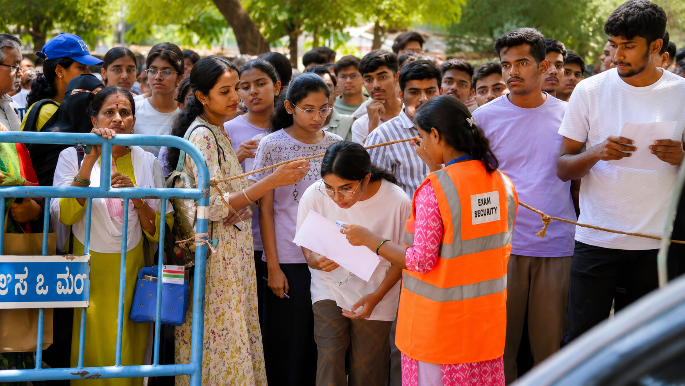
The committee also addressed cases in which candidates arrive at examination centers a few minutes after the reporting deadline and are denied entry. It said some delays may occur for genuine reasons and recommended a mechanism to allow late-arriving candidates to enter after signing an undertaking recording their late arrival.
Such candidates should be permitted to take the examination only for the time remaining, with no additional time granted under any circumstances.
The panel also highlighted the effect of public rallies, processions and large gatherings on examination days. Such events can delay candidates and cause them to miss reporting deadlines.
It recommended amending the Public Examinations (Prevention of Unfair Means) Act, 2024, to direct district administrations to withhold permission for rallies, processions and other public gatherings on examination days. District authorities should also ensure that traffic and law-and-order arrangements are in place well in advance to prevent avoidable disruptions.
Review of NEET qualifying criteria and examination structure
The committee observed that the number of candidates qualifying NEET-UG is substantially higher than the number of seats available across MBBS, BDS, AYUSH and nursing courses combined.
While a sufficiently large pool of qualified candidates allows students to participate in counseling rounds and compete for private and deemed university seats, the committee said an excessively wide gap between qualifying candidates and available seats creates unnecessary stress for lakhs of students.
It recommended that the NTA and the Ministry of Health and Family Welfare undertake a data-based, year-wise review of the qualifying percentile and cutoff methodology. The number of candidates qualifying should remain reasonably aligned with the seats available, without compromising merit.
The committee also questioned whether a single-stage NEET-UG examination is the most suitable format for admissions to several different courses. It noted that the examination covers MBBS, BDS, nursing and AYUSH admissions and handles more than 22 lakh candidates.
Drawing a comparison with the multi-stage Civil Services Examination, the committee recommended that the NTA examine the feasibility of a two-stage structure for large examinations. One possibility would be a common preliminary examination for medical streams, followed by specialized main examinations for individual courses.
Under such a system, candidates seeking nursing or AYUSH admissions could be tested and ranked separately from those applying for MBBS, potentially reducing avoidable competition.
The committee also noted that NEET-UG currently has no limit on the number of attempts and no effective upper age limit, resulting in cases of candidates older than 70 appearing for the examination.
It recommended that the Ministry of Education explore reasonable age and attempt limits for major examinations, including NEET-UG, in consultation with the Ministry of Health and Family Welfare and other relevant stakeholders. The committee said an exception to the proposed limits could be considered only for UGC-NET.
National registry proposed for blacklisted examination vendors
The report raised concerns about firms involved in examination-related services, including paper setting, logistics, printing and administration, that have been blacklisted by one or more state governments or organizations but have continued to obtain contracts elsewhere.
The committee said there was no effective preventive mechanism to stop such firms from securing new contracts and recommended the creation of a publicly accessible National Registry of Blacklisted Examination Vendors.
The proposed registry should record the names of blacklisted firms, associated individuals and entities, the nature of their disqualification and the authority responsible for imposing it.
The committee recommended that contracting with an entity listed in the registry by the NTA, any state government or another public examination authority should be treated under the Public Examinations (Prevention of Unfair Means) Act, 2024.
It noted that it had made a similar recommendation in its 371st report on the Autonomous Bodies of the Department of Higher Education.
Regulation of coaching centers and school curriculum alignment
The committee criticized the influence of the coaching industry on entrance examination preparation, observing that coaching has increasingly developed into a parallel curriculum that can take precedence over regular school education.
It said examination papers that go beyond the NCERT or state board syllabus, or reward rapid recall and pattern recognition developed through repetitive practice, give coaching-dependent students an advantage over candidates who rely on school-based learning.
According to the committee, this approach has helped expand a largely unregulated private coaching industry and created barriers to socioeconomic mobility by giving students who can afford coaching a structural advantage over equally capable candidates who cannot.
The committee recommended that the Ministry of Education establish specific and measurable standards to ensure that NEET-UG, JEE-Main and CUET assess conceptual understanding based on the official school curriculum rather than techniques associated with coaching.
It also called for a regulatory framework for the coaching industry, with provisions addressing fee transparency, safety standards and students' mental health.
Annual equity audit recommended
The committee noted that the NTA currently maintains data on the number of candidates registered from different states for various examinations but does not have equivalent information on their success rates.
It emphasized that registration figures alone cannot provide a complete picture of educational access and outcomes. A state may have high registration numbers but low pass rates, potentially indicating problems related to education quality or access.
To address this gap, the committee recommended an annual Equity Audit covering participation rates, pass rates and cutoff achievement rates in each major examination.
The audit should break down the data by state, gender, school board type, including government, aided and private schools, medium of instruction and social category, including OBC, SC, ST, EWS and general categories.
The findings should be published in the NTA's Annual Report and submitted to the Ministry of Education for policy consideration. The ministry could use the findings to identify disparities and develop targeted interventions.
Mental health support and candidate welfare
The committee expressed concern about the psychological pressure associated with high-stakes examinations, noting that lakhs of candidates experience stress before examinations, while taking tests and after results are announced.
It recommended that the NTA partner with mental health professionals to provide free and accessible counseling helplines. The agency should also circulate simple stress-management materials well before each examination and ensure that examination centers maintain a calm and supportive environment, particularly around the declaration of results.
The panel further recommended that the NTA establish a clear duty of care toward candidates. This framework could include financial compensation for students affected by administrative cancellations and prescribed timelines for grievance redressal to reduce the financial and psychological burden of such disruptions.
It also called for a secure channel through which candidates can report concerns and seek resolution of grievances related to all aspects of examinations.
In addition, the committee recommended creating an independent mechanism for educational examinations that would operate separately from the NTA. The proposed body should have the authority to audit examination security protocols, investigate candidate grievances and submit its findings directly to the Ministry of Education.
The committee also called for a dedicated protocol for candidates with disabilities. The NTA should ensure accessible examination centers, adequate scribes and compensatory time where required, accessible digital platforms and a dedicated grievance-redressal mechanism.
The panel said these measures would help improve access to higher education for students with disabilities and ensure that their specific needs are addressed during examinations.
Greater transparency in results and paper leak investigations
The committee recommended that the NTA adopt transparent result-publication practices similar to those followed by the Union Public Service Commission (UPSC).
It noted that NEET-UG results are generally not published in a publicly accessible manner. In 2024, however, the NTA released detailed results following an order from the Supreme Court, prompting wider public discussion about differences in student performance across cities and examination centers.
The committee said publishing results transparently could help the NTA identify unusual patterns in candidate and center performance, improve scrutiny and strengthen public confidence. It also noted that restrictions on candidates selecting their own examination centers had reduced opportunities for misuse.
The panel called for the development of in-house capabilities to identify, trace and establish prima facie irregularities in the examination system, allowing the agency to respond more quickly when problems arise.
It also highlighted the absence of an official public record documenting paper leaks, related first information reports, and investigations and prosecutions by the CBI and other investigative agencies.
The Department of Higher Education informed the committee that examination malpractices and disruptions had occurred but that no paper leak had taken place in an NTA-conducted examination between the agency's formation in 2017 and 2025. The committee noted that this assertion differed from the views of some of its members.
It recommended that the NTA work with the Department of Higher Education and other government agencies to publish a report documenting relevant details of examinations conducted by the agency and investigations associated with them.
State government representation and a stronger research role
The committee emphasized that state governments provide essential cooperation and expertise for conducting national examinations. It recommended that a restructured NTA include adequate representation from state governments on its Governing Body.
It also proposed expanding the agency's role beyond examination administration by developing it into a think tank for examination-related policies and research.
The report recommended establishing a research wing staffed by academics with expertise in education research rather than relying primarily on bureaucrats and administrative officers. Such a unit could conduct longitudinal studies to assess whether examinations such as NEET, CUET and UGC-NET are achieving their intended objectives.
The committee said stronger academic capacity could also allow the NTA to support other educational institutions, including the Central Board of Secondary Education (CBSE), which is implementing initiatives such as on-screen marking in board examinations.
The report further recommended that the NTA refocus its immediate priorities on entrance examinations for admission to higher education institutions. It noted that the agency continues to conduct recruitment examinations that are not linked to higher education admissions.
The committee said narrowing the agency's mandate would be consistent with the recommendation of the Radhakrishnan Committee, which had proposed that the NTA focus on entrance examinations and take on additional functions only after demonstrating adequate institutional capacity.
The report cited the NTA's mission statement: “[T]o improve equity and quality in education by administering research based valid, reliable, efficient, transparent, fair and international level assessments.”
Financial resources and examination infrastructure
The committee noted that the NTA had accumulated a revenue surplus of ₹590 crore between the financial years 2018-19 and 2024-25. It was informed that surplus funds available at different times were being invested in fixed deposits until they were needed for operational purposes.
The panel recommended using this financial capacity to invest in government-owned CBT centers and organize mock examinations that familiarize candidates with digital testing.
It also reiterated that the NTA needs a concrete implementation plan for secure government-owned computer-based testing facilities, supported by appropriate budgetary allocations and an up-to-date mapping of existing government infrastructure.
The committee said adequate public infrastructure should be established to reduce dependence on private examination centers and improve control over examination security.
Implementation of earlier reforms and further capacity building
The committee reviewed the implementation of the 101 recommendations made by the Dr. Radhakrishnan Committee to strengthen the examination process. It was informed that most of these recommendations had been implemented, although 60 related to 2025 and 2026.
The parliamentary panel called for the remaining reforms to be implemented quickly, including any pending measures among the 60 recommendations relating to those two years.
It also recommended training and capacity-building programs for all stakeholders involved in examination administration, including officials from state governments and other agencies responsible for arrangements at the district and examination-center levels. The committee said reforms must become part of routine practice rather than being implemented merely to meet formal requirements.
The report stressed that education is central to national progress and social development. It called for sustained reforms that eliminate unfair practices, reduce unnecessary examination-related stress and encourage a more comprehensive assessment of students' abilities.
The committee said it would continue to monitor the issue and encouraged stakeholders to contribute ideas toward improving the country's examination and education system.




.jfif&w=256&q=75)



.jpg&w=256&q=75)
.jpg&w=256&q=75)
.webp&w=256&q=75)
.jpg&w=256&q=75)
