


The proposal is among several options being examined by the Department of Home Affairs to strengthen student visa financial checks, with the government seeking feedback until Nov 23.
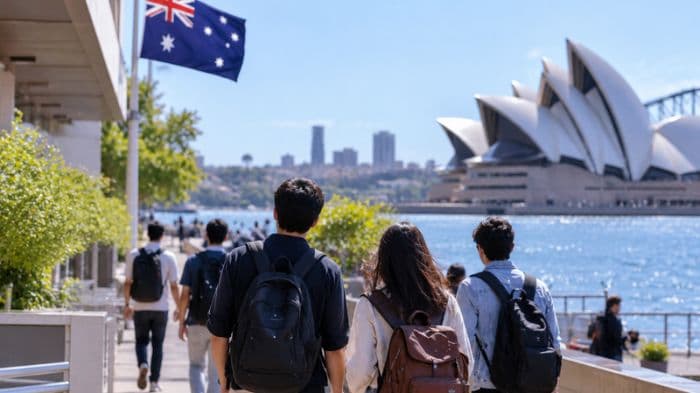
Australia is considering requiring prospective international students to hold money for their tuition fees and living expenses in Australian bank accounts before applying for student visas, under proposals released by the Department of Home Affairs.
The options are part of a review of the country's student visa financial-capacity framework. One proposal would require applicants to deposit funds in an eligible Australian bank account in their own name, up to three months before submitting their visa applications, to demonstrate that they have genuine and sustainable access to the money.

The discussion paper refers to the existing annual living-cost requirement of A$29,710 for an international student. However, the amount applicants may need to demonstrate under the proposed arrangements would depend on the model adopted and could also include tuition fees. The figure should therefore not be interpreted as a proposed flat deposit for every applicant.
The department is examining different ways of holding and verifying funds. These include arrangements based on a proportion of the total tuition and living costs for the course, as well as an option linked to the first year's expenses.
Overseas accounts and additional checks
The proposals also consider accepting verified overseas bank accounts as a transitional arrangement where opening an Australian account is not reasonable or practicable.
Separately, the department is seeking views on stronger financial documentation for applicants from countries classified at Evidence Level 3, Australia's highest documentation-risk category. The proposed interim measure could require these applicants to provide at least six months of financial transaction history, regardless of their education provider.
The government says the review is intended to improve the assessment of whether applicants can genuinely access the money required for their studies and living expenses.
Assistant international education minister Julian Hill said the government wanted to make financial requirements clearer for prospective students and align published rules with the department's visa-processing approach.
Speaking at the Australian International Education Conference, Hill said the government wanted to improve visa grant rates and provide greater certainty, even if this meant raising financial standards and reducing the pool of prospective applicants.
Concerns over financial risks for applicants
The proposals have drawn concerns from education and migration-sector representatives over the possibility of students transferring substantial sums before knowing whether their visas will be approved.
Immigration lawyer Marsha Bassily questioned whether applicants should be expected to send large amounts of money overseas before receiving a visa decision. Education consultant Claire Field also warned that the changes could add to perceptions of instability in Australia's student visa settings.
Ravi Lochan Singh, managing director of education agency Global Reach, raised concerns about potential losses through exchange-rate movements and bank-transfer charges if students transfer funds but subsequently have their visa applications refused.
The department is also reviewing Ministerial Direction 106, which guides how immigration officials assess the Genuine Student requirement. The consultation seeks feedback on possible changes to the assessment, including how applicants' study histories are considered.
Stakeholders have until Nov 23 to submit their views. The proposals remain under consultation, and the department has not announced any final changes to the student visa financial-capacity requirements.

Khalifa University and Sanofi launch genomic research partnership to study asthma and COPD in UAE

EU and Jordan discuss expanding university research cooperation under Horizon Europe

Research England to end three university funding schemes after £390 million investment
Australia considers requiring international students to hold study funds in local bank accounts

Sainik School Admission 2027: AISSEE Registration Opens for Class 6 and 9; Exam on January 31

Japan's Hokkaido University faces faculty exodus as funding cuts hit research environment

Why are Japanese families paying more for private high schools despite tuition subsidies?

China honors five scholars from four countries with global education research award

IIT Kanpur, BIT Mesra sign five-year agreement to strengthen academic and research collaboration
Why are India's leading universities slipping in QS Asia Rankings 2027 despite growing representation?

Khalifa University and Sanofi launch genomic research partnership to study asthma and COPD in UAE
EU and Jordan discuss expanding university research cooperation under Horizon Europe
Research England to end three university funding schemes after £390 million investment
Australia considers requiring international students to hold study funds in local bank accounts
Sainik School Admission 2027: AISSEE Registration Opens for Class 6 and 9; Exam on January 31
Japan's Hokkaido University faces faculty exodus as funding cuts hit research environment
Why are Japanese families paying more for private high schools despite tuition subsidies?
China honors five scholars from four countries with global education research award
IIT Kanpur, BIT Mesra sign five-year agreement to strengthen academic and research collaboration
Why are India's leading universities slipping in QS Asia Rankings 2027 despite growing representation?
Copyright© educationpost.in 2026 All Rights Reserved.