


A Cambridge-led international team detected evidence of a beauty particle decaying into two muons, a rare process that could help physicists investigate particles and forces beyond the Standard Model.
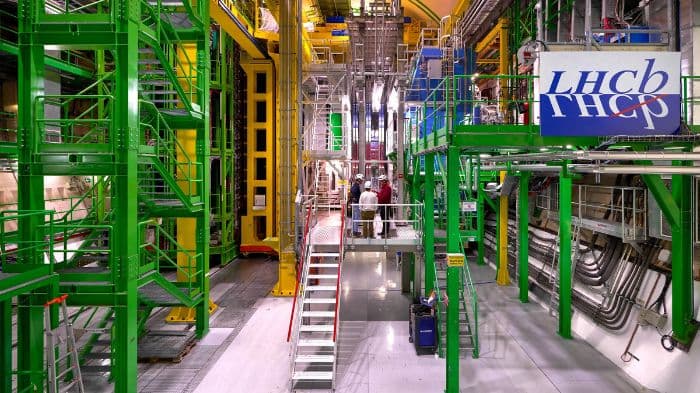
An international team of physicists working at CERN's Large Hadron Collider (LHC) has found evidence of an exceptionally rare subatomic particle decay after more than four decades of searching for the process.
The researchers, working with the upgraded LHCb experiment near Geneva, detected evidence of a beauty particle decaying into two smaller particles called muons. The process, known as the B0 to muon-antimuon decay, is extremely rare and is estimated to occur in only a tiny fraction of beauty particles.

The findings were led by researchers at the University of Cambridge's Cavendish Laboratory, with around 20 physicists from the UK, Germany, Italy, Spain and the Netherlands contributing to the work.
The result marks the first time a single experiment has produced evidence for this particular decay. The findings had not yet been peer-reviewed when announced and were scheduled for presentation at CERN on November 3, 2026.
Machine learning helps identify rare particle decay
Beauty quarks are short-lived particles produced in large numbers during high-energy collisions at the LHC. They exist for only around one and a half trillionths of a second before decaying into other particles.
By studying these decay processes, physicists can investigate the influence of particles that may be too small or elusive to detect directly.
The team analysed data collected in 2024 and 2025 following a major upgrade to the LHCb experiment. It combined these results with earlier data from 2011 to 2018.
Machine learning techniques helped researchers distinguish the extremely rare signal from large amounts of background noise generated by other particle interactions.
The combined data produced a signal strength of 3.2 sigma. This is above the three-sigma threshold commonly used as evidence for a new phenomenon, although it falls short of the five-sigma standard generally required for a discovery in particle physics.
Dr Harry Cliff of Cambridge's Cavendish Laboratory, who led the analysis team, said the result was exciting after decades of attempts to observe the decay.
Rare decay could offer clues to the zeptoverse
The research could help scientists investigate a theoretical region of physics known as the zeptoverse, where new particles may exist at extremely small distance scales.
A zeptometre is one trillionth of a billionth of a metre. Although the LHC cannot directly resolve structures at these scales, precise measurements of rare particle decays can reveal indirect effects of particles that may be present.
According to the researchers, new particles could influence how beauty quarks decay, potentially changing the frequency of particular processes. This makes rare decays useful for testing predictions made by the Standard Model, the established framework describing fundamental particles and their interactions.
The newly observed signal is consistent with Standard Model predictions. It does not, therefore, establish the existence of new particles or provide evidence of dark matter. Instead, it gives physicists a more precise measurement to guide future investigations.
Further LHC upgrades planned
Researchers plan to continue studying the decay as more data becomes available. Another major upgrade to the LHCb experiment is planned for the mid-2030s and could increase its data collection rate by a further order of magnitude.
The additional data could allow scientists to examine rare particle decays with greater precision and look for deviations from Standard Model predictions.
Professor Tim Gershon of the University of Warwick, who leads the LHCb experiment, said the result demonstrated the experiment's ability to probe fundamental physics. He also highlighted the importance of the planned upgrade for future research.
The UK contribution to CERN is supported by the Science and Technology Facilities Council, part of UK Research and Innovation.
CERN experiment captures evidence of a rare particle decay that could test physics theories

Cambridge spinout uses AI and quantum computing to explore new treatments for heart disease

Google invests over US$6 million in AI research and education initiatives in Singapore

Research England proposes first major overhaul of university innovation funding formula since 2008

Bihar Schools to Introduce Maithili, Bhojpuri, Magahi and Four Other Regional Languages from 2027
Google invests over US$6 million in AI research and education initiatives in Singapore

Cabinet Approves ₹4,371 Crore VISTAR Scheme to Modernize India's Statistical System

AI tutor outperforms classroom learning in US university trial, OECD report finds

Why will students lose Google Search access if schools reject Google's AI tools? Company announces new rules

Australian experts back school digital detox as concerns grow over AI and screen use

CERN experiment captures evidence of a rare particle decay that could test physics theories
Cambridge spinout uses AI and quantum computing to explore new treatments for heart disease
Google invests over US$6 million in AI research and education initiatives in Singapore
Research England proposes first major overhaul of university innovation funding formula since 2008
Bihar Schools to Introduce Maithili, Bhojpuri, Magahi and Four Other Regional Languages from 2027
Google invests over US$6 million in AI research and education initiatives in Singapore
Cabinet Approves ₹4,371 Crore VISTAR Scheme to Modernize India's Statistical System
AI tutor outperforms classroom learning in US university trial, OECD report finds
Why will students lose Google Search access if schools reject Google's AI tools? Company announces new rules
Australian experts back school digital detox as concerns grow over AI and screen use
Copyright© educationpost.in 2026 All Rights Reserved.