


The HP Futures 2026 report highlights students’ continued reliance on handwritten notes and printed materials, while calling for stronger critical thinking, creativity and foundational skills in education.
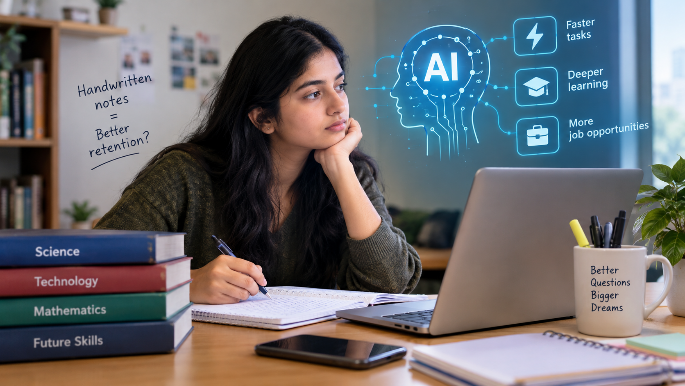
Indian students are increasingly using artificial intelligence (AI) to complete academic tasks, but many remain concerned that the technology could weaken their understanding of study material, according to the HP Futures 2026 report, “Skills in the Age of Intelligent Machines.”
The survey found that 82% of Indian students were concerned that AI could help them finish tasks faster at the expense of deeper learning. The findings highlight students' concerns about balancing the convenience of AI tools with meaningful engagement with academic content.

Despite these concerns, students continue to value conventional study methods when their priority is remembering information. The report found that 82% of Indian students preferred traditional methods, such as handwriting or printing notes, to retain what they had studied.
Among the respondents, 42% preferred printed materials or handwritten notes over AI-generated summaries when trying to remember information. Only 17% said they preferred AI-generated summaries for this purpose.
The findings suggest that while AI is becoming part of students' academic routines, traditional learning practices continue to play an important role in information retention.
The HP Futures 2026 global survey also found that Indian students recognize the importance of AI alongside durable skills, including creativity and critical thinking, in preparing for future job markets.
According to the report, 78% of Indian students believed AI would create more job opportunities than it would replace. Meanwhile, 87% expressed confidence in their ability to use AI tools effectively and responsibly in their future careers.
The survey also indicated strong confidence in the country's education system, with 92% of Indian students believing their education was preparing them for the job market.
The report, titled Skills in the Age of Intelligent Machines, was led by HP, the Global Learning Council and the Education Leaders Forum. It surveyed more than 6,000 students worldwide, including 758 students in India.
The study also brought together 58 experts from education, policymaking and the future-of-work sectors to examine how education systems can prepare young people for workplaces increasingly shaped by AI.
Report calls for greater focus on foundational and durable skills
The report urged policymakers in India and other countries to develop clear plans to make critical thinking, creativity and other durable skills central to education, rather than treating them as optional or extracurricular additions.
It also recommended keeping literacy, numeracy and foundational learning at the heart of education while incorporating practical and creative teaching methods.
The findings underscore the need for education systems to balance the adoption of AI with teaching approaches that strengthen students' ability to think critically, understand concepts and retain knowledge.
As AI tools become more common in education and employment, the report emphasizes the importance of preparing students not only to use the technology responsibly but also to develop the skills needed to navigate changing workplace demands.

How penguin droppings could be changing Antarctica’s snowy landscape, study finds

Housing costs, education and austerity fuel protests across Europe
Hundreds of websites go offline as critical PHP flaws trigger global cyber alert

Anti-Putin cyberattack disrupts nationwide school assessments in Russia

SRH University begins 2026–27 winter semester with Indian students across German campuses
How penguin droppings could be changing Antarctica’s snowy landscape, study finds

Delhi Police may seek further custody of CJP leaders Saurav Das, Ashutosh Ranka

SBI probes data leak after personal details in 3,897 customer records surface on dark web

Sharjah schools set boundaries for AI use in homework and exams

Former MIT scientist wins $6 million defamation verdict in misconduct dispute

How penguin droppings could be changing Antarctica’s snowy landscape, study finds
Housing costs, education and austerity fuel protests across Europe
Hundreds of websites go offline as critical PHP flaws trigger global cyber alert
Anti-Putin cyberattack disrupts nationwide school assessments in Russia
SRH University begins 2026–27 winter semester with Indian students across German campuses
How penguin droppings could be changing Antarctica’s snowy landscape, study finds
Delhi Police may seek further custody of CJP leaders Saurav Das, Ashutosh Ranka
SBI probes data leak after personal details in 3,897 customer records surface on dark web
Sharjah schools set boundaries for AI use in homework and exams
Former MIT scientist wins $6 million defamation verdict in misconduct dispute
Copyright© educationpost.in 2026 All Rights Reserved.