


New ethical framework allows AI-assisted research but requires students to think independently, verify information and protect academic integrity.
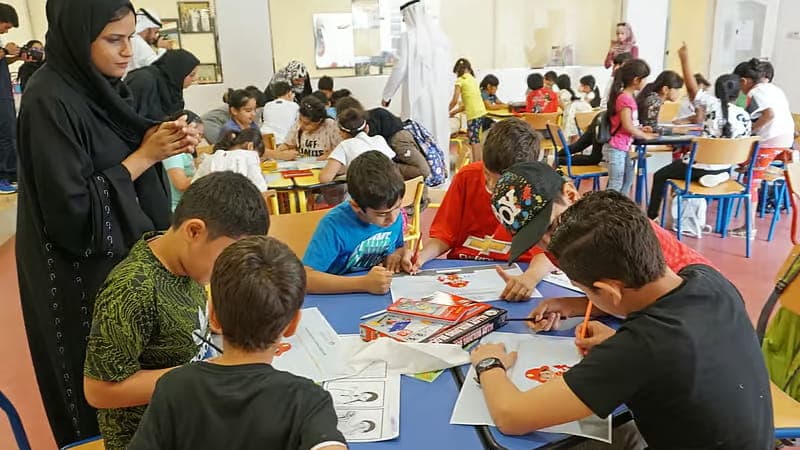
Schools in Sharjah are drawing a clear line between using artificial intelligence (AI) to support learning and relying on it to do students’ work. Under new guidelines, students can use tools such as ChatGPT to research topics, explore ideas and deepen their understanding, but they are expected to produce their own answers and assignments.
The Sharjah Private Education Authority (SPEA) has introduced an ethical framework governing AI use across educational institutions, setting out responsibilities for students, teachers, school leaders, parents and IT teams. The guidelines seek to harness the benefits of emerging technologies without compromising academic integrity, student privacy or the central role of teachers in education.

Aligned with the UAE’s national directives and values, the framework emphasises fairness, transparency, accountability, human oversight, cybersecurity and critical thinking. It also calls for students to disclose AI use where appropriate and verify information generated by AI tools rather than accepting it at face value.
The initiative reflects a growing effort to integrate AI into classrooms while ensuring that technology strengthens students’ learning instead of replacing their ability to reason, question and solve problems independently.
Aisha Butti Al Ghafli, director of SPEA’s Curriculum and Assessment Department, said the framework reflected the authority’s commitment to adopting modern technologies while protecting learners’ data, reinforcing teachers’ roles and developing students’ critical-thinking skills.
School principals in Sharjah say the guidelines will require a shift in how students approach assignments and how teachers assess learning, with greater emphasis on original thinking and demonstrated understanding.
Pramod Mahajan, principal of Sharjah Indian School, said the central objective was to preserve academic honesty and ensure students developed the confidence to think independently.
“The aim behind changing the AI rules is to ensure academic honesty. Students should not depend entirely on ChatGPT or other AI tools to write their answers or complete assignments. Their work should reflect their own understanding, creativity and ability to think independently,” he said.
Mahajan said AI could be useful when students need to research a subject, gather information or identify areas for further exploration. However, the responsibility for analysing that information, drawing conclusions and presenting answers must remain with the learner.
Rather than treating AI as a shortcut to completed assignments, students should use it to ask questions, examine different perspectives and develop their own understanding, he said.
“AI should be used to challenge students and encourage them to think, rather than simply provide them with answers. They can use it to explore a topic or gather information, but the next step must come from them. They should be able to think through the information and come up with their own answers.”
The shift also has implications for classroom assessments. Teachers cannot always rely on submitted assignments alone to determine whether students have understood a subject, particularly when AI tools can generate polished responses within seconds.
Mahajan said Sharjah Indian School planned to use assessments that test students’ understanding directly, including quizzes and questions requiring them to respond independently.
“For instance, we may give them a quiz that requires them to respond immediately, allowing us to assess their understanding rather than just the answers they submit,” he said.
Students may use AI to collect information and identify points worth exploring, but their final responses must demonstrate their own reasoning. Mahajan added that AI could also assist in identifying instances where students had relied on the technology to generate their work.
He welcomed SPEA’s initiative, saying the broader objective was to prepare students to use emerging technologies responsibly without weakening their ability to think for themselves.
Dr Armeena Tabassum, principal of Raffles World Academy Sharjah, said schools needed to prepare students for a technology-driven future while ensuring they continued to develop the skills required to learn independently.
She said the challenge was not to exclude AI from education, but to establish clear boundaries around its use and ensure it served a meaningful learning purpose.
“We recognise that artificial intelligence is becoming an increasingly important part of education and the world our students are growing up in. Our approach is to strike a careful balance between embracing technology as a purposeful tool for enhancing teaching and learning, while developing students' academic integrity, critical thinking and independence,” she said.
Tabassum stressed that students must understand the difference between using AI to improve their learning and allowing it to complete their work for them.
“We want our students to understand that AI should support their thinking, not replace it.”
At Raffles World Academy Sharjah, responsible AI use involves clear expectations on academic integrity, online safety and the need to check the accuracy of AI-generated information.
Teachers are expected to model appropriate use of the technology, helping students understand both its potential and its limitations. Parents also have a role to play by encouraging children to attempt tasks independently before turning to digital assistance.
Tabassum said this shared approach was essential to helping students develop sound learning habits as AI tools became increasingly accessible.
The framework places responsibility across the school community, recognising that the effective integration of AI involves more than introducing new technology. It requires students to understand their academic responsibilities, teachers to adapt assessment practices and parents to reinforce independent learning at home.
For schools, the challenge is to ensure that students emerge from the AI era better equipped to question information, assess its reliability and form their own conclusions. The aim is not to keep technology out of the classroom, but to ensure that students remain active participants in their education rather than passive recipients of machine-generated answers.

UAE parents urged to check if children truly learn from AI homework

Chennai School Holiday Today: Schools Closed in 5 Tamil Nadu Districts Due to Heavy Rain

Sharjah schools set boundaries for AI use in homework and exams

Palghar Ashram School Accident: Two Students Die, Three Injured After Navratri Fair Visit
Engineering Research Should Focus on Actual Problem Solving
Sharjah schools set boundaries for AI use in homework and exams

Former MIT scientist wins $6 million defamation verdict in misconduct dispute

McMahon highlights Trump’s push to return education powers to states

Could smarter energy solutions make data centres more sustainable?

Cambridge and AstraZeneca extend joint PhD programme for three years

UAE parents urged to check if children truly learn from AI homework
Chennai School Holiday Today: Schools Closed in 5 Tamil Nadu Districts Due to Heavy Rain
Sharjah schools set boundaries for AI use in homework and exams
Palghar Ashram School Accident: Two Students Die, Three Injured After Navratri Fair Visit
Engineering Research Should Focus on Actual Problem Solving
Sharjah schools set boundaries for AI use in homework and exams
Former MIT scientist wins $6 million defamation verdict in misconduct dispute
McMahon highlights Trump’s push to return education powers to states
Could smarter energy solutions make data centres more sustainable?
Cambridge and AstraZeneca extend joint PhD programme for three years
Copyright© educationpost.in 2026 All Rights Reserved.