


The NCPI’s call to honour Chief Election Commissioner Gyanesh Kumar comes as the poll panel faces scrutiny over reported internal objections, its handling of electoral-roll revision and a Supreme Court plea questioning aspects of the CEC’s functioning.
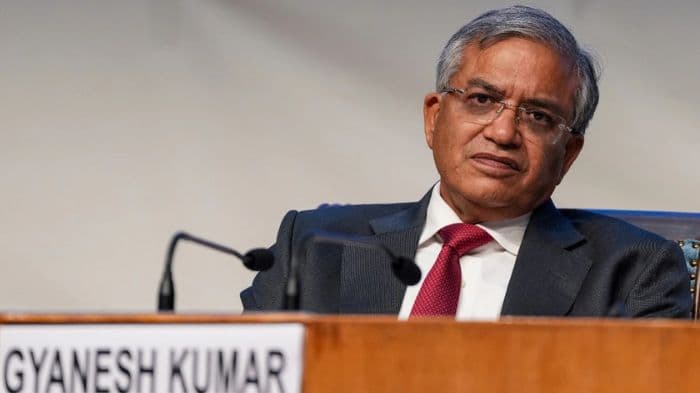
The Nationalist Citizens Party of India (NCPI) has written to Prime Minister Narendra Modi seeking the Bharat Ratna for Chief Election Commissioner Gyanesh Kumar, praising his leadership of the Election Commission of India and the conduct of the recent West Bengal Assembly election.
In its Sep 30 letter, NCPI president Jyotiprokash Chatterjee described Kumar’s tenure as an example of strong electoral administration and cited peaceful polling, voter-list revision and voter turnout as reasons for the proposed honour.

The request arrives at a particularly contested moment for the Election Commission.
In recent weeks, reports have emerged of disagreements within the three-member poll panel over decisions relating to electoral rolls, voter registration, database access and the Special Intensive Revision (SIR) process.
An investigation by The Indian Express reported that Election Commissioners Sukhbir Singh Sandhu and Vivek Joshi had formally recorded objections on at least 14 occasions over a 10-month period, including concerns about decisions they said had been taken without their knowledge.
The Election Commission has disputed the suggestion of an institutional breakdown. Officials have said that decisions, including SIR, had the approval of all three commissioners, while the Commission has also issued point-by-point clarifications on some of the issues raised in the reports.
The dispute has now moved beyond political commentary. The Supreme Court has agreed to hear a petition questioning the functioning of CEC Gyanesh Kumar and raising issues around whether powers vested in the multi-member Election Commission can be exercised individually. The petition also challenges aspects of the SIR process.
That backdrop gives the NCPI's Bharat Ratna request a notable context. The organisation's letter presents Kumar's stewardship of the ECI as evidence of institutional credibility, while the public debate around the Commission is currently focused on questions of internal decision-making, transparency and the management of electoral rolls.
The contrast does not by itself establish whether Kumar's record merits or does not merit the country's highest civilian honour. It does, however, highlight the very different assessments of his tenure that are emerging simultaneously.
NCPI's letter specifically praised the West Bengal Assembly election, arguing that the poll was conducted peacefully and helped restore voter confidence. Those are political and organisational assessments made by the party in its representation to the Prime Minister.
At the same time, the reported objections by two Election Commissioners and the pending Supreme Court proceedings mean that several questions concerning the functioning of the poll panel remain subject to scrutiny.
The Commission has maintained that its decisions were collectively approved and that internal differences are part of institutional functioning.
The result is an unusual moment in which a proposal for the country's highest civilian honour for the head of India's election machinery has surfaced alongside an active debate over how that machinery itself has been functioning.
Whether the Bharat Ratna proposal gains any official consideration is a separate matter. For now, the more immediate question in the public domain remains how the Election Commission's decisions, internal processes and electoral-roll revision withstand institutional and judicial scrutiny.

Critical Security Flaws Prompt Emergency Action

Four Members Warn of Broadening Price Pressures
Section 17A of Prevention of Corruption Act Does Not Cover Every Act of Public Servants

Hamas Rejects Disarmament, US and Israel Consider Iran Strikes

Compromised Cryptographic Keys Trigger Global Cybersecurity Concerns

Egypt insists international schools include Arabic, history in final scores

China’s Chery unveils AI companion robot designed to ease loneliness

New Zealand reforms could leave more students without school qualifications

Alfred Nobel’s will created one of the world’s most recognised prizes. Here’s how

Pepperdine University earns Google recognition and Digital Education Council membership for AI initiatives

Critical Security Flaws Prompt Emergency Action
Four Members Warn of Broadening Price Pressures
Section 17A of Prevention of Corruption Act Does Not Cover Every Act of Public Servants
Hamas Rejects Disarmament, US and Israel Consider Iran Strikes
Compromised Cryptographic Keys Trigger Global Cybersecurity Concerns
Egypt insists international schools include Arabic, history in final scores
China’s Chery unveils AI companion robot designed to ease loneliness
New Zealand reforms could leave more students without school qualifications
Alfred Nobel’s will created one of the world’s most recognised prizes. Here’s how
Pepperdine University earns Google recognition and Digital Education Council membership for AI initiatives
Copyright© educationpost.in 2026 All Rights Reserved.