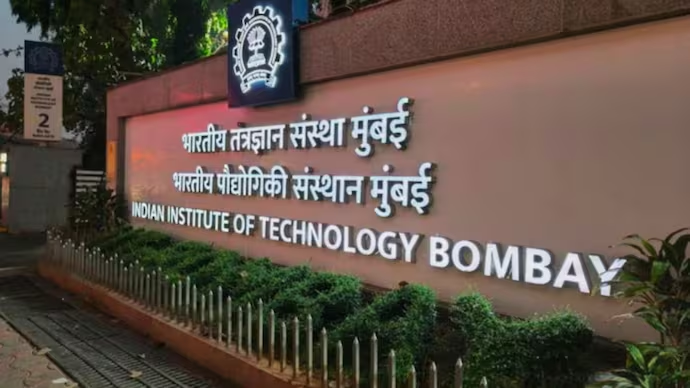
The country's education journey has expanded access, institutions and policy reforms, but examination irregularities, governance concerns and implementation gaps continue to test public confidence.
Pragya Kumari16 September 2026 15:09
India's medical entrance examination system is facing one of its biggest credibility crises in recent years. Allegations of paper leaks, repeated examination irregularities, and nationwide protests over NEET UG have shaken public confidence in a test that determines the future of more than 20 lakh aspirants every year.
For millions of students, NEET UG is not just another competitive examination. It is the single gateway to undergraduate medical education, deciding admissions to MBBS, BDS, AYUSH, veterinary, nursing, and other allied health science courses across the country.
Any disruption in its conduct has consequences that extend far beyond examination halls, affecting academic calendars, admissions, and ultimately the healthcare workforce.
The controversy reached a political flashpoint with the resignation of Union Education Minister Dharmendra Pradhan on July 25, 2026, following mounting demands for accountability over examination irregularities.
Pralhad Joshi was subsequently entrusted with the additional charge of the Ministry of Education, inheriting one of the most challenging phases in the ministry's recent history.
While the immediate focus remains on restoring the credibility of India's examination system, the episode has also reignited a larger debate. Nearly eight decades after Independence, has India's education system lived up to the vision of the leaders who shaped it?
From expanding access to education and establishing world-class institutions to introducing landmark policies such as the National Policy on Education and the National Education Policy 2020, successive governments have transformed the country's educational landscape.
Yet recurring paper leaks, governance lapses, institutional vacancies, implementation gaps, and concerns over examination integrity continue to cast a shadow over these achievements.
The Ministry of Education, entrusted with shaping the nation's academic future, is responsible for formulating education policies, improving school and higher education, promoting research and innovation, strengthening teacher education, and expanding equitable access to quality learning.
Since 1947, more than 30 Union Education Ministers have led the ministry, each contributing to India's educational journey through reforms, institution-building, and policy interventions. Their tenures reflect not only the evolution of the country's education system but also the changing priorities and challenges that have defined every era.
From Independence to reforms
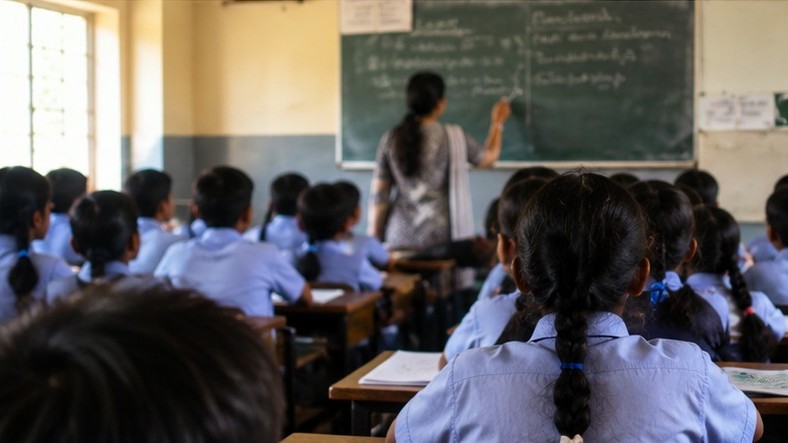
The history of India's education system is, in many ways, the story of the country's own transformation. From overcoming the challenges of low literacy and limited educational infrastructure after Independence to becoming home to some of the world's largest school and higher education networks, the sector has undergone sweeping changes over the past eight decades.
Successive Union Education Ministers have played a pivotal role in shaping these reforms, introducing policies that expanded access to education, strengthened institutions, promoted research, and adapted learning to the needs of a rapidly changing society.
The journey began with Maulana Abul Kalam Azad, Independent India's first Education Minister, whose vision laid the foundation for the country's modern education system. Serving from 1947 to 1958, Azad believed that education was essential to nation-building.
At a time when India was recovering from the effects of Partition and widespread illiteracy, he championed universal primary education, adult literacy, women's education, scientific research, and technical education.
Azad also played a pivotal role in establishing institutions that continue to shape Indian education today.
He played a key role in setting up the University Grants Commission (UGC), supported the expansion of the Indian Institutes of Technology (IITs), and encouraged the creation of premier cultural institutions such as the Indian Council for Cultural Relations (ICCR), Sahitya Akademi, Sangeet Natak Akademi, and Lalit Kala Akademi.
His contribution remains so significant that his birth anniversary, November 11, is observed as National Education Day every year.
The decades that followed witnessed a gradual shift from laying educational foundations to expanding quality and access. Dr. K. L. Shrimali concentrated on strengthening rural education and teacher training, recognizing that improving classroom learning required well-trained educators.
Dr. Triguna Sen focused on technical education during a period that saw the recommendations of the Kothari Commission shape the landmark National Policy on Education, 1968.
Around the same time, Dr. V. K. R. V. Rao advocated research-driven educational planning, while S. Nurul Hasan expanded academic and research institutions, including the Indian Council of Historical Research.
Sheila Kaul further strengthened efforts to improve girls' education and widen access to primary schooling, reflecting the growing emphasis on educational inclusion.
The Changing Priorities of Indian Education
As India progressed economically and socially, the priorities of the education ministry evolved as well.
The focus gradually expanded from improving literacy and school enrollment to strengthening higher education, promoting scientific research, increasing institutional autonomy, encouraging vocational education, and embracing technology-driven learning.
These changing priorities would eventually pave the way for some of the country's most significant education reforms in the decades that followed.
Major policy milestones
As India's education system matured, successive governments shifted their focus from expanding access to improving quality, equity, and institutional capacity.
Several landmark policies introduced over the decades fundamentally reshaped school education, higher education, teacher training, and research, leaving a lasting impact on millions of students.
One of the most significant turning points came during the tenure of P. V. Narasimha Rao, under whom the National Policy on Education (NPE), 1986, was introduced. The policy sought to universalize elementary education while emphasizing teacher training, women's education, adult literacy, and vocational education.
It also paved the way for flagship initiatives such as Jawahar Navodaya Vidyalayas, Operation Blackboard, and District Institutes of Education and Training (DIETs), aimed at improving school infrastructure and strengthening teacher preparation across the country.
The expansion of higher education gathered pace during Arjun Singh's tenure. His government established additional Central Universities, Indian Institutes of Technology (IITs), Indian Institutes of Management (IIMs), and Indian Institutes of Science Education and Research (IISERs), significantly increasing opportunities for higher learning.
His tenure also coincided with key developments that culminated in the enactment of the Right of Children to Free and Compulsory Education Act, 2009, making education a fundamental right for children between the ages of six and fourteen.
Murli Manohar Joshi focused on strengthening school education through the expansion of the Sarva Shiksha Abhiyan while promoting science education and introducing the National Curriculum Framework (NCF), 2000.
His tenure reflected the growing recognition that curriculum reforms and universal elementary education had to progress together to improve learning outcomes.
The reform momentum continued under Kapil Sibal, who oversaw the implementation of the Right to Education (RTE) Act. He also introduced the Continuous and Comprehensive Evaluation (CCE) system and the CGPA-based grading system for CBSE Class 10 students, while advocating greater use of technology in classrooms.
Although several of these measures generated debate over their long-term effectiveness, they marked a significant shift in the way student assessment and school education were envisioned. M. M. Pallam Raju, who succeeded him, continued efforts to strengthen teacher education, institutional quality, and skill development.
Alongside these ministerial initiatives, India's education system witnessed several landmark legislative and policy reforms. The National Policy on Education, 1968, based on the recommendations of the Kothari Commission, introduced the three-language formula and recommended free and compulsory education up to the age of 14.
The National Policy on Education, 1986, later revised in 1992, emphasized educational equity, Operation Blackboard, and the expansion of Jawahar Navodaya Vidyalayas. The Right to Education Act, 2009, transformed elementary education by making free and compulsory schooling a legal entitlement for children aged six to 14.
More recently, the National Education Policy (NEP) 2020 replaced the 34-year-old policy framework, introduced the 5+3+3+4 school structure, encouraged multidisciplinary learning and vocational integration, and restored the ministry's original name from the Ministry of Human Resource Development to the Ministry of Education. Together, these reforms have shaped the direction of Indian education over the past five decades.
The BJP years: Reforms under scrutiny
The education portfolio entered a new phase after the Bharatiya Janata Party (BJP) assumed office in 2014. Over the past 12 years, five leaders have handled the ministry, overseeing some of the most significant policy changes in recent decades while also confronting controversies that repeatedly tested public confidence in India's education system.
The period witnessed sweeping reforms aimed at improving quality, expanding digital learning, strengthening institutional autonomy, and implementing the National Education Policy (NEP) 2020.
At the same time, recurring examination irregularities, paper leaks, and governance concerns increasingly overshadowed many of these initiatives.
Smriti Irani, who served as Education Minister from 2014 to 2016, inherited a sector undergoing rapid change.
During her tenure, the controversial Four-Year Undergraduate Programme (FYUP) at Delhi University was rolled back, work began on drafting a new National Education Policy, and the National Institutional Ranking Framework (NIRF) was launched to improve transparency and competitiveness among higher education institutions.
However, her tenure was equally marked by intense political debates surrounding the protests at Jawaharlal Nehru University and the death of Hyderabad Central University research scholar Rohith Vemula, placing higher education at the center of national discourse.
Her successor, Prakash Javadekar, focused on institutional reforms and examination systems. His tenure saw the enactment of the Indian Institutes of Management (IIM) Act, 2017, granting greater autonomy to the country's premier management institutes.
Perhaps one of the most consequential decisions during this period was the establishment of the National Testing Agency (NTA), which was envisioned as a specialized body to conduct transparent, standardized, and technology-driven entrance examinations across the country.
He also amended the Right to Education Act by ending the mandatory No Detention Policy. Despite these reforms, the 2018 CBSE paper leak controversy and criticism surrounding the Institution of Eminence status granted to the proposed Jio Institute drew significant public attention and raised fresh questions about examination security and governance.
The NEP Era and Beyond
Ramesh Pokhriyal 'Nishank', who assumed office in 2019, presided over one of the most transformative periods in Indian education. His tenure culminated in the Cabinet approval of the National Education Policy (NEP) 2020, replacing the country's 34-year-old education policy and introducing sweeping reforms across school and higher education.
The ministry also reverted to its original name from the Ministry of Human Resource Development (MHRD) to the Ministry of Education. However, his tenure also attracted criticism as several Central Universities and IITs continued to function without permanent vice chancellors and directors. He resigned in July 2021, citing health reasons.
Dharmendra Pradhan, who succeeded Pokhriyal, became the longest-serving Education Minister under the NDA government.
His tenure was defined by the large-scale implementation of NEP 2020 through initiatives such as PM SHRI Schools, the National Curriculum Framework, the Academic Bank of Credits, the National Credit Framework, multilingual education, and research promotion through the Anusandhan National Research Foundation (ANRF).
The ministry also accelerated efforts to modernize curricula, promote flexibility in higher education, and strengthen digital learning ecosystems.
Yet, as implementation gathered pace, the ministry found itself grappling with an escalating series of examination controversies.
Allegations of paper leaks, irregularities in competitive examinations, and repeated cancellations increasingly dominated public discourse, overshadowing policy achievements and raising concerns over institutional accountability.
The nationwide protests surrounding NEET UG eventually became the defining challenge of Pradhan's tenure, culminating in his resignation on July 25, 2026, amid mounting demands for accountability.
Restoring Trust in India's Education System
With Pralhad Joshi taking additional charge of the Ministry of Education, the government faces the immediate task of restoring public confidence in one of India's most critical public institutions. The challenge extends beyond conducting examinations on schedule.
It involves strengthening institutional governance, ensuring transparency in recruitment and entrance tests, addressing implementation gaps, and rebuilding trust among millions of students whose academic and professional futures depend on the credibility of the country's education system.
From Azad's vision of nation-building through education to the ambitious reforms introduced under the National Education Policy 2020, India's education journey has been one of continuous transformation.
Premier institutions have been established, access to education has expanded, technology has entered classrooms, and policy frameworks have evolved to meet changing national priorities.
However, the recurring controversies surrounding competitive examinations serve as a reminder that reforms are only as effective as their implementation.
As the ministry enters a new phase of leadership, restoring the integrity of India's examination system may prove to be as significant as any policy reform introduced over the past eight decades.