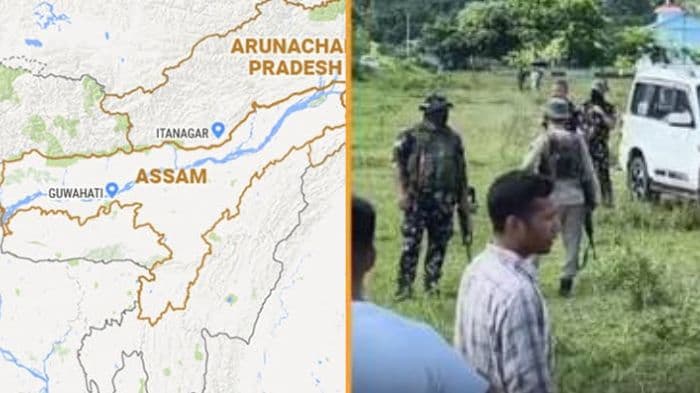
Tensions along the Assam-Arunachal Pradesh border have escalated following a firing incident that injured 11 people, an indefinite economic blockade and a fresh confrontation between protesters from the two states.
Political leaders from Assam and Arunachal Pradesh have appealed for calm and urged people not to allow the latest dispute to escalate into a wider confrontation.

But what exactly triggered the current tension, and how does it connect to the longstanding boundary dispute between the two states?
What happened?
The immediate trigger was a firing incident reported on Aug 12 in the Bodoti area of Mingmang. According to the reports, several people from Assam were injured in the incident.
The incident was followed by an indefinite economic blockade called by the Takam Mising Porin Kebang (TMPK), an apex student organisation of Assam's Mising community.
The organisation demanded action against those allegedly responsible for the firing and called for their arrest. It also raised concerns over the broader boundary dispute and alleged encroachment on Assam land.
The blockade affected the movement of people and goods between the two states.
The tension escalated further on Aug 13 when protesters from Assam and Arunachal Pradesh reportedly confronted each other at Likabali in Arunachal Pradesh's Lower Siang district.
Police intervened and fired warning shots into the air to disperse the gathering, according to the India Today NE report.
The fresh confrontation came amid the continuing blockade, increasing concerns about the possibility of the dispute escalating beyond the immediate incident.
Why is there a dispute between Assam and Arunachal Pradesh?
The two states have been involved in a boundary dispute for decades.
Arunachal Pradesh became a full-fledged state in 1987. The boundary between the former North-East Frontier Agency and Assam had already been a contentious issue, with disagreements continuing over areas claimed by both sides.
A tripartite committee was subsequently constituted to examine the dispute. It recommended transferring certain territories from Assam to Arunachal Pradesh.
The disagreement over the boundary has continued despite several attempts to resolve it.
Attempts to settle dispute
In 2022, Assam Chief Minister Himanta Biswa Sarma and Arunachal Pradesh Chief Minister Pema Khandu signed the Namsai Declaration as part of an effort to resolve the boundary dispute.
The process involved regional committees examining the disputed areas and working towards reducing the number of areas under dispute.
According to Sarma, the number of disputed villages has since fallen from 123 to 52.
The two state governments have continued discussions on the remaining areas.
Why has the latest incident become politically sensitive?
The current situation involves more than the original firing incident.
The firing was followed by an economic blockade, which affects movement and supplies between the neighbouring states. A fresh confrontation between protesters then took place, bringing the longstanding boundary issue back into focus.
The situation has therefore prompted political leaders from both states to intervene and appeal for restraint.
Assam Chief Minister Himanta Biswa Sarma urged people in both states to maintain peace and harmony, saying that geographical boundaries should not divide people.
Union Parliamentary Affairs Minister and Arunachal Pradesh MP Kiren Rijiju also appealed for the dispute to be resolved peacefully.
Rijiju said he had spoken to the chief ministers of both states and that discussions were continuing.
Meanwhile, Sarma said the two governments had made progress in reducing the number of disputed villages and would continue discussions over the remaining areas.
Rijiju stressed the longstanding social ties between the people of Assam and Arunachal Pradesh and appealed against allowing local disputes to develop into a larger confrontation between the two states.
Arunachal Pradesh Chief Minister Pema Khandu has also appealed for peace.
The underlying boundary dispute remains unresolved in the areas that are still contested. At the same time, both state governments have an existing mechanism for negotiations and have publicly indicated their preference for resolving the dispute through dialogue.









.jpg&w=256&q=75)
.jpg&w=256&q=75)
.webp&w=256&q=75)
