


Growing enrollment in Mandarin courses, rising HSK participation and expanding university partnerships are connecting Indonesian students with academic programs and employment prospects across multiple professional sectors.
Chinese language proficiency is increasingly becoming part of the academic and career plans of young Indonesians, with more students learning Mandarin, exploring university opportunities in China and preparing to enter industries linked to growing bilateral cooperation.
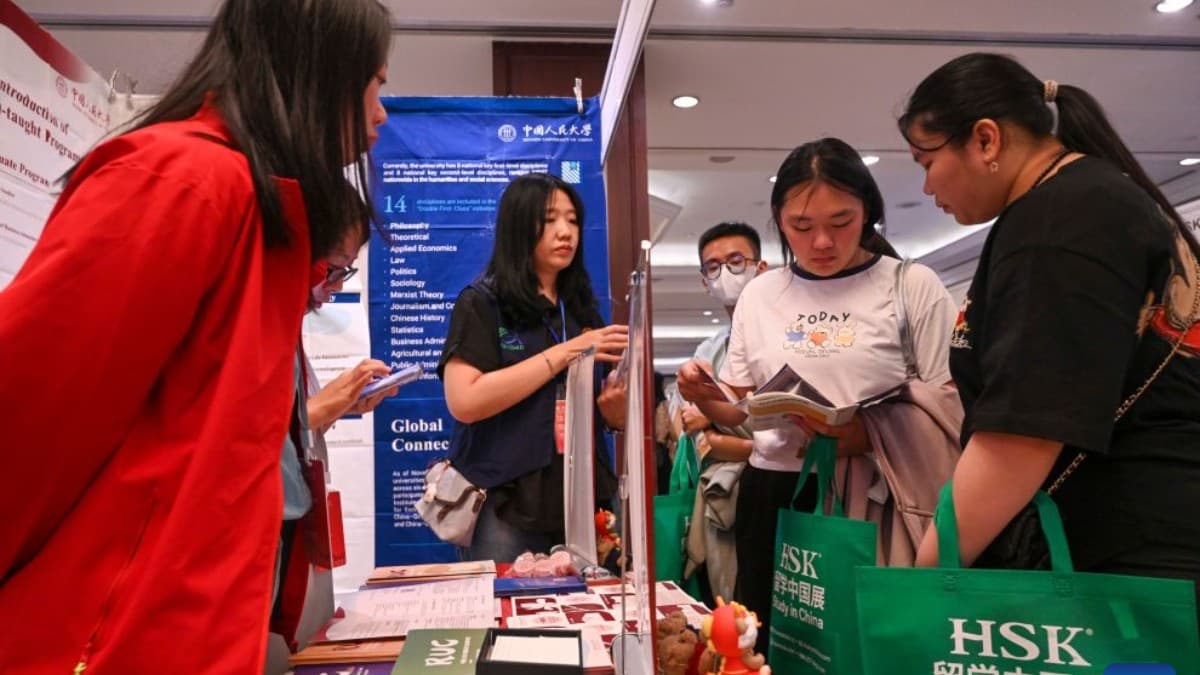
The trend was visible at the 2026 Indonesia HSK Study in China and Career Expo, held in Jakarta. The event brought together representatives from 21 Chinese universities, including Peking University and Tsinghua University, and attracted approximately 3,000 Indonesian students, Chinese language learners and parents interested in higher education opportunities in China.

For several young visitors, the exhibition was an opportunity to understand university admission requirements and explore academic programs that could shape their future careers.
Among them was 16-year-old Calysta Jacqueline Wijaya, a first-year high school student who has already spent 11 years learning Chinese. She visited the exhibition to gather information about admission opportunities at Chinese universities.
Calysta hopes to pursue a degree in pharmacy in China and eventually use her education to contribute to Indonesia's healthcare sector.
"I want to study pharmacy in China," Calysta told Xinhua, noting that she hopes to bring professional knowledge back to Indonesia to help more people.
She is currently working to improve her performance in the Chinese Proficiency Test, commonly known as HSK, as part of her preparation for university applications.
Her classmate, 15-year-old Richard Dharma Hungnata, is also considering higher education in China. He began learning Chinese in his first year of primary school and has developed enough proficiency to communicate fluently in the language.
His interest in studying in China has also been shaped by his visits to Beijing, Shanghai and other Chinese cities. The experiences gave him an opportunity to observe the country's development and strengthened his interest in pursuing higher education there.
With mathematics and physics among his strongest interests, Richard plans to study engineering at a Chinese university. He intends to take the HSK examination after completing his second year of high school.
He hopes to achieve a higher score to improve his chances of securing admission to his preferred university.
Mandarin learning gains popularity among Indonesian students
The growing interest in Chinese universities is also reflected in the increasing number of Indonesian students enrolling in Mandarin language courses.
Zheng Wenting, a Chinese language teacher who also heads a Mandarin education center in Indonesia, said she has observed a noticeable change in parents' attitudes toward Chinese language education.
According to Zheng, more Indonesian families are encouraging their children to learn Mandarin, while an increasing number of students are considering China as a destination for higher education.
The expansion of her institution reflects this growing demand. Around a decade ago, the center enrolled approximately 50 students in each intake. The number has since increased to nearly 500 students per intake.
The trend indicates how Chinese language education is becoming a more prominent part of the academic journeys of Indonesian children and teenagers.
Students begin with the basics of Chinese characters and pinyin during their primary school years. As they progress through their education, many start preparing for language proficiency examinations, researching university programs and identifying potential career opportunities in China.
For some, learning Mandarin is no longer limited to acquiring an additional language. It has become a step toward accessing international education and developing professional skills that could be useful in the job market.
Studying in China opens career opportunities for Indonesian graduates
The connection between Chinese language education, overseas university degrees and employment opportunities was also evident at the Jakarta exhibition.
At the booth of the Beijing-based China University of Petroleum, Indonesian graduate Dexter Godwin shared his experience of studying in China with prospective applicants and their families.
Dexter completed his degree in petroleum engineering at the university in 2025. His decision to study there was influenced by information he found online about the institution's academic strengths in petroleum engineering.
After enrolling, he spent four years in China, where he gained specialized knowledge in his chosen discipline while also developing his Mandarin language skills.
His education has since translated into an employment opportunity in Indonesia. He secured a position at an oil company operating in the country, allowing him to apply the technical knowledge acquired during his university education.
Sharing his experience with students attending the exhibition, Dexter highlighted how his academic training and interactions with teachers helped him prepare for professional responsibilities.
"I feel fortunate to have studied at China University of Petroleum for four years and to be able to put what I learned into practice," Dexter said, adding that he had benefited greatly from his academic training and the support of his teachers.
His experience illustrates how international education can connect academic qualifications with employment opportunities in a student's home country.
It also highlights the potential value of combining specialized professional training with language proficiency, particularly for graduates seeking employment in industries where international cooperation is expanding.
China-Indonesia cooperation creates demand for bilingual professionals
The growing interest in studying in China is also connected to the expanding economic and diplomatic relationship between the two countries.
China and Indonesia continue to strengthen cooperation across several sectors, including trade, infrastructure, energy and other industries. As these partnerships expand, professionals who understand both countries' languages and possess relevant technical expertise are increasingly positioned to participate in cross-border business and professional activities.
The combination of Mandarin proficiency and specialized academic qualifications could therefore provide Indonesian graduates with additional opportunities in industries connected to bilateral cooperation.
Data from Chinese Testing International Co., Ltd. also highlights the scale of interest in Chinese language learning across Indonesia.
Since the HSK examination was introduced in Indonesia in 2001, the country has established 56 test centers and recorded more than 300,000 test takers cumulatively.
Indonesia ranked fourth globally in the number of HSK test takers in 2026, indicating the growing reach of Chinese language education in the country.
Liu Xiaolong, deputy general manager of Chinese Testing International Co., Ltd., said Chinese language learning, higher education in China and career development are becoming increasingly connected.
He noted that the expansion of cooperation between the two countries across different sectors is creating greater demand for young professionals who possess both Chinese language skills and specialized knowledge.
Such qualifications can help graduates navigate professional environments involving Chinese and Indonesian organizations while contributing to partnerships in different industries.
Youth exchanges strengthen education ties between China and Indonesia
Education exchanges are also being viewed as an important part of the broader relationship between the two countries.
Chen Wu, education counselor at the Chinese Embassy in Indonesia, highlighted the role of young people in maintaining and strengthening the friendship between China and Indonesia.
He said youth exchanges play an important role in sustaining bilateral relations and encouraged more Indonesian students to explore educational opportunities that would allow them to develop a deeper understanding of China.
China welcomes more young Indonesians to gain exposure to its society, education system and development through academic experiences, he added.
The Jakarta education and career exhibition brought together prospective students, university representatives, language educators and graduates who have already completed their studies in China.
Their experiences reflect different stages of an increasingly connected education pathway, from learning Mandarin during primary school to preparing for university admission and eventually entering the workforce.
With Indonesia recording more than 300,000 HSK test takers since 2001 and ranking fourth worldwide in 2026, Chinese language proficiency is gaining a stronger place in the country's education landscape.
For students such as Calysta and Richard, Mandarin is an opportunity to pursue academic ambitions in China. For graduates such as Dexter, it has become an additional skill alongside a professional degree that can be applied in Indonesia's growing industrial and economic partnerships.
As educational and economic cooperation between the two countries continues to develop, the combination of international education, language proficiency and specialized professional training is emerging as an important pathway for Indonesian youth seeking broader career opportunities.

IIIT-Delhi Awards Degrees to 830 Students at 15th Convocation; Recognises Academic and Research Excellence
Universal AI University Awards Degrees to 369 Graduates at 15th Convocation Ceremony

Bengaluru Water Crisis: Poor Families Spend ₹3,000 Monthly on Drinking Water, Survey Flags
Japan's Okayama University uses robotics competitions to build engineering and workplace skills

Indian Navy Rescues 20 Crew from Hijacked Iranian Vessel off Somalia
Japan's Okayama University uses robotics competitions to build engineering and workplace skills
Indian Navy Rescues 20 Crew from Hijacked Iranian Vessel off Somalia

Learning Mandarin, earning degrees in China: How Indonesian youth are preparing for global careers
China allows clinical medicine master's and PhD students to graduate without thesis under new pathway

Delhi HC Declines Action Against ACP Over Alleged Threats to Lawyers

IIIT-Delhi Awards Degrees to 830 Students at 15th Convocation; Recognises Academic and Research Excellence
Universal AI University Awards Degrees to 369 Graduates at 15th Convocation Ceremony
Bengaluru Water Crisis: Poor Families Spend ₹3,000 Monthly on Drinking Water, Survey Flags
Japan's Okayama University uses robotics competitions to build engineering and workplace skills
Indian Navy Rescues 20 Crew from Hijacked Iranian Vessel off Somalia
Japan's Okayama University uses robotics competitions to build engineering and workplace skills
Indian Navy Rescues 20 Crew from Hijacked Iranian Vessel off Somalia
Learning Mandarin, earning degrees in China: How Indonesian youth are preparing for global careers
China allows clinical medicine master's and PhD students to graduate without thesis under new pathway
Delhi HC Declines Action Against ACP Over Alleged Threats to Lawyers
Copyright© educationpost.in 2026 All Rights Reserved.