


Diversified exports, stronger domestic capabilities and deeper global value-chain integration needed to help Indian firms compete internationally.
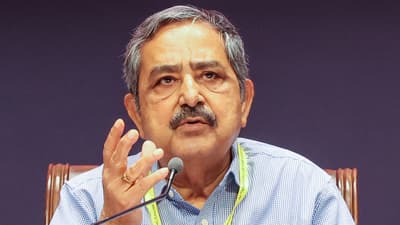
Strengthening India’s trade competitiveness will require continued diversification of export markets and products, deeper integration with global and regional value chains, stronger domestic capabilities in strategic sectors, and a policy environment that enables firms to compete effectively in international markets, NITI Aayog Vice Chairman Ashok Kumar Lahiri said on Wednesday.
Lahiri was speaking at the launch of the latest edition of the ‘Trade Watch Quarterly’ publication for the April- June 2026 period.

India’s merchandise and services trade continued to expand, with total trade reaching $506.9 billion in Q1 FY27, registering 15.5 per cent annual growth.
The NITI Aayog report examines India’s export competitiveness and growing import dependence across metals and ores, with a focus on critical minerals and higher-value non-ferrous metals, while assessing structural constraints and opportunities to strengthen domestic value addition, investment, market diversification and global competitiveness.
India’s merchandise exports grew strongly in Q1 FY27, led by mineral fuels, electrical machinery, nuclear reactors, iron and steel, and vehicles, supported by a rise in shipments of petroleum products, steel, engineering goods, and automobiles.
Imports continued to support India’s industrial and energy requirements, with notable growth in capital goods, electronic components and copper. This trend reflects the strength of domestic investment activity, expanding industrial capacity and the growing integration of Indian industry with global value chains.
According to NITI Aayog, India’s export destinations continued to diversify, with Tanzania and South Africa emerging among the top ten markets, alongside strong growth in exports to Singapore.
Imports from Latin America and West Africa recorded significant growth, supported in part by the diversification of crude oil sourcing, thereby enhancing resilience and flexibility in India’s import basket.
At the same time, Northeast Asia, West Asia-GCC, and ASEAN remained important sources of imports, together accounting for around half of India’s total imports.
Trade with FTA partners also gained further momentum, with exports increasing by 36.3 per cent and imports by 10.0 per cent, underscoring the strengthening of economic partnerships and deeper integration of India with global trade and supply chains, said the report.
Metals exports reached $34.8 billion in 2025, with iron and steel, articles of iron and steel, and aluminium together accounting for around 78 per cent of exports. Metals and ores imports increased from $32.2 billion in 2015 to $60.5 billion in 2025, reflecting the growing demand for key industrial and strategic minerals, particularly copper, lithium, cobalt and nickel, in line with India’s expanding manufacturing base, infrastructure development and energy transition requirements.
(Except the headline, this article has not been edited by Education Post)

Critical Security Flaws Prompt Emergency Action
Four Members Warn of Broadening Price Pressures
Section 17A of Prevention of Corruption Act Does Not Cover Every Act of Public Servants
Hamas Rejects Disarmament, US and Israel Consider Iran Strikes

Compromised Cryptographic Keys Trigger Global Cybersecurity Concerns

Egypt insists international schools include Arabic, history in final scores
China’s Chery unveils AI companion robot designed to ease loneliness

New Zealand reforms could leave more students without school qualifications

Alfred Nobel’s will created one of the world’s most recognised prizes. Here’s how

Pepperdine University earns Google recognition and Digital Education Council membership for AI initiatives

Critical Security Flaws Prompt Emergency Action
Four Members Warn of Broadening Price Pressures
Section 17A of Prevention of Corruption Act Does Not Cover Every Act of Public Servants
Hamas Rejects Disarmament, US and Israel Consider Iran Strikes
Compromised Cryptographic Keys Trigger Global Cybersecurity Concerns
Egypt insists international schools include Arabic, history in final scores
China’s Chery unveils AI companion robot designed to ease loneliness
New Zealand reforms could leave more students without school qualifications
Alfred Nobel’s will created one of the world’s most recognised prizes. Here’s how
Pepperdine University earns Google recognition and Digital Education Council membership for AI initiatives
Copyright© educationpost.in 2026 All Rights Reserved.