Protest movements have traditionally relied on slogans, banners, speeches and marches to put their demands across. But a new generation of protesters is increasingly adding memes, pop-culture references, satire and social media-friendly visuals to the mix.
The latest example came from Jharkhand on Aug 10, where students protesting alleged irregularities in government recruitment examinations brought a distinctly Gen Z style to their march towards the state Assembly.

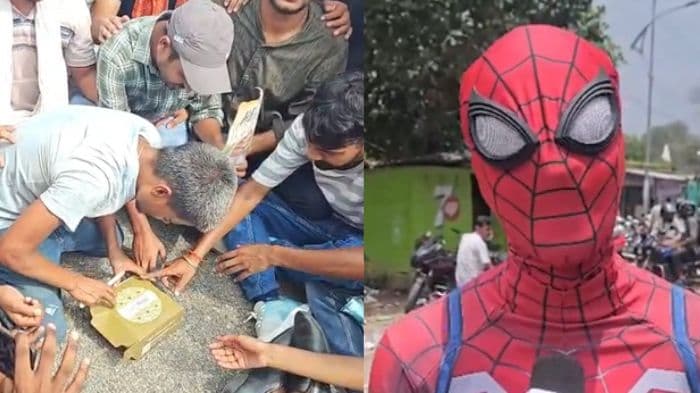
One student turned up dressed as Spider-Man, explaining that the costume was part of the younger generation's unconventional approach to protest. Another group marked Chief Minister Hemant Soren's birthday with a sarcastic cake-cutting ceremony, using the occasion to repeat their demands over the recruitment examinations.
Students also used humour to make a point about their grievances. One protester carried a placard saying “Hariya becho, exam nahi”, referring to Hariyaa, a traditional rice-based fermented drink, while criticising alleged irregularities in examinations.
These tactics have echoes of the student protests at Delhi's Jantar Mantar, where humour and internet culture became central to how Gen Z protesters communicated their anger.
During the Jantar Mantar agitation, protesters used memes, satirical posters, reels and jokes to address issues surrounding examinations and the education system. Instead of relying exclusively on conventional political messaging, many protesters turned their demands into content that could be easily understood, photographed, shared and circulated online.
The approach also brought elements of popular culture into the protest space. Memes and references familiar to young social media users became tools for expressing frustration, while humorous signs and performances helped protesters draw attention to issues that might otherwise struggle to cut through the crowded digital environment.
The use of humour does not necessarily mean the issues themselves are being treated lightly. For Gen Z protesters, satire can work as a way of making serious grievances more accessible while also allowing them to challenge authorities without adopting the conventional language associated with political demonstrations.
At Jantar Mantar, the protest culture was closely connected to social media. Young demonstrators documented their participation, created short-form content and used memes and visual humour to amplify their messages beyond the physical protest site.
That dynamic was visible in Jharkhand as well. The Spider-Man protester explicitly linked his choice of costume to Gen Z's style of expression, while the birthday cake and Hariyaa references created visuals that could easily become social media material.
The difference is particularly significant in an era when a protest no longer remains confined to the location where it takes place. A placard, costume, meme or unusual act can become a photograph or short video and reach audiences far beyond the protest site.
For a generation accustomed to communicating through images, short videos, memes and cultural references, such forms of expression can make a protest feel more familiar and relatable. They can also help individual protesters create distinct identities within a larger movement.
The Jharkhand agitation has nevertheless retained the conventional elements of protest. Students marched towards the Assembly, raised slogans and confronted security barricades, after which police used water cannons and carried out a lathi charge. Fasting student leader Devendra Nath Mahto also joined the march on a stretcher.
At the centre of the agitation are demands concerning alleged irregularities in recruitment examinations, including calls for cancellation of affected examinations, an independent investigation and reforms in the recruitment process.
The combination of conventional mobilisation with memes, humour and pop culture points to a broader shift in how young Indians are expressing dissent.
For Gen Z protesters, the protest site is increasingly both a physical space and a digital content space. The slogan still matters, but so does the meme, the costume, the placard, the photograph and the short video that can carry that slogan much further.




%20Region%20Director%20at%20Logitech%3B%20Madhura%20DasGupta%20Sinha%2C%20Founder%20and%20CEO%2C%20Aspi.webp&w=256&q=75)


.webp&w=256&q=75)
.webp&w=256&q=75)