


A preliminary household survey by the Water Satyagraha campaign highlights the financial burden of private water tankers, while raising concerns over a projected 600 MLD supply gap, groundwater depletion and untreated sewage.
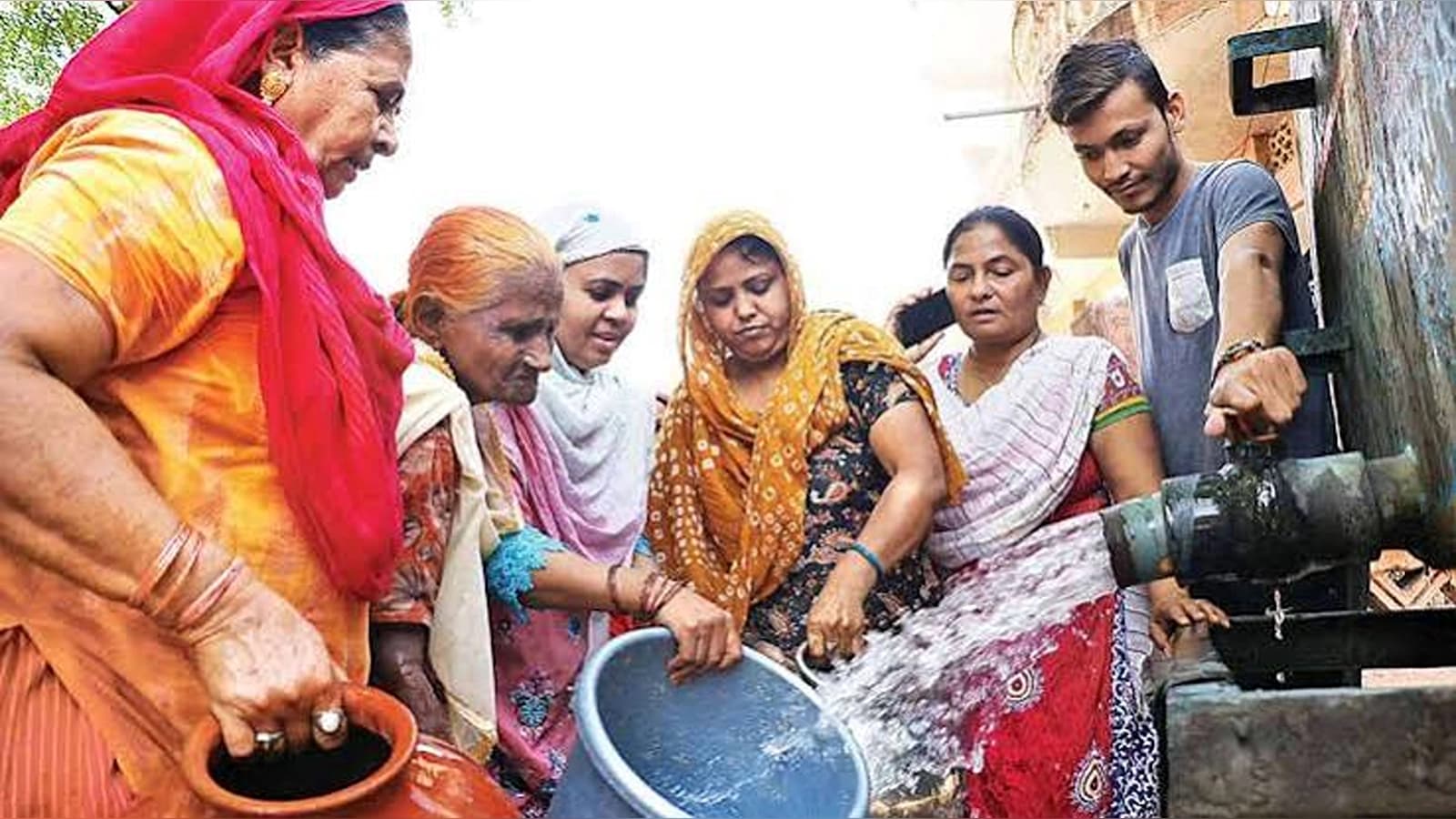
Bengaluru Water Crisis: Poor Families Spend ₹3,000 Monthly on Drinking Water, Survey Flags
Bengaluru's growing water crisis is raising concerns about the affordability of one of life's most basic necessities. Economically weaker families, particularly those living in slum settlements and areas without reliable piped-water connections, are reportedly spending around ₹3,000 every month on drinking water purchased from private tankers.
The findings were highlighted by the Water Satyagraha campaign, which has been conducting a household survey across Bengaluru to examine water availability, expenditure and access to safe drinking water.

According to campaign convenor Syed Ahmed Hussain, the monthly expenditure is higher than the ₹2,000 assistance provided to women under the Karnataka government's Gruha Lakshmi scheme. The findings point to the financial pressure on households that cannot depend on regular municipal water supply.
Bengaluru Faces a Projected Water Supply Shortfall of Over 600 MLD
The campaign has also warned that Bengaluru could face a daily water supply shortfall of more than 600 million liters. According to its preliminary findings, the city receives approximately 1,470 million liters per day (MLD) of Cauvery water, against an estimated daily demand exceeding 2,100 MLD.
The difference indicates a gap of more than 600 MLD between the reported Cauvery supply and estimated demand. However, this does not represent the city's entire water availability, as Bengaluru also depends on groundwater and other sources. The campaign has argued that households in peripheral areas are particularly vulnerable because of their dependence on private water tankers. It has also highlighted the absence of regulatory powers with the Bangalore Water Supply and Sewerage Board (BWSSB) to control prices charged by private tanker operators.
Groundwater Depletion and Water Leakage Add to Bengaluru's Problems
Groundwater depletion is another major concern raised by the campaign. Syed Ahmed Hussain said Bengaluru extracts groundwater at nearly twice the rate at which it is naturally replenished. He also claimed that approximately 400 MLD of piped water is lost daily through leakage, theft and unbilled consumption.
The campaign estimates that nearly 27% of the city's piped water is lost before it is accounted for. These figures are preliminary claims and require independent verification through official BWSSB and groundwater assessment data.
Bengaluru Generates 772 MLD of Untreated Sewage Daily
The city's water concerns extend beyond availability to sewage management and water quality. According to figures presented by the campaign, Bengaluru generates approximately 2,120 MLD of sewage every day. Of this, around 1,348 MLD is treated, leaving approximately 772 MLD untreated.
The campaign has also raised concerns about drinking-water pipelines running alongside sewage pipelines. Leaking joints, it said, could increase the risk of contamination. It further alleged that although BWSSB tests between 80 and 150 water samples daily, ward-wise information about contamination and pipeline leakages is not publicly available.
Water Satyagraha Plans Survey of Three Lakh Households
The campaign plans to expand its household survey to cover approximately three lakh households across Bengaluru by March 2027. The findings are expected to be compiled into a report and submitted to the Karnataka government. The survey aims to examine household water expenditure, access to municipal supply and dependence on private tankers.
The campaign has also linked its initiative to the centenary of the Mahad Satyagraha, led by Dr. B.R. Ambedkar on March 20, 1927, which asserted the right of marginalized communities to access public drinking water.
As Bengaluru prepares for another summer amid concerns over rainfall deficits and groundwater availability, the findings raise a larger question: Should access to drinking water depend on a family's ability to pay private suppliers? For low-income households, the city's water crisis is no longer just an infrastructure problem. It is increasingly an issue of affordability, inequality and access to basic public services.
IIIT-Delhi Awards Degrees to 830 Students at 15th Convocation; Recognises Academic and Research Excellence

Universal AI University Awards Degrees to 369 Graduates at 15th Convocation Ceremony
Bengaluru Water Crisis: Poor Families Spend ₹3,000 Monthly on Drinking Water, Survey Flags
Japan's Okayama University uses robotics competitions to build engineering and workplace skills
Indian Navy Rescues 20 Crew from Hijacked Iranian Vessel off Somalia
Japan's Okayama University uses robotics competitions to build engineering and workplace skills
Indian Navy Rescues 20 Crew from Hijacked Iranian Vessel off Somalia

Learning Mandarin, earning degrees in China: How Indonesian youth are preparing for global careers
China allows clinical medicine master's and PhD students to graduate without thesis under new pathway
Delhi HC Declines Action Against ACP Over Alleged Threats to Lawyers

IIIT-Delhi Awards Degrees to 830 Students at 15th Convocation; Recognises Academic and Research Excellence
Universal AI University Awards Degrees to 369 Graduates at 15th Convocation Ceremony
Bengaluru Water Crisis: Poor Families Spend ₹3,000 Monthly on Drinking Water, Survey Flags
Japan's Okayama University uses robotics competitions to build engineering and workplace skills
Indian Navy Rescues 20 Crew from Hijacked Iranian Vessel off Somalia
Japan's Okayama University uses robotics competitions to build engineering and workplace skills
Indian Navy Rescues 20 Crew from Hijacked Iranian Vessel off Somalia
Learning Mandarin, earning degrees in China: How Indonesian youth are preparing for global careers
China allows clinical medicine master's and PhD students to graduate without thesis under new pathway
Delhi HC Declines Action Against ACP Over Alleged Threats to Lawyers
Copyright© educationpost.in 2026 All Rights Reserved.