


Students built drinks-can-sized satellites and launched them on rockets, testing their engineering skills through real-flight experiments and international teamwork.
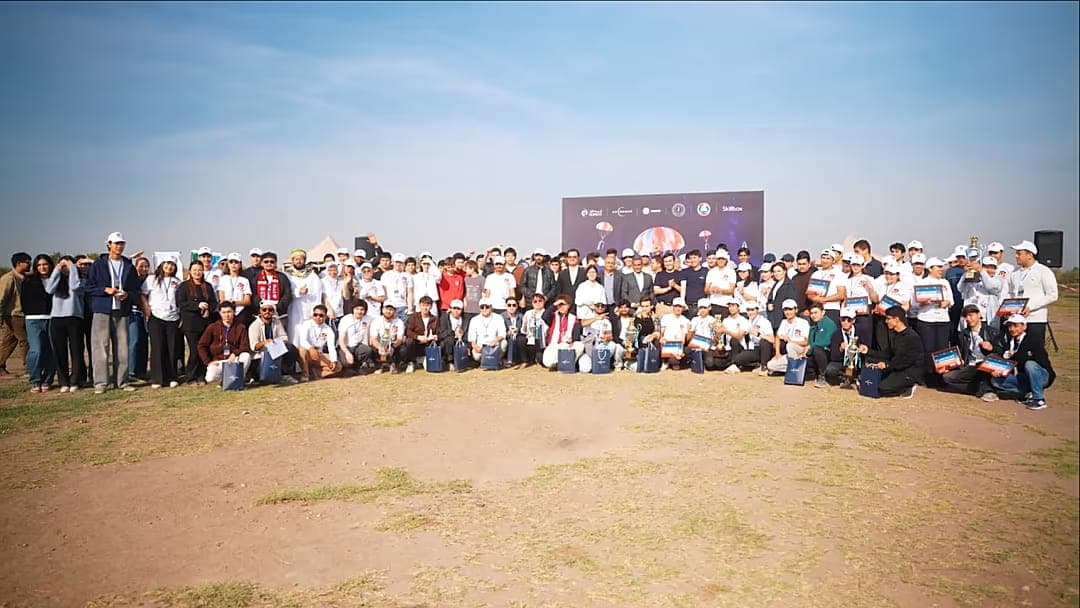
Building a satellite normally demands years of research, sophisticated facilities and substantial investment. But for young engineers from 15 countries gathered near Uzbekistan's capital, Tashkent, the challenge was to achieve a miniature version of that feat using a device no bigger than a drinks can.
Their creations, known as CanSats, packed sensors, electronic components and communication systems into compact devices designed to simulate the operations of a satellite. Launched aboard rockets and released to descend by parachute, the miniature systems collected data under real flight conditions, giving students hands-on experience of space technology without leaving Earth's atmosphere.

Unlike conventional satellites, CanSats do not enter orbit. Instead, they replicate selected functions of a space mission, allowing students to experience the engineering, programming and data analysis involved in satellite operations.
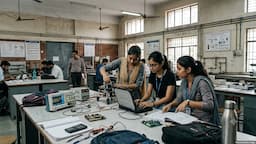
The international teams spent several days at Turin Polytechnic University in Tashkent assembling electronics, configuring sensors and programming their devices before preparing them for launch. The programme brought together 50 international participants and more than 100 students from Uzbekistan.
Turning classroom knowledge into real-world engineering
The real test began once the CanSats were airborne. As the devices descended under parachutes, teams had to ensure their systems continued functioning independently, collecting measurements and transmitting information to ground stations. One Uzbek team equipped its CanSat with a camera and sensors to measure temperature and air pressure, while also attempting to transmit live video during the flight.
“The main challenge here is to make sustainable telemetry. It should connect the ground station and the CanSat itself,” Ahmadkhon Latipov was quoted as saying by Euronews. The devices were also programmed to store information onboard, ensuring that valuable flight data could be recovered even if communication with the ground station was interrupted.
Baris Beynek, an instructor from Istanbul Technical University, said the exercise reflected a key feature of actual satellite operations, where systems must both transmit and retain information. “In the real satellite project, there is a satellite which sends the data to ground station and also stores inside, which we also do,” he said.
Once the devices landed, participants recovered their creations and examined the recorded information, comparing their initial calculations with actual flight performance. The exercise tested not only their electronics and communication systems but also their ability to design reliable parachutes and troubleshoot technical problems.
Fourteen teams advanced to the final competition, with Team Nebula securing first place. Pegasus finished second, followed by Sky Lab.
Preparing a new generation for the space sector
The competition was part of the fifth international CanSat training workshop, organised jointly by Uzbekistan's space agency, Uzcosmos, the Islamic World Educational, Scientific and Cultural Organization (ICESCO) and Turin Polytechnic University in Tashkent. Beyond the competition, the initiative aims to introduce young people to a rapidly expanding field in which satellite technology is increasingly important to everyday life.
Dr Muhammad Sharif, an adviser for science and environment at ICESCO, said the growing use of satellite applications was creating demand for expertise in areas extending beyond traditional aerospace engineering. He pointed to Earth observation, satellite communications and artificial intelligence, highlighting their potential applications in agriculture, food security and climate monitoring.
The programme also emphasised the importance of collaboration across national borders, bringing together students and instructors to solve engineering problems through shared knowledge and practical experience. “They need to use their own skills, and they need to cooperate with other people,” Beynek said. “In space, international cooperation is the most important thing.”
For Uzbekistan, the initiative offers an opportunity to develop homegrown technical talent and prepare young specialists for its emerging space sector. For the participating students, it provides something equally valuable: the chance to turn classroom theories into working technology and experience the challenges of engineering under real conditions.

InAmerica Education helps students turn personal passions into real-world impact

Canada seeks expanded access to EU student exchange programme
Young engineers from 15 countries put mini satellites to the test in Uzbekistan

Portland summit to unite education, industry leaders to expand computer science learning
Dubai group offers free online classes to over 1,000 expatriate children
The Future Belongs to Those Who Can Collaborate Intelligently with AI

Diljit Dosanjh Delhi Concert Today: Traffic Restrictions from 1 PM, Check Roads to Avoid, Metro Timings and Parking Details
Why Are Women Still Only 20% of IIT Admissions? JEE Advanced 2026 Data Explained

Google adds hundreds of free textbooks to Gemini Notebook for students in India and US

NBEMS opens NEET Super Specialty 2026 applications: Check eligibility, dates and registration steps

InAmerica Education helps students turn personal passions into real-world impact
Canada seeks expanded access to EU student exchange programme
Young engineers from 15 countries put mini satellites to the test in Uzbekistan
Portland summit to unite education, industry leaders to expand computer science learning
Dubai group offers free online classes to over 1,000 expatriate children
The Future Belongs to Those Who Can Collaborate Intelligently with AI
Diljit Dosanjh Delhi Concert Today: Traffic Restrictions from 1 PM, Check Roads to Avoid, Metro Timings and Parking Details
Why Are Women Still Only 20% of IIT Admissions? JEE Advanced 2026 Data Explained
Google adds hundreds of free textbooks to Gemini Notebook for students in India and US
NBEMS opens NEET Super Specialty 2026 applications: Check eligibility, dates and registration steps
Copyright© educationpost.in 2026 All Rights Reserved.