


University of Chicago computer scientist Andrew A. Chien explains how flexible computing, battery storage and a proposed energy facility model could help data centres reduce pressure on electricity grids and make better use of renewable power.

Data centres, the facilities that store and process the information behind internet services and artificial intelligence tools, are facing growing scrutiny over their electricity consumption, water use and impact on local communities.
As AI applications expand, the infrastructure supporting them is becoming an increasingly important part of the debate over the environmental costs of computing.

In an interview published by the University of Chicago, computer science professor Andrew A. Chien explained why data centres require substantial amounts of energy and outlined ways to reduce their impact on electricity grids and the environment.
Chien, the William Eckhardt Distinguished Service Professor of Computer Science at the university, previously served as vice-president of research at Intel Corporation. Since 2015, his research group has studied ways to make computing more sustainable and better integrated with electricity grids.
Why AI is increasing demand for data centres
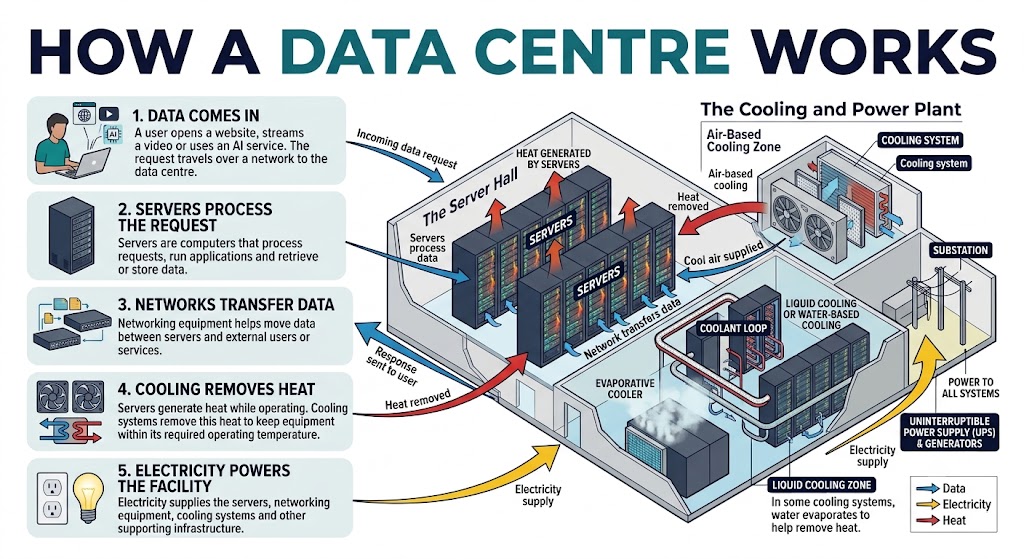
Data centres house the computing equipment needed to run websites, cloud services, social media platforms and AI applications. Chien describes them as the places where much of the internet's underlying infrastructure operates.
AI services are adding to this demand because they require substantial computation to generate responses, process information and perform tasks. Unlike a conventional search that retrieves information from an existing index, an AI system generates an answer through computational processing.
Chien said data centres vary considerably in size. While many consume electricity in the tens or hundreds of megawatts, the largest facilities can be much bigger.
He estimated that data centres accounted for around 5% of US electricity generation in 2025. Based on his research group's calculations, that share could rise to 15% by 2030 and 50% by 2040. He described these projections as conservative estimates.
These figures represent Chien's estimates rather than settled forecasts. Actual consumption will depend on the pace of AI adoption, improvements in computing efficiency, the construction of new facilities and the availability of electricity infrastructure.
Nevertheless, the projections illustrate the scale of the challenge facing energy planners as demand for AI computing grows.
Why data centres also need water
Electricity consumption is only one part of the environmental challenge. Servers generate heat while processing information, and data centres must remove that heat to operate safely and reliably.
One cooling method is evaporative cooling, which uses water evaporation to remove heat. Chien said this can be an efficient approach, but it also creates concerns about water consumption, particularly where resources are already under pressure.
Existing facilities that rely on water-intensive cooling systems may be difficult or expensive to retrofit. Chien noted that the cost of changing established infrastructure can discourage companies from making such investments.
The environmental footprint of a data centre therefore depends on more than its electricity use. Cooling technology, local water availability and the source of its power all influence its impact.
How computing could become more sustainable
Chien identified data centre flexibility as one approach to reducing pressure on electricity grids. Under this model, facilities would shift suitable computing tasks towards periods when electricity demand is lower or renewable power from sources such as solar and wind is more readily available.
Operators could also use periods of lower grid demand to charge local batteries. Such measures could help reduce the need for additional electricity infrastructure designed primarily to meet peak demand.
Another approach developed by Chien's research group is called Middlebox. It involves pairing a data centre with a dedicated energy facility to provide reliable power and coordinate energy use with the wider grid.
Chien said the combined arrangement could help reduce peak electricity demand and allow operators to take greater advantage of periods when renewable energy is available. He also cited research suggesting that participating companies could benefit financially through improved electricity costs and reduced exposure to peak-demand charges.
However, he argued that technical solutions alone would not be enough. Their adoption would also depend on commercial incentives, infrastructure planning and public policy.
Do data centres benefit local communities?
The expansion of data centres can bring construction activity and investment, but Chien questioned whether the long-term economic benefits for host communities always match the scale of the facilities.
He argued that data centres typically employ relatively few people once construction is complete, compared with some other industrial facilities. Communities may therefore face substantial infrastructure demands without receiving equivalent long-term employment benefits.
Chien also raised concerns about negotiations conducted under non-disclosure agreements. In some cases, he said, local residents may learn about proposed facilities only after key arrangements have been made, limiting their ability to participate in decisions that affect them.
He advocated greater transparency in negotiations between companies and public authorities, including disclosure of concessions and permitting arrangements.
For Chien, the location of facilities is another important consideration. Modern fibre-optic networks can transmit information over long distances quickly, meaning data centres do not necessarily have to be built next to the populations using their services.
He suggested concentrating facilities in appropriately zoned industrial areas with access to electricity and network infrastructure. Such planning, he argued, could reduce disruption to residential communities.
Who should pay for the infrastructure?
Building and operating large data centres can require investment in electricity generation, grid connections and other infrastructure. Chien argued that companies should cover the cost of the additional infrastructure they require over its full operating lifetime, which he put at 15 to 30 years.
He called for coordinated action by state and national governments to plan infrastructure, establish appropriate locations for facilities and ensure that the costs and benefits of expansion are distributed more fairly.
He also argued that public policy can influence corporate behaviour, pointing to companies' responses to regulatory requirements in different markets.
The wider question, according to Chien, is how to accommodate growing demand for AI computing without placing disproportionate environmental and financial burdens on the communities that host the infrastructure.
As AI services continue to expand, data centres will remain essential to digital infrastructure. The challenge is to ensure that their growth is accompanied by more efficient energy use, responsible water management, transparent planning and a fairer allocation of infrastructure costs.
Chien's central argument is that the environmental impact of computing can be reduced through technical changes, but putting those solutions into practice will also require companies and governments to make different decisions about where data centres are built, how they use energy and who pays for their expansion.

NEET UG Stray Vacancy Result 2026: MBBS Seat Allotted at AIR 11.90 Lakh; Check Closing Ranks

Telangana to Implement 25% RTE Quota in Private Schools for EWS and Disadvantaged Children

Could smarter energy solutions make data centres more sustainable?

Cambridge and AstraZeneca extend joint PhD programme for three years

Australia’s higher education regulator discontinues corporate-governance guidance note
Could smarter energy solutions make data centres more sustainable?
Cambridge and AstraZeneca extend joint PhD programme for three years

China shuts three Tibetan schools, raising fears for language and cultural identity

CCPA reports 3,940 delistings in crackdown on online sale of explosive substances

UGC seeks governors’ intervention as 82 Tamil Nadu institutions face 150 fee-refund complaints

NEET UG Stray Vacancy Result 2026: MBBS Seat Allotted at AIR 11.90 Lakh; Check Closing Ranks
Telangana to Implement 25% RTE Quota in Private Schools for EWS and Disadvantaged Children
Could smarter energy solutions make data centres more sustainable?
Cambridge and AstraZeneca extend joint PhD programme for three years
Australia’s higher education regulator discontinues corporate-governance guidance note
Could smarter energy solutions make data centres more sustainable?
Cambridge and AstraZeneca extend joint PhD programme for three years
China shuts three Tibetan schools, raising fears for language and cultural identity
CCPA reports 3,940 delistings in crackdown on online sale of explosive substances
UGC seeks governors’ intervention as 82 Tamil Nadu institutions face 150 fee-refund complaints
Copyright© educationpost.in 2026 All Rights Reserved.