


The test brought together flight software, avionics and simulated sensor inputs to rehearse autonomous flight and landing manoeuvres for NASA’s rotorcraft mission to Saturn’s largest moon.
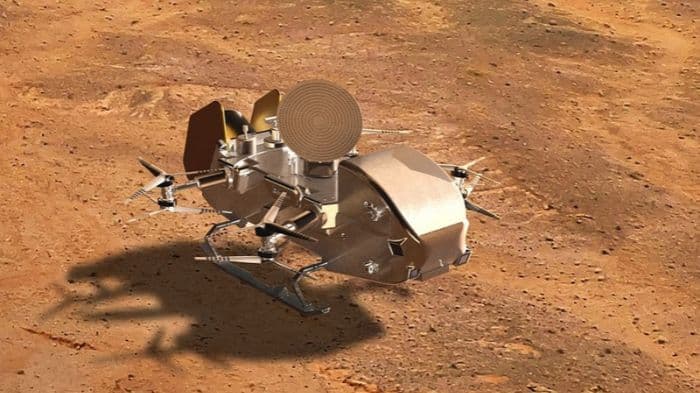
NASA’s Dragonfly mission has completed its most comprehensive simulated flight to date, allowing engineers to test how the rotorcraft’s navigation and flight systems work together ahead of its planned journey to Saturn’s moon Titan.
The test, announced by NASA on Oct 23, was conducted on a computer testbed at the Johns Hopkins Applied Physics Laboratory (APL) in Maryland. It recreated the sequence of events involved in Dragonfly’s first flight, including surveying the terrain, identifying a safe landing site and descending towards it.

The exercise did not involve an actual flight. Instead, it used flight-like computer hardware and simulated sensor inputs to assess the spacecraft’s ability to carry out complex manoeuvres autonomously.
Testing navigation and landing systems together
The simulation integrated Dragonfly’s flight software and avionics with data representing inputs from its navigation cameras, inertial measurement units and lidar system.
Lidar will help the rotorcraft measure terrain altitude and slope and identify potential hazards. Engineers generated simulated terrain for the system and created real-time images resembling the scenes Dragonfly’s cameras are expected to encounter on Titan.
The test brought these elements together in a single sequence, allowing engineers to examine how the systems communicate and respond to information in real time.
Zach Putnam, Dragonfly’s mobility subsystem lead engineer at APL, said the first-flight scenario was particularly challenging because it uses every piece of flight-sensor hardware on the lander.
The team had previously tested individual capabilities incrementally, from spinning a single rotor to performing repositioning and partial scouting manoeuvres. Adding lidar enabled a more comprehensive simulation of the flight and landing sequence.
Why autonomous flight matters on Titan
Dragonfly is designed to travel between locations on Titan, using its rotors to explore the moon’s surface and investigate its chemistry, geology and atmosphere.
Because Titan is so far from Earth, the spacecraft will have to perform flight operations without real-time instructions from mission controllers. Its systems must therefore interpret sensor data, assess the terrain and respond to potential hazards autonomously.
NASA says further tests will include running the first-flight sequence on Dragonfly’s actual flight system, rather than a testbed. Engineers also plan to evaluate other flight profiles and deliberately introduce faults to test how the spacecraft responds when something goes wrong.
These tests are part of the mission’s preparation for launch, currently scheduled no earlier than 2028. Dragonfly is expected to reach Titan in 2034 and conduct a mission lasting approximately three years.
The simulated flight marks a step in testing the systems needed for that mission, but it does not mean the spacecraft has flown on Titan or completed its testing programme.

Birla Open Minds, Burlington English Join Hands to Introduce Digital English Learning for Grades 1–8

Australian universities back student-feedback benchmark for education agents

Yuva Sangam: UP Governor Highlights Cooking Skills, Maternal Health Awareness Among Students

Centre Amends Motor Vehicle Rules to Allow E100 Ethanol Fuel in Flex-Fuel Vehicles
NASA’s Dragonfly completes first full simulated flight ahead of Titan mission
Centre Amends Motor Vehicle Rules to Allow E100 Ethanol Fuel in Flex-Fuel Vehicles

Study in Malaysia for Indian Students 2026: Universities, Fees, Scholarships, Visa and Career Opportunities
Delhi BS6 Entry Ban From November 1 Could Affect Over 10 Lakh NCR Vehicles

Study in Indonesia for Indian Students 2026: Top Universities, Fees, Scholarships, Visa and Career Opportunities

Study in China 2027: Top Universities, Fees, Scholarships, Visas and Career Options for Indian Students

Birla Open Minds, Burlington English Join Hands to Introduce Digital English Learning for Grades 1–8
Australian universities back student-feedback benchmark for education agents
Yuva Sangam: UP Governor Highlights Cooking Skills, Maternal Health Awareness Among Students
Centre Amends Motor Vehicle Rules to Allow E100 Ethanol Fuel in Flex-Fuel Vehicles
NASA’s Dragonfly completes first full simulated flight ahead of Titan mission
Centre Amends Motor Vehicle Rules to Allow E100 Ethanol Fuel in Flex-Fuel Vehicles
Study in Malaysia for Indian Students 2026: Universities, Fees, Scholarships, Visa and Career Opportunities
Delhi BS6 Entry Ban From November 1 Could Affect Over 10 Lakh NCR Vehicles
Study in Indonesia for Indian Students 2026: Top Universities, Fees, Scholarships, Visa and Career Opportunities
Study in China 2027: Top Universities, Fees, Scholarships, Visas and Career Options for Indian Students
Copyright© educationpost.in 2026 All Rights Reserved.