


The initiative aims to simplify arrangements for families, strengthen continuity in children’s learning and care, and support preschool development, with a pilot launching at two centers in 2027.
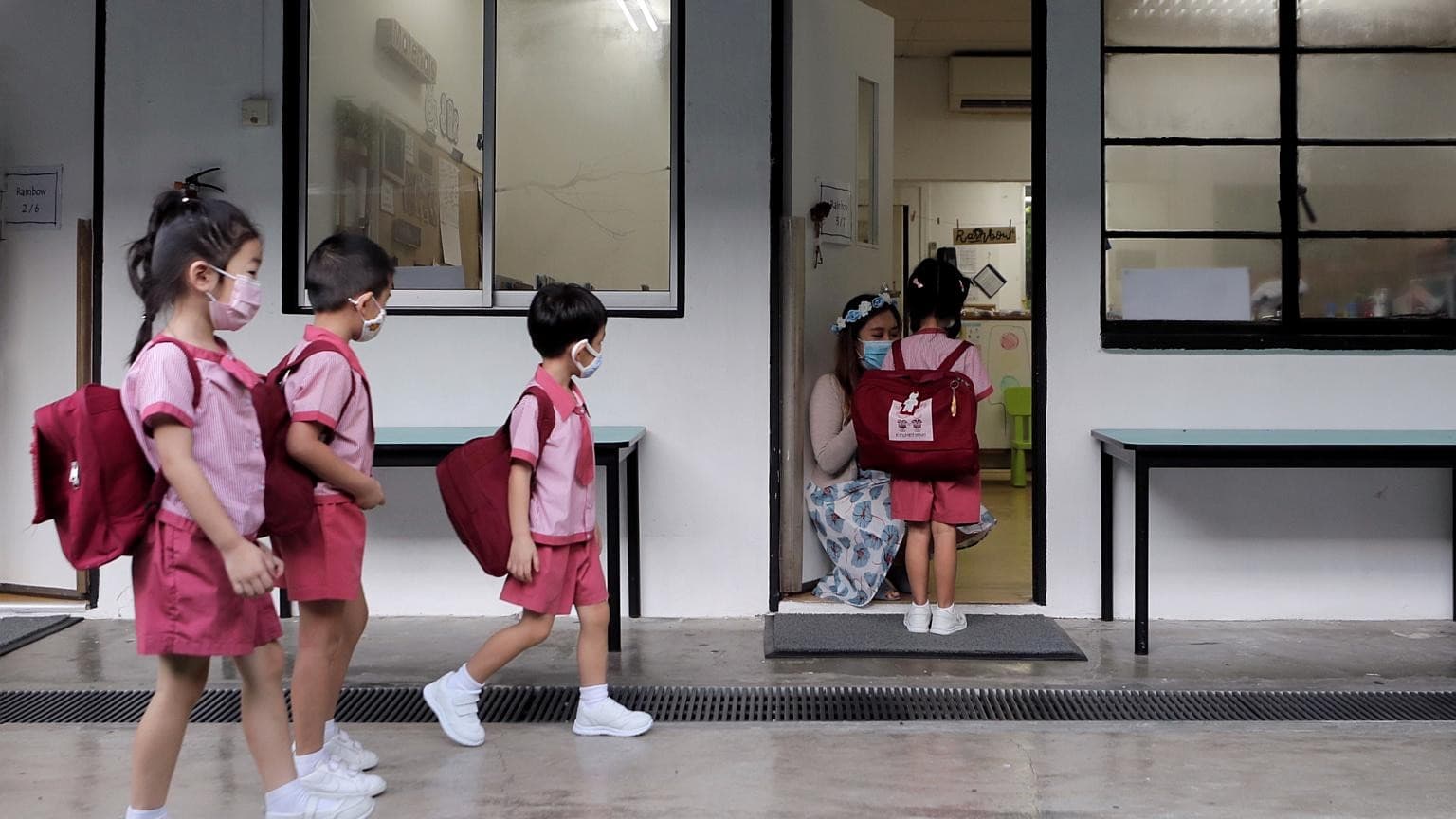
Singapore’s Ministry of Education (MOE) will introduce a full-day kindergarten model across all its kindergartens by 2030, allowing children to access learning, play and care under a single program from 7 am to 7 pm.
The initiative aims to provide families with a more integrated preschool experience and strengthen continuity in children’s learning and development.

According to Asia News Network, the ministry announced on Oct 28 that the new model will be piloted in 2027 at two centers, MK@Rivervale and MK@West View. The rollout across all MOE Kindergartens is scheduled to take place between 2028 and 2030.
MOE currently operates 56 kindergartens offering four-hour programs for Kindergarten 1 (K1) and Kindergarten 2 (K2) children, generally ages five and six. Parents who need care beyond the existing kindergarten hours can enroll their children in Kindergarten Care (KCare), an after-school service provided by external operators appointed by the ministry.
Under the proposed model, education, play and care will be combined into one program managed by MOE Kindergarten educators. Ministry-employed program officers will support children’s care and supervision, including during meals and other daily routines. MOE said educators will remain primarily responsible for curriculum delivery.
Speaking to the media on Oct 28, Senior Parliamentary Secretary for Education Syed Harun Alhabsyi said the changes followed feedback from parents and kindergarten educators, alongside evolving needs in the preschool sector. He added that an integrated arrangement would help educators better understand individual children’s needs and provide more targeted support.
Singapore's full-day kindergarten model: Operating hours and staffing
Under the new arrangement, MOE Kindergartens will operate from 7 a.m. to 7 p.m. on weekdays during school terms and holidays. Public holidays, designated school holidays and center closure days will be excluded from the operating schedule.
Families that do not require full-day care will retain the option of a half-day program running from 7 a.m. to 12:30 p.m. The full-day arrangement is intended to provide parents with greater flexibility while allowing children to remain in a familiar educational setting for longer periods.
MOE said it would recruit additional staff to support the extended operating hours. The number of educators and program officers assigned to each kindergarten will depend on enrollment. The ministry currently employs around 1,100 MOE Kindergarten teachers.
Existing KCare employees may also be recruited as program officers if they meet the suitability requirements. Their role will focus on supporting children's care and supervision, while kindergarten educators will continue to lead teaching and curriculum delivery.
The ministry said the integrated arrangement would allow children to experience greater continuity in their daily routines and maintain more sustained interactions with familiar staff. These interactions are expected to help children build stronger relationships with educators.
Children from disadvantaged backgrounds are also expected to benefit from a more seamless and supportive learning environment, MOE said. The change is intended to reduce the separation between formal kindergarten education and the care provided after classes.
Currently, approximately 65% of the 8,000 children attending MOE Kindergartens use KCare services. The new model will bring education and care together under one arrangement for families requiring full-day provision.
New activities to expand learning through play
The full-day program will introduce additional activities designed to give children more opportunities to explore, learn and develop practical skills. These will include play-based experiences in mother tongue languages, allowing children to take greater ownership of their learning while building confidence in language use.
Children will also have opportunities for outdoor play using materials such as planks and tires. These activities are intended to broaden their play experiences and encourage exploration through different materials and environments.
Holiday activities will incorporate science, technology, engineering and mathematics (STEM), along with drama and visual arts. The expanded range of experiences will allow children to engage with different subjects and creative activities beyond the existing four-hour kindergarten program.
MOE said the integrated model would also help educators observe children's development across different parts of the day. Longer periods in a consistent environment could give staff more opportunities to identify individual needs and provide targeted support.
Singapore MOE kindergarten fees under the new model
The full-day arrangement will introduce a single fee payable to MOE Kindergartens, replacing the separate payments families currently make for kindergarten education and KCare.
At the two pilot centers, monthly fees for Singaporean children enrolled in the full-day program will range from $3 to $425 after applicable subsidies. The half-day program will cost between $1 and $160 per month after subsidies.
Before subsidies, the monthly fees will be $665 for the full-day program and $310 for the half-day option.
MOE said families' out-of-pocket expenses under the new model would be comparable to the combined fees currently charged for MOE Kindergarten and KCare. The costs are also expected to be comparable to fees at full-day childcare centers operated by anchor operators.
Under the existing arrangement, Singaporean children pay $160 per month for MOE Kindergarten before means-tested subsidies. KCare fees can reach $275 per month after the basic subsidy.
The ministry said fee details for kindergartens joining the new model at later stages would be announced when available. The list of centers scheduled to adopt the arrangement each year will be released during the preceding year's MOE Kindergarten registration exercise in March.
MOE will work with kindergartens, schools and KCare operators to support a smooth transition to the full-day model.
Singapore aims to make quality preschool education more affordable
The changes follow Prime Minister Lawrence Wong's announcement at the National Day Rally in August that the government aims to reduce full-day childcare fees at government-supported preschools to $150 per month by 2030.
The target forms part of broader efforts to make quality and affordable preschool education accessible to families across Singapore. The full-day kindergarten model is another step toward providing a more integrated service for parents who need both education and care for their children.
The existing outsourced KCare arrangement came under scrutiny earlier in 2026 after MOE terminated its contracts with student care operator Little Professors Learning Centre in February. The decision followed contractual breaches, including the nonpayment of staff salaries.
Around 1,800 children across eight primary schools were affected by the incident. The group included children attending KCare at six of those schools.
Following the incident, MOE tightened financial checks on operators and introduced additional safeguards. However, the ministry said the move toward a full-day kindergarten model was not a response to the Little Professors case.
Syed Harun said the review had begun before the incident. “This review was done even before the Little Professors incident,” he said.
MOE said discussions about an integrated full-day model had started several years earlier in response to parents seeking a more seamless experience for their children. Some parents had found it confusing to navigate separate kindergarten and KCare providers, particularly when trying to determine which program was responsible when an incident occurred.
The new arrangement is intended to provide families with a clearer point of contact and reduce the administrative burden associated with dealing with separate service providers.
Parents welcome continuity in care and communication
Parents have welcomed the prospect of children remaining with familiar educators throughout the day. Fung, a parent who asked to be identified only by her surname, said the full-day arrangement would benefit her K1 daughter, who has developed a good relationship with teachers at MK@West View.
Fung, 38, works full-time as an administrative officer and said knowing that her daughter would continue to be cared for by familiar staff after the morning program would provide reassurance.
“Knowing they are being cared for by familiar faces after noon gives me peace of mind.”
She also welcomed the prospect of simpler communication with the kindergarten. Under the existing system, she must notify both MOE Kindergarten and KCare separately when her daughter is unwell.
The integrated model is expected to make such communication easier by bringing education and care under the same arrangement. It could also help parents avoid uncertainty about which provider is responsible for their children at different times of the day.
MOE teachers' working hours and workload under the new model
MOE said teachers' daily working hours will remain unchanged under the full-day model. Teachers will work earlier or later shifts to support the extended operating hours of the kindergartens.
Currently, teachers typically work from 6:45 a.m. to 4 p.m. or from 7:45 a.m. to 5 p.m. After teaching ends at noon, they use the remaining time for lesson planning and administrative responsibilities.
The ministry expects the amount of time teachers spend interacting directly with children to remain largely unchanged. However, those interactions will be distributed throughout the day instead of being concentrated within the current four-hour kindergarten program.
Teachers will also retain protected vacation time during school holidays, although they will need to take turns taking leave so that centers can remain open.
For example, during the four-week June school holidays, teachers will continue to receive two weeks of protected vacation time. However, individual teachers may take their leave during different weeks to maintain staffing at the centers.
MOE said the new arrangement would require coordination to ensure that children receive consistent care while teachers retain their existing working-hour arrangements and vacation entitlements.
Educators see opportunities for more targeted support
Sherilyn Pua, a 33-year-old senior teacher specializing in child development at MK@West View, said the full-day model would provide teachers with more opportunities and time to offer targeted assistance to children.
She cited practicing fine motor skills as an example of an area where educators could provide additional support. The integrated arrangement could allow teachers to observe children's progress across different activities and respond to their developmental needs.
Nur Jannah Fatin, a 35-year-old Malay-language senior teacher at the same center, said more opportunities to use mother tongue languages during play would help children gain confidence in speaking them.
MK@West View center head Shereen Low, 40, said teachers' contact hours with children would remain unchanged at approximately five hours under the new model. Those hours, however, would be spread across the day rather than concentrated in the existing morning program.
The educators' comments highlight the potential benefits of integrating care and learning, particularly in supporting children's language development, practical skills and relationships with staff.
Teachers raise concerns about staffing and school holiday arrangements
Not all educators are without concerns about the transition. One teacher who previously worked in full-day childcare said she had joined an MOE Kindergarten because of “its shorter, fixed working hours and better work-life balance”.
The teacher, who is in her mid-30s and spoke to The Straits Times on condition of anonymity, described rotating shifts in the childcare sector as “exhausting and unsustainable” over the long term. She said teachers often fall sick under such arrangements.
She also expressed concern about losing time during school holidays that is currently available for lesson preparation, professional training and rest. Although she believes the full-day model would benefit children, she said additional staff would be needed to support the transition.
The concerns reflect questions about how the expanded operating schedule will affect staff availability, workload and preparation time. MOE has said teachers' direct contact hours and daily working hours will remain largely unchanged, but staff will need to coordinate shifts and vacation schedules to keep centers operating.
Addressing questions about educators' workload, Syed Harun said: “We are studying how best we can support their workload as they educate our young ones.”
He added that MOE also aims to strengthen professional development opportunities for kindergarten educators.
“Because the better we take care of our MK educators, the more our students continue to benefit, and learn well in our schools.”
The ministry's planned rollout, beginning with two pilot centers in 2027, will provide an opportunity to implement the integrated model before expanding it across all MOE Kindergartens between 2028 and 2030.

Magnitude 5.1 Earthquake Strikes Near Andaman and Nicobar Islands; No Immediate Reports of Damage

Earth’s life story may not have begun with comets, new study finds

Can India's Biggest Examinations Become Leak-Proof?
IIM Lucknow Launches MBA in Family Business 2027: Check Eligibility, Fees, Admission Dates

Less juggling for parents? Singapore to unite kindergarten learning and after-school care by 2030
Earth’s life story may not have begun with comets, new study finds
Can India's Biggest Examinations Become Leak-Proof?
Less juggling for parents? Singapore to unite kindergarten learning and after-school care by 2030
Bihar’s NMCH suspends 146 students over ragging: Wake-up call for medical colleges

Bihar Teacher Salary Scam 2026: ₹1.85 Crore Irregularities Detected in Three Districts

Magnitude 5.1 Earthquake Strikes Near Andaman and Nicobar Islands; No Immediate Reports of Damage
Earth’s life story may not have begun with comets, new study finds
Can India's Biggest Examinations Become Leak-Proof?
IIM Lucknow Launches MBA in Family Business 2027: Check Eligibility, Fees, Admission Dates
Less juggling for parents? Singapore to unite kindergarten learning and after-school care by 2030
Earth’s life story may not have begun with comets, new study finds
Can India's Biggest Examinations Become Leak-Proof?
Less juggling for parents? Singapore to unite kindergarten learning and after-school care by 2030
Bihar’s NMCH suspends 146 students over ragging: Wake-up call for medical colleges
Bihar Teacher Salary Scam 2026: ₹1.85 Crore Irregularities Detected in Three Districts
Copyright© educationpost.in 2026 All Rights Reserved.