


A new study by the University of Cambridge has found that comets were unlikely to deliver enough hydrogen cyanide to early Earth to help life begin. The findings challenge a long-standing theory, though researchers say a rare successful impact remains possible.
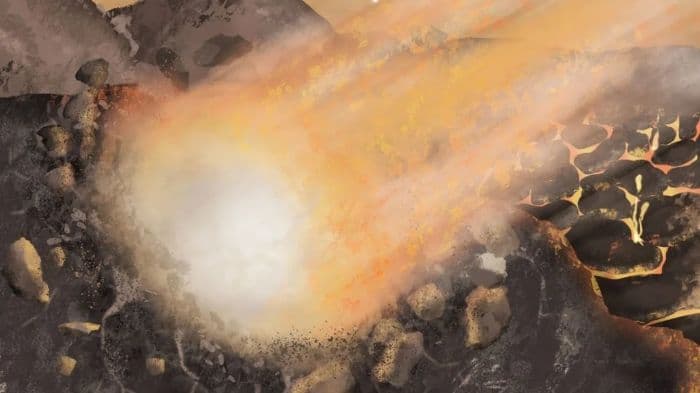
Comets may have played a much smaller role in supplying the chemical building blocks of life to early Earth than scientists have long suspected, according to a new study led by researchers at the University of Cambridge.
Published in Scientific Reports on Oct 28, the research used computer simulations to examine whether comets could deliver organic molecules to Earth’s surface without destroying them during atmospheric entry and impact. The researchers concluded that successful delivery of sufficiently concentrated prebiotic molecules was extremely unlikely.

The findings challenge the long-standing hypothesis that comets helped supply the raw materials needed for life to emerge on Earth. Comets contain carbon- and nitrogen-bearing compounds that can participate in chemical reactions associated with the origins of life.
However, the presence of these molecules in space does not necessarily mean they could survive a collision with a planet in quantities sufficient to support those reactions.
The researchers stressed that their findings do not prove that comets never contributed to the origins of life. Instead, the study suggests that the conditions required for a comet to deliver a useful concentration of prebiotic chemicals to early Earth were exceptionally rare.
Why scientists investigated comet impacts
Comets are remnants of the early Solar System, containing ice, dust and a variety of chemical compounds. Scientists have long considered them possible carriers of ingredients needed for life because some of these compounds are also involved in prebiotic chemistry — the chemical processes that preceded the emergence of living organisms.
The idea has been particularly attractive because Earth experienced frequent impacts during its early history. Comets striking the young planet could, in principle, have transported molecules formed elsewhere in the Solar System.
However, scientists have increasingly examined whether those molecules could withstand the extreme conditions associated with high-speed impacts.
The Cambridge-led research builds on an earlier study published in 2023 by some of the same researchers. That work explored the possibility that comets in planetary systems with closely orbiting planets might lose energy through repeated gravitational interactions, potentially allowing them to deliver organic material more gently.
The new research investigated whether a comparable mechanism could make cometary delivery plausible in our own Solar System. The results suggest that the process would be far less effective than the theory might imply.
Hydrogen cyanide was central to the study
The researchers focused on hydrogen cyanide (HCN), a molecule found in comets and considered important in prebiotic chemistry. Hydrogen cyanide contains carbon and nitrogen, and its chemical reactions can contribute to the formation of compounds relevant to the development of life.
The team used Monte Carlo simulations to model comet impacts on early Earth. This approach involves running many simulations with different possible conditions to estimate how frequently particular outcomes might occur.
The calculations examined factors including impact speed, the angle at which a comet struck Earth, atmospheric conditions and the survival of hydrogen cyanide during impact. The researchers then assessed whether the surviving material could reach concentrations that might support prebiotic chemistry.
The results indicated that most comet impacts would not deliver the molecule intact in sufficient quantities. Comets generally travel at high speeds, and impacts at steep angles can expose their contents to extreme temperatures and pressures. These conditions can destroy fragile organic molecules before they become available for chemical reactions at the surface.
Even in the relatively uncommon cases where hydrogen cyanide survived, the researchers found that delivering a useful concentration was another significant obstacle.
The study therefore examined not simply whether a comet could carry organic material to Earth, but whether the material could survive the journey and remain concentrated enough for subsequent chemistry to occur.
Successful delivery would have required rare conditions
The simulations suggested that a successful impact would require a narrow combination of conditions, including a sufficiently low impact speed and a suitable angle of approach.
The researchers also examined what would happen after a comet reached the surface. Any surviving hydrogen cyanide would need to remain concentrated in a suitable environment long enough for chemical reactions to proceed.
That presents a further difficulty. Water entering an impact site, rainfall and surface runoff could dilute the chemical material over a short period. If the concentration fell too quickly, the molecule might not be available in sufficient quantities for the reactions needed to produce more complex compounds.
The study found that the number of comets striking Earth declined rapidly during the planet’s first 500 million years. This limited the opportunities for the rare combination of a survivable impact and suitable post-impact conditions to occur.
Lead author Dr Richard Anslow of Cambridge’s Institute of Astronomy described successful delivery as an exceptionally rare event. The researchers said they could not rule out a fortunate impact, but their calculations suggested that cometary delivery was unlikely to have provided a reliable or substantial source of prebiotic material.
The study also cautions against treating the delivery of one molecule as sufficient to explain the origins of life. Hydrogen cyanide alone cannot provide every chemical ingredient required for life to emerge, and additional reactions and environmental conditions would have been necessary.
Mars may have been a more suitable destination
Although the study found cometary delivery to Earth unlikely, the researchers identified Mars as a potentially more favourable destination for comet-borne prebiotic molecules.
Mars is smaller than Earth and has a much thinner atmosphere today. The researchers’ modelling suggests that these characteristics could have allowed a greater proportion of impacting comets to reach its surface without losing all their chemical material.
The simulations indicated that hydrogen cyanide could have been delivered successfully to Mars under a wider range of impact conditions than on Earth. However, the researchers did not establish that this process actually led to the emergence of life on Mars.
They also noted that the delivery of prebiotic molecules would depend on several other factors, including the history of comet impacts and the conditions on the planet’s surface.
The findings therefore do not establish Mars as the origin of life. They suggest only that cometary delivery may have been more plausible there than on Earth under the conditions considered in the study.
Where could Earth’s chemical building blocks have come from?
If comets were not a substantial source of the concentrated chemical ingredients needed for prebiotic chemistry, other explanations remain possible.
One possibility is that some important compounds formed through chemical processes on Earth itself. Reactions in the atmosphere, potentially powered by energy from lightning or asteroid impacts, could have produced molecules that later participated in prebiotic chemistry.
Carbon-rich asteroids are another potential source of organic material. Unlike comets, asteroids have different compositions and impact characteristics, so their ability to deliver chemical ingredients needs to be assessed separately.
The Cambridge study does not settle which pathway supplied the materials from which life emerged. It instead challenges one particular explanation by showing that cometary delivery faces more severe physical and chemical constraints than previously assumed.
The researchers also suggested that their findings could inform the search for life beyond the Solar System. Future observations of planets around other stars may help scientists identify systems where the delivery of prebiotic molecules by comets is more or less likely.
However, the conditions that govern comet impacts vary across planetary systems. The results for Earth cannot automatically be applied to every planet orbiting another star.
The study ultimately questions the assumption that comets were a dependable source of life’s chemical building blocks on early Earth. It leaves open the possibility of a rare successful impact while pointing to other chemical pathways that scientists will need to investigate to better understand how life began.

Oxford researchers turn historic plant collection into a window on colonial science

Magnitude 5.1 Earthquake Strikes Near Andaman and Nicobar Islands; No Immediate Reports of Damage
Earth’s life story may not have begun with comets, new study finds

Can India's Biggest Examinations Become Leak-Proof?
IIM Lucknow Launches MBA in Family Business 2027: Check Eligibility, Fees, Admission Dates
Earth’s life story may not have begun with comets, new study finds
Can India's Biggest Examinations Become Leak-Proof?

Less juggling for parents? Singapore to unite kindergarten learning and after-school care by 2030

Bihar’s NMCH suspends 146 students over ragging: Wake-up call for medical colleges

Bihar Teacher Salary Scam 2026: ₹1.85 Crore Irregularities Detected in Three Districts

Oxford researchers turn historic plant collection into a window on colonial science
Magnitude 5.1 Earthquake Strikes Near Andaman and Nicobar Islands; No Immediate Reports of Damage
Earth’s life story may not have begun with comets, new study finds
Can India's Biggest Examinations Become Leak-Proof?
IIM Lucknow Launches MBA in Family Business 2027: Check Eligibility, Fees, Admission Dates
Earth’s life story may not have begun with comets, new study finds
Can India's Biggest Examinations Become Leak-Proof?
Less juggling for parents? Singapore to unite kindergarten learning and after-school care by 2030
Bihar’s NMCH suspends 146 students over ragging: Wake-up call for medical colleges
Bihar Teacher Salary Scam 2026: ₹1.85 Crore Irregularities Detected in Three Districts
Copyright© educationpost.in 2026 All Rights Reserved.