


Scientists from the University of Tokyo and Osaka University used an atomic force microscope to show how van der Waals interactions lower energy input, potentially advancing energy-efficient molecular machines and catalysts.
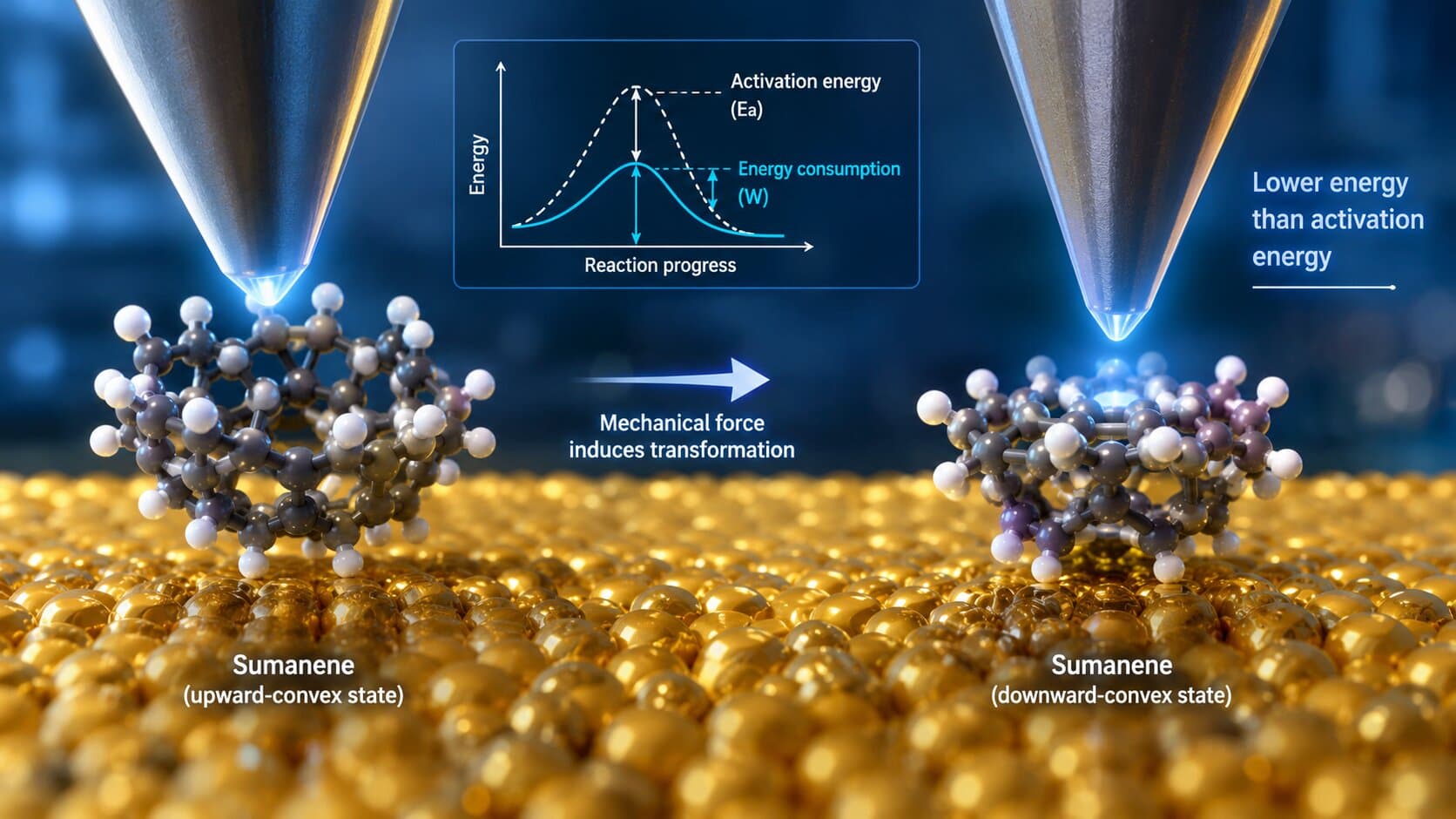
Researchers from the University of Tokyo and Osaka University have demonstrated that mechanical force can trigger structural changes in an individual organic molecule while consuming less energy than the activation energy theoretically required for the reaction.
The finding offers new insights into mechanochemistry, a field that investigates how physical forces can control chemical reactions. It could also support the development of energy-efficient molecular machines and catalysts.

The research team used an atomic force microscope (AFM) to apply a pushing force to a bowl-shaped organic molecule called sumanene, which was adsorbed onto a gold substrate.
The experiment showed that the molecule could be inverted from an upward-convex structure to a downward-convex structure with a measured mechanical energy consumption of 0.3 to 0.5 electron volts (eV). This was below the theoretically calculated activation energy of 0.67 eV.
The study was conducted by a research group led by Project Researcher Kota Iwata and graduate student Ryu Kuroki, both at the time of the research, along with Professor Yoshiaki Sugimoto of the Graduate School of Frontier Sciences at the University of Tokyo.
The work was carried out in collaboration with a team led by Professor Ikutaro Hamada, graduate student Ranmaru Kuno and graduate student Hiroki Enomoto, both at the time of the research, and Professor Hidehiro Sakurai of the Graduate School of Engineering at Osaka University.
The researchers found that van der Waals interactions between the AFM probe and the molecule played an important role in lowering the external energy required to induce the structural transformation.
Their calculations and analysis indicated that the probe receives mechanical energy through attractive van der Waals interactions as it approaches the molecule. This energy exchange reduces the effective energy input needed to drive the reaction.
The findings provide experimental and theoretical evidence of an energy-transfer mechanism in mechanically driven molecular reactions. The researchers expect that applying the principle to other molecular systems and catalytic processes could contribute to energy-saving technologies in nanotechnology and molecular science.
Mechanochemistry offers an alternative to conventional chemical reactions
Chemical reactions have traditionally been induced or controlled using heat, light or electricity. These approaches supply energy to molecules to help them overcome the barriers separating their initial and final states.
Mechanochemistry takes a different approach by using physical forces, including pulling, pushing or compressing, to induce chemical changes.
The field has attracted interest as a potential next-generation reaction process because certain mechanochemical methods can operate without solvents or external heating, potentially reducing their environmental impact and energy requirements.
However, the relationship between the energy supplied to a single molecule, the activation energy required for a reaction and the energy dissipated during the process has remained unclear.
This is particularly relevant when mechanical interactions are used to initiate molecular transformations.
In conventional single-molecule reactions driven by light or electrons through an electric current, the externally supplied energy is consumed in a one-way process and cannot be recovered after the reaction.
The energy provided must therefore exceed the activation energy required for the molecule to cross the reaction barrier. Any excess energy is dissipated as heat.
The research team sought to determine whether mechanically induced reactions follow the same energy-consumption pattern.
By measuring the force and energy involved in changing the structure of an individual molecule, the researchers investigated whether the net energy required for a reaction could fall below its theoretical activation energy.
Their findings demonstrated that, under the experimental conditions, mechanical energy consumption could be lower than the activation energy calculated for the molecular transformation.
The result points to a distinct way of managing energy during chemical reactions, in which interactions between the molecule and the probe influence the overall energy balance.
AFM experiment tracks structural inversion of a bowl-shaped molecule
To investigate the energy balance of mechanochemistry at the single-molecule level, the researchers used an atomic force microscope.
The instrument allowed them to apply a controlled mechanical stimulus to an individual molecule while measuring the force involved in its structural transformation.
The team selected sumanene, an organic molecule with a three-dimensional bowl-shaped structure that forms part of the structural framework associated with the soccer-ball-shaped fullerene molecule C60.
When sumanene molecules are adsorbed onto a gold single-crystal substrate, they can adopt two orientations: an upward-convex state and a downward-convex state.
The researchers used this reversible change in orientation to examine how mechanical force affects the molecule and how much energy is consumed during the process.
The experiment was conducted under ultra-high-vacuum conditions at an extremely low temperature of 4.8 kelvin, approximately -268°C.
Using the AFM, the researchers slowly moved the probe toward a sumanene molecule in the upward-convex state and applied a pushing force.
As the probe approached the molecule, the interaction between the two changed. When the probe reached a particular limiting distance, the molecule deformed under the repulsive force and flipped into the downward-convex state.
The researchers observed the structural transformation by monitoring the interaction between the probe and the molecule. They recorded the force as the probe approached the molecule and then withdrew it, enabling them to determine the mechanical energy consumed during the inversion.
The experiment showed that the structural change could be induced by controlling the distance between the AFM probe and the molecule. The measurements also provided a way to compare the energy used during the mechanically driven transformation with the activation energy predicted by theoretical calculations.
Mechanical energy consumption falls below calculated activation energy
The AFM measurements placed the mechanical energy consumption of the sumanene inversion reaction at 0.3 to 0.5 eV.
To establish the activation energy required for the transformation, the researchers performed first-principles calculations based on density functional theory (DFT).
The calculations estimated the activation energy at 0.67 eV. This represents the energy barrier the molecule must overcome to transition from its initial structural state to the final state under the theoretical model.
Comparing the experimental and theoretical values, the researchers found that the measured mechanical energy consumption was lower than the calculated activation energy.
The relationship was expressed as W less than Ea, where W represents the energy consumed during the mechanical process and Ea represents the activation energy.
The result indicates that the net energy required to drive the structural inversion does not necessarily have to match or exceed the activation energy calculated for the molecular transformation.
Instead, interactions involving the probe can influence the effective energy required to initiate and complete the change.
The researchers investigated this difference through a detailed analysis of the forces acting during the experiment. Their findings showed that the local repulsive force generated near the tip of the AFM probe was not the only factor involved in the transformation.
Attractive van der Waals interactions acting between the molecule and the wider probe also played an important role. These interactions enabled an exchange of mechanical energy as the probe approached the molecule, changing the overall energy balance of the process.
Van der Waals interactions help reduce external energy input
Van der Waals interactions are relatively weak interactions between atoms and molecules that can contribute to attraction between objects.
In the experiment, the researchers found that these interactions extended beyond the immediate contact region near the AFM probe tip and influenced the energy required for molecular inversion.
As the probe moved toward the sumanene molecule, attractive van der Waals interactions allowed the probe to receive mechanical energy.
According to the researchers' calculations and analysis, this energy exchange helped reduce the amount of external energy that had to be supplied to trigger the structural transformation.
The findings suggest that the energy balance of a mechanically induced reaction depends not only on the force directly applied to a molecule but also on how the molecule interacts with the surrounding probe.
This mechanism provides an explanation for why the measured mechanical energy consumption could remain below the theoretically calculated activation energy. Rather than relying solely on an external energy input to overcome the reaction barrier, the system benefits from interactions that modify the energy requirements during the process.
The study therefore identifies a potential energy-utilization mechanism in mechanochemistry, in which mechanical interactions between a probe and a molecule help lower the effective energy cost of a structural transformation.
Findings could support energy-efficient molecular machines and catalysts
The researchers said the results establish a new operating principle for mechanically induced structural transformations at the single-molecule level.
The experiment and theoretical analysis demonstrate that interactions between a molecule and a probe can enable a reaction to proceed with energy consumption below the calculated activation energy.
The findings also point to the potential energy-efficiency advantages of mechanochemistry compared with conventional thermal and photochemical approaches.
However, the reported result concerns a specific molecular system and experimental setup. Further research would be needed to determine how broadly the mechanism applies to other reactions.
Future work could investigate whether the same principle can be used with different molecular structures and catalytic systems.
Understanding how mechanical interactions affect energy transfer and dissipation could help researchers design processes that require less external energy to induce molecular changes. One potential application is the development of nanomolecular machines that operate while limiting energy losses.
Such machines rely on controlled molecular movements and structural changes, making the relationship between mechanical input and energy consumption an important consideration in their design.
Another possible direction is the development of more efficient molecular catalysts that use mechanical stimulation to facilitate chemical transformations. If the mechanism can be applied to suitable catalytic systems, it could offer new ways to control reactions while reducing the energy required to drive them.
The research could also contribute to broader advances in nanotechnology and molecular science by improving understanding of how forces, intermolecular interactions and energy transfer influence chemical behavior at extremely small scales.
By demonstrating that a mechanically driven molecular inversion can consume less energy than its theoretically calculated activation energy, the study provides a basis for further investigation into energy-efficient reaction pathways and the design of molecular systems controlled through mechanical force.

Delhi BS6 Entry Ban From November 1 Could Affect Over 10 Lakh NCR Vehicles

Study in China 2027: Top Universities, Fees, Scholarships, Visas and Career Options for Indian Students

Beyond borders: University of Johannesburg brings Chinese and African universities together to advance research

From policy advice to degree quality: China defines new priorities for postgraduate education
Can force beat the energy barrier? Researchers uncover new route to molecular reactions
Delhi BS6 Entry Ban From November 1 Could Affect Over 10 Lakh NCR Vehicles
Study in China 2027: Top Universities, Fees, Scholarships, Visas and Career Options for Indian Students

AI boom puts forward deployed engineers on track for ₹1 crore annual packages

Reed College’s concrete owl stolen, frozen and set on fire

Canada announces $813 million research boost to back 450-plus researchers

Delhi BS6 Entry Ban From November 1 Could Affect Over 10 Lakh NCR Vehicles
Study in China 2027: Top Universities, Fees, Scholarships, Visas and Career Options for Indian Students
Beyond borders: University of Johannesburg brings Chinese and African universities together to advance research
From policy advice to degree quality: China defines new priorities for postgraduate education
Can force beat the energy barrier? Researchers uncover new route to molecular reactions
Delhi BS6 Entry Ban From November 1 Could Affect Over 10 Lakh NCR Vehicles
Study in China 2027: Top Universities, Fees, Scholarships, Visas and Career Options for Indian Students
AI boom puts forward deployed engineers on track for ₹1 crore annual packages
Reed College’s concrete owl stolen, frozen and set on fire
Canada announces $813 million research boost to back 450-plus researchers
Copyright© educationpost.in 2026 All Rights Reserved.