


The initiative connects Seoul students with peers in Japan, Indonesia and 31 other countries through virtual lessons, cultural exchanges and collaborative activities that build English skills and global citizenship.
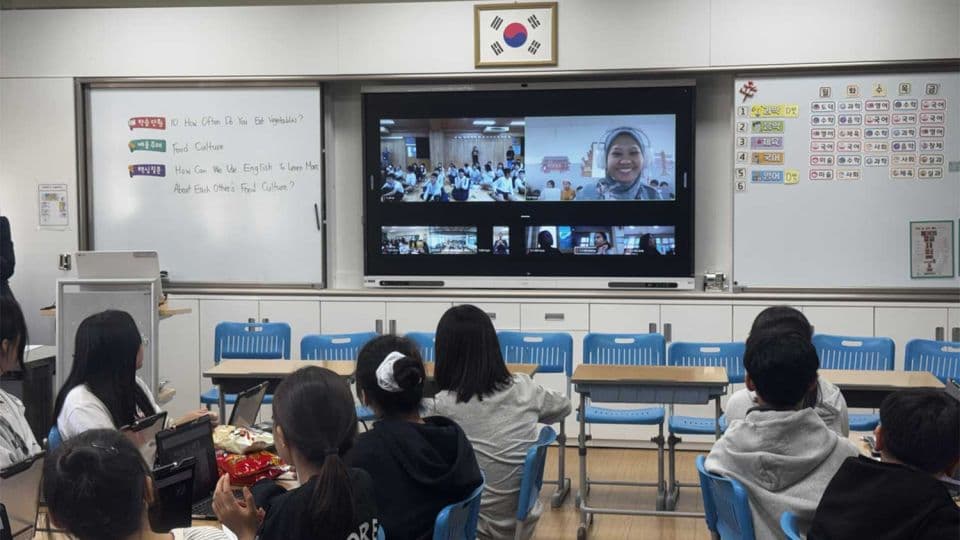
Students at an elementary school in Seoul are using online classrooms to interact with peers in other countries, discuss cultural differences and practice English through conversations that extend beyond their textbooks.
During a recent session, sixth grader Kim Ha-jin introduced a traditional Korean ingredient to students joining the class from Indonesia and Japan. Holding a spoonful of red pepper paste in front of her laptop camera, she explained, “This is gochujang, a Korean sauce made with red chili peppers.”

Kim was attending the session with her classmates at Seoul Beondong Elementary School, while students from SDIT Al Ihsan Banjarmasin, an Islamic elementary school in South Kalimantan, Indonesia, and Bansei Elementary School in Nara, Japan, participated remotely. The schools are located as far as 5,000 kilometers apart.
The Tuesday session focused on food culture. Students from the three countries introduced traditional dishes, popular snacks and table manners, giving their peers an opportunity to learn about everyday practices in different societies.
Each sixth grader at the Seoul school sat in front of a laptop connected to students overseas. After the initial presentations, participants divided into smaller groups to discuss the topics and exchange questions.
The interaction offered students an opportunity to use English in conversations with children from different cultural backgrounds rather than limiting their practice to classroom exercises.
“During regular classes, we speak English with our teacher and classmates, but this class was more fun because we got to talk to friends from other countries,” Kim told The Korea Herald.
Another sixth grader, Song Shin-hu, said direct conversations helped students learn information that may not be available in textbooks.
“When we study from textbooks, we can only learn what’s written in them, so there are still things we’re curious about,” Song said. “But this time, I could ask students from other countries directly and get answers to many of my questions.”
International joint classes expand global learning opportunities
The exchange was organized under the Seoul Metropolitan Office of Education’s International Joint Class program, which links schools in Seoul with partner institutions in other countries.
The initiative enables students to learn about different cultures while using foreign languages in real conversations. Participating teachers jointly select lesson themes and coordinate exchanges through video calls and online collaboration platforms.
Schools have flexibility in scheduling these sessions. They can hold classes during regular school hours, after school or as part of extracurricular activities. The frequency of exchanges is also determined by the participating institutions.
The program began in 2021 during the COVID-19 pandemic, when restrictions and reduced opportunities for face-to-face interaction limited international student exchanges.
Since its launch, the initiative has expanded considerably. It grew from 53 participating schools across seven countries to 358 schools in 33 countries by 2025.
For teachers involved in the initiative, the classes also offer a way to demonstrate how English can be used beyond academic exercises and examinations.
Jeon Yu-jin, the English teacher who led Tuesday's session, said students previously questioned the need to learn English if they did not intend to travel overseas. Interactions with international peers have helped them understand the relevance of the language in an increasingly connected world.
“Students used to ask why they needed to learn English if they weren’t planning to go abroad,” Jeon said. “But through these classes, they’ve come to realize that they’re already living in a globalized world as global citizens.”
Jeon said the program encourages students to focus on communication rather than viewing English proficiency as a requirement for speaking with others.
“Students often think they can’t speak English unless they’re good at it,” Jeon said. “But I always emphasize, ‘Simple English, deep thinking.'”
She added that students can communicate their ideas even when they use shorter sentences or break complex thoughts into smaller parts. The experience of expressing themselves and being understood by peers from other countries has been particularly valuable.
“Seeing students realize that they can express themselves and communicate, even by breaking their thoughts into smaller sentences, has been particularly meaningful,” Jeon said.
Beyond its exchanges with Indonesia and Japan, Seoul Beondong Elementary School also maintains connections with schools in the United States and Ukraine. However, students from these institutions mainly communicate through online message boards and comments because differences in time zones make live sessions difficult to arrange.
Online exchanges make international education more accessible
The Seoul Metropolitan Office of Education said the International Joint Class program has widened access to international learning by allowing students to engage with peers overseas without the financial and logistical challenges associated with traveling abroad.
Through online exchanges, students can participate in cross-border learning activities and develop an understanding of other societies without leaving their schools.
In an earlier interview with The Korea Herald, Seoul Education Superintendent Jeong Geun-sik said the initiative helps students understand cultural differences and learn to work with people from varied backgrounds.
Jeong said the central purpose of international joint classes is not limited to introducing students to foreign cultures. The exchanges also encourage them to collaborate, communicate their views and find common ground while working with peers who may have different languages and experiences.
“What matters is the experience of working on shared tasks with students who speak different languages and come from different cultures, explaining one’s ideas, listening to others and reconciling different opinions to reach a common outcome,” Jeong said.
He also emphasized that global citizenship education should connect international developments with issues that students encounter in their own lives.
According to Jeong, students should be able to understand how challenges such as climate change, poverty, migration, international conflicts and artificial intelligence affect communities across the world. They should also learn to consider possible solutions through cooperation with others.
“Students need to understand issues such as the climate crisis, poverty, migration, international conflicts and AI as problems that affect their own lives, and think about how to find solutions together,” Jeong said.
KVS Samvaad App: Parents May Soon Track Attendance, Academic Performance; KVS Warns Against Fake Apps

South Korea's student suicide toll nears 1,000 in four years, with India's figures also drawing attention
Want to explore the world without leaving your classroom? Seoul students show how
When smart glasses become cheating tools: South Korea draws tougher exam rules

Jeans out, formals in: Bihar rolls out stricter rules for government school staff
South Korea's student suicide toll nears 1,000 in four years, with India's figures also drawing attention
Want to explore the world without leaving your classroom? Seoul students show how
When smart glasses become cheating tools: South Korea draws tougher exam rules
Jeans out, formals in: Bihar rolls out stricter rules for government school staff
Auslan gains ground in Western Australian schools

KVS Samvaad App: Parents May Soon Track Attendance, Academic Performance; KVS Warns Against Fake Apps
South Korea's student suicide toll nears 1,000 in four years, with India's figures also drawing attention
Want to explore the world without leaving your classroom? Seoul students show how
When smart glasses become cheating tools: South Korea draws tougher exam rules
Jeans out, formals in: Bihar rolls out stricter rules for government school staff
Auslan gains ground in Western Australian schools
Copyright© educationpost.in 2026 All Rights Reserved.