


The initiative will cover 48,527 government schools across the state, offering students a choice between Kannada and English instruction while aiming to improve enrollment and access to bilingual education.
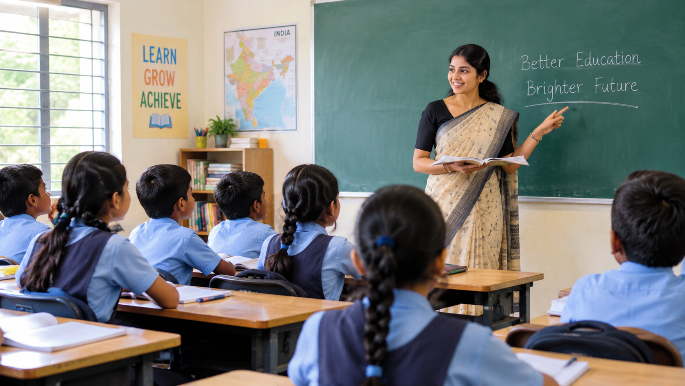
The Karnataka government plans to introduce English-medium sections in all government schools across the state while continuing existing Kannada-medium classes. The initiative aims to expand educational choices for students and parents, particularly in rural areas where access to English-medium education remains limited.
School Education and Literacy Minister Madhu Bangarappa announced that the initiative will eventually extend to all 48,527 government schools in Karnataka.

Students will have the option to pursue their education in either Kannada or English, without discontinuing the existing Kannada-medium system.
Why is Karnataka expanding English-medium education?
The decision comes against the backdrop of changing parental preferences, with many families increasingly opting for private schools because of the importance they attach to English-language proficiency.
Parents often consider English skills essential for competitive examinations, higher education opportunities and future employment. This preference has contributed to declining student enrollment in several government schools across the state.
Karnataka introduced its bilingual education program during the 2019-20 academic year, initially covering 6,539 government schools. Students admitted under the first phase of the initiative have now progressed to Class 7.
The program has gradually expanded over the subsequent academic years, with more government schools receiving approval to introduce English-medium sections.
The expansion includes:
The government expects the availability of English-medium education within the public school system to encourage more parents to enroll their children in government institutions.
It could also reduce the financial pressure on families who otherwise turn to private schools to access English-medium instruction.
Teacher training to support transition to English-medium classes
Preparing teachers to deliver lessons effectively in English will be a major factor in implementing the bilingual education initiative. The transition will require educators to develop the language proficiency and teaching skills needed to handle classroom instruction in both languages.
To facilitate this process, the Karnataka Education Department is collaborating with organizations such as the British Council to conduct teacher-training programs.
These initiatives aim to strengthen teachers' English communication abilities and equip them with the skills required to explain different subjects effectively in bilingual classrooms.
However, education experts have emphasized that occasional or short-duration training programs may not adequately prepare teachers for the transition. They have recommended continuous and long-term professional development, particularly for educators working in rural government schools.
Regular training will be important to ensure that teachers can communicate subject concepts clearly in English while supporting students who are more comfortable learning in Kannada.
Kannada-medium education to continue alongside English
The state government has maintained that the expansion of English-medium sections will not come at the expense of Kannada-language education. Kannada will continue to retain an important position in the state's school education system.
Students will have opportunities to learn through their mother tongue while gradually developing their English reading, writing and speaking abilities.
The bilingual approach is intended to help children strengthen their understanding of subjects without facing difficulties associated with an abrupt shift to an unfamiliar language.
The government aims to maintain a balance between mother-tongue instruction and English-language proficiency, allowing students to develop skills in both languages during their school years.
How will the bilingual education model benefit students?
The expansion of English-medium sections across government schools is expected to improve access to education and provide families with alternatives to private institutions.
The proposed bilingual model is expected to offer several benefits:
Through the expansion, the Karnataka government aims to make English-language education more accessible without weakening the role of Kannada in classrooms.
The initiative is also expected to strengthen the public education system by giving students from rural and economically disadvantaged backgrounds greater opportunities to develop language skills needed for higher education and future employment.

Karnataka plans English-medium sections in all govt schools while retaining Kannada classes

Australian universities oppose proposed expansion of higher education regulator's powers

Odisha Schools Reopen After 23 Days in Flood-Hit Ganjam; Six Government Schools Remain Closed

India-US Plan Joint Crackdown on Global Drug Cartels: Synthetic Drugs and Chemical Supply Chains in Focus

NCERT, SCERT Organise 5-Day NISHTHA Training Programme for Teachers and School Heads
Karnataka plans English-medium sections in all govt schools while retaining Kannada classes
India-US Plan Joint Crackdown on Global Drug Cartels: Synthetic Drugs and Chemical Supply Chains in Focus

Facing risk of losing ancient knowledge, China establishes rare disciplines school

From smart classrooms to surveillance concerns: Why China's Nanjing University rolled back AI feature

Screen time concerns shape Japan's digital textbook policy, printed books to remain primary

Karnataka plans English-medium sections in all govt schools while retaining Kannada classes
Australian universities oppose proposed expansion of higher education regulator's powers
Odisha Schools Reopen After 23 Days in Flood-Hit Ganjam; Six Government Schools Remain Closed
India-US Plan Joint Crackdown on Global Drug Cartels: Synthetic Drugs and Chemical Supply Chains in Focus
NCERT, SCERT Organise 5-Day NISHTHA Training Programme for Teachers and School Heads
Karnataka plans English-medium sections in all govt schools while retaining Kannada classes
India-US Plan Joint Crackdown on Global Drug Cartels: Synthetic Drugs and Chemical Supply Chains in Focus
Facing risk of losing ancient knowledge, China establishes rare disciplines school
From smart classrooms to surveillance concerns: Why China's Nanjing University rolled back AI feature
Screen time concerns shape Japan's digital textbook policy, printed books to remain primary
Copyright© educationpost.in 2026 All Rights Reserved.